Bio: Preston Fassel is an award-winning journalist and author whose work has appeared in Rue Morgue magazine, in Screem Magazine, and on Cinedump.com. He is the author of Remembering Vanessa, the first published biography of British horror star Vanessa Howard, printed in the spring 2014 issue of Screem Magazine. His first novel, Our Lady of the Inferno, was the recipient of the Independent Publisher Book Award for Horror and was named one of Bloody Disgusting‘s 10 Best Horror Books of 2018.
James Gallagher: Our Lady of the Inferno goes to some really dark places, and there are scenes that must have been gut-wrenching to write. Was it difficult to move on from these characters after finishing the novel?
Preston Fassel: It was, though not for the reason a reader might expect. For as dark and gritty as the story was, I really fell in love with Ginny, and I missed being in her headspace. She started out in the development process as a much more sinister, less redeemable character, and through writing her I discovered this great depth of beauty and spirituality and vivaciousness.
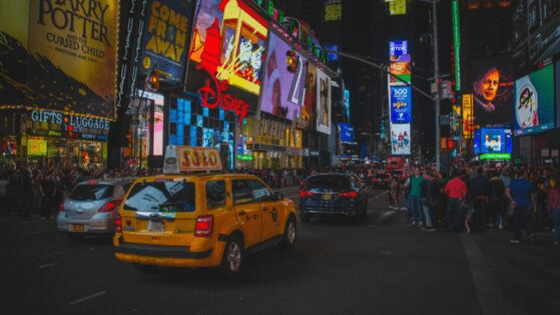
As soon as I was done working on the book I actually started writing another Ginny story just because I didn’t want to leave her behind. I’ve also always been fascinated by 42nd Street as a location, that it was this kind of Kingdom of the Damned with its own subcultures and unspoken rules and weird hierarchies, and that’s just such fertile ground for a writer.
I stopped working on the second Ginny story because I realized it was distracting me from getting this book out into the world, but I’m going to go back to her again one day. I have at least one more Ginny story to tell, if not a few more.
James: Horror fans will eat up the movie references in Our Lady. What’s the first horror film that you remember having a profound influence on you?
Preston: I saw them around the same time, so I can’t say which was first, but it’d either be Beetlejuice or Ghostbusters. I had to have been three or four, and it started what became a pattern in my life of being drawn to something macabre, watching it obsessively, getting traumatized by it, not watching anything scary again for a while, and then seeking out something horrifying again.
The Librarian Ghost and the Beetlejuice snake terrified me. I’d hide my head under the covers and have nightmares. And then I’d go back and watch the movies again. I was more fascinated by those worlds and characters and creatures than I was scared.
James: What has been the role of editing in your development as a writer?
Preston: Editing was a big part of the development of Our Lady of the Inferno and is a big part of anything I write, due to my literary style. My influences in terms of style are E.L. Doctorow, Michael Cunningham, Virginia Woolf, and Jane Austen.
I sit at the keyboard and let the words flow out, and I’m a big fan of free indirect discourse, so you’re reading a third-person account focalized through a character’s mind. The results can be a sentence that runs an entire paragraph or a compound-complex sentence with a dozen semicolons in it. Which of course requires a good editor to make sure that the text is remaining true to my style and my literary vision, but is also readable by someone picking this up for enjoyment.
Every time I write something, it goes through multiple rounds of edits. I always do the first edit myself so that I can pick up any continuity errors and make sure that character voices are consistent at the same time I’m correcting for grammar, spelling, etc.
Then I’ll turn it over to my wife for a second round of edits. She has an English degree and used to work as a writing center tutor, and is currently a high school English teacher. She also knows my writing style and my literary voice, so she can help maintain that authenticity at the same time she’s telling me, “This sentence is too long, you need a comma here, you need a colon here,” etc.
Then I’ll go back in and do a second edit of my own. This is both reviewing her changes and also making any last-minute tweaks or additions to the story.
In the case of Our Lady, the original manuscript was 125,000 words long. I was afraid it was too bloated and might turn people off, being a first novel, so during the second editing process I cut it down to 100,000 words. The bulk of what I deleted was descriptions of places in and around 42nd Street and local color and history that didn’t have much to do with the actual story itself.
The description of the Colossus theater, for example, originally included a complete history of the building, and I had an entire backstory for why Ginny frequents the diner where she takes Mary. At the same time I also added in small character touches here or there; it was during my last round of edits that I wrote the “goodbye” scene between Ginny and Trish near the end of the book.
After my second round of edits, I turn my work over to a third party, who goes into the book completely blind. This is so that a fresh set of eyes is seeing the text, and that person will be able to pick up on any minutiae that my wife or I missed during our edits.
This is usually stuff like minor misspellings or small punctuation errors. Our Lady actually had two people do additional edits at the behest of my publisher—first a woman named Majanka Verstraete, who did a hard punctuation edit, and then a woman named Francie Crawford, who also double-checked the layout and typesetting.
Majanke helped rein in a lot of my wilder stylistic choices. At one point there was a stream-of-consciousness sentence that ran for an entire page, which she encouraged me to break up.
James: What recent movies, books, or TV series are you particularly excited about?
Preston: There’s a lot I want to be excited about, but we’ve reached a point of such saturation that it’s difficult for me to really get interested in something new, because I get fatigued with all the news stories, and think pieces, and hot takes, and overmerchandising.
I loved the first season of Stranger Things, but I quickly got worn out by the cultural domination of it. I want to be excited about the new It, but ditto.
It’s easier for me to get really excited about something old and ostensibly lost that, say, Arrow Video or Scream Factory is salvaging and rereleasing. I like to be able to consume books or movies or TV shows in and of themselves and think about them myself without getting hit from every single angle with tie-in merch or commentators condemning it for being “problematic” or treating it like it’s some sort of cultural revelation.
Every piece of media now is either a fantastic cultural event or the worst thing that’s ever happened—until the next event or worst thing comes out and then it’s forgotten. It’s an exhausting treatment of media, and it’s diluting the value of things that are either truly great or truly horrible.
Tag: Our Lady of the Inferno
-
Four on the Floor with Preston Fassel
-
Book Review: ‘Our Lady of the Inferno’ by Preston Fassel
Along with the much-anticipated rebirth of Fangoria magazine came Fangoria Presents, a publishing venture that launched with the release of 2018’s critically acclaimed Our Lady of the Inferno by Preston Fassel.
With its splashy neon-pink-accented cover art and the all-but-flickering “Fangoria Presents” signage in the paperback’s upper-right corner, Our Lady has much of the same irresistible appeal that readers of a certain age will remember from garishly designed VHS tapes in their local video-rental store.
(Another pink book, Autumn Christian’s wonderful Girl Like a Bomb, is basking in similarly positive reviews, making one wonder if pink has become horror’s new black.)
The Setting
Fassel’s tale takes place over nine days in June of 1983 and is set largely on New York’s Forty-Second Street, otherwise known as the Deuce. The nineties had yet to see Times Square turned into a place where tourists could safely swing into an Applebee’s (shudder), and you were more likely to run into hookers, drug dealers, and porn theaters than a “three-for” app combo.
For most, eighties nostalgia is a joyful blast from the past, and, as we know, it’s everywhere, seen particularly in films like It and the at-least-partly It-inspired Netflix series Stranger Things.
Readers, however, should not expect a glut of “fun” references to that decade, which isn’t to say that Our Lady doesn’t skillfully reference the eighties. It does, and talk of exploding heads and summer camp slashers attest to Fassel’s knowledge and love for the genre. But the novel is more Taxi Driver than Friday the Thirteenth, and references to Flashdance and Sally Ride and the X-Men’s Jean Grey are both intentional and essential to the story and its lead character.
The Plot
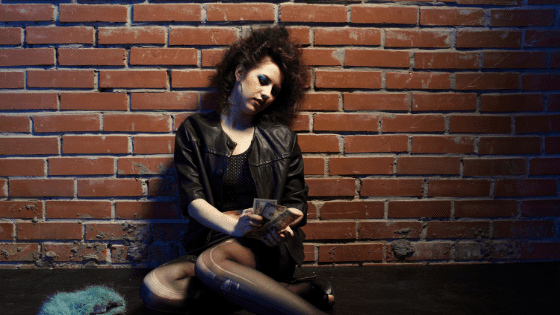
Our Lady centers on Ginny Kurva, the bottom girl (a sort of fixer) for a group of prostitutes living at the seedy (and aptly named) Misanthrope. Having maneuvered her way into a position of influence with a grotesque pimp known as the Colonel, Ginny is able to care for her younger sister (wheelchair user Tricia) and run a type of school for the Colonel’s hookers, even as Ginny herself is subject to the pain and degradation inflicted by the life.
Ginny has also struck up a friendship of sorts with horror-film fanatic Roger Neiderman, who tips her off to a predator stalking girls on the Deuce. We learn that the predator, assumed male, is in fact Nicolette, who works at the Staten Island Landfill by day and creates there a kind of killer-dog-prowled, Thunderdome-esque labyrinth by night, with Nicolette the Minotaur at its heart.
As Ginny sinks deeper into alcohol-fueled self-care and is pushed to the breaking point, she nears a confrontation with both the Colonel and Nicolette, with the stakes being any hope for the future, should she even survive.
But is it horror?
Even as a horror fan, this is a question that usually doesn’t excite me. Yes, it’s somewhat annoying when people take the tack that anything skillfully enough realized cannot possibly be horror (Silence of the Lambs a prominent example), but I largely block out that noise. In many ways horror is the most inclusive of genres, and people who can only cast it in a restricted light are doing themselves a disservice.
Still, I have seen people questioning whether Our Lady is horror, so I suppose it’s worth addressing. The novel doesn’t have supernatural elements, and the author doesn’t employ jump-scare-like tactics to frighten the reader. Fassel also leans on character over plot, with big issues much on his mind (the case of course with so much good horror), so those with an aversion to anything remotely literary might get nervous.
But, as mentioned, horror references abound, specifically to films of the era, and the gore comes in sharp spikes. If you look at elements that horror must have, you can see that the book contains an attack by a monster (Nicolette), a speech in praise of the monster, a labyrinth, and a scene with the hero (Ginny) at the mercy of the monster.
Our Lady also has a consistently bleak tone. The book is horror enough for me, but you can debate that to your heart’s content.
The Verdict
Fassel is one hell of a writer, and Our Lady of the Inferno is an extraordinary novel drenched in an eighties atmosphere both more true and less sanitized than many are accustomed to. The real horrors here lie in botched abortions, hopeless servitude, and the kind of arrangements one brokers with oneself to get by — and to care for those they love.
If I have any quibbles it’s that Nicolette, in comparison with Ginny, feels underdeveloped, and the confrontation between the two is pushed so late into the novel that one might wish it had a little more room to breathe.
But those are minor complaints, and Our Lady lives up to its place as the first book in the Fangoria Presents line, which continues with My Pet Serial Killer by Michael J. Seidlinger and Carnivorous Lunar Activities by Max Booth III. I’m looking forward to both and happy to have Our Lady on my bookshelf.
(Fassel had apparently done a signing the week before at the store where I bought the book, so I was also lucky enough to unknowingly snag a signed copy.)