Tag: justin cronin

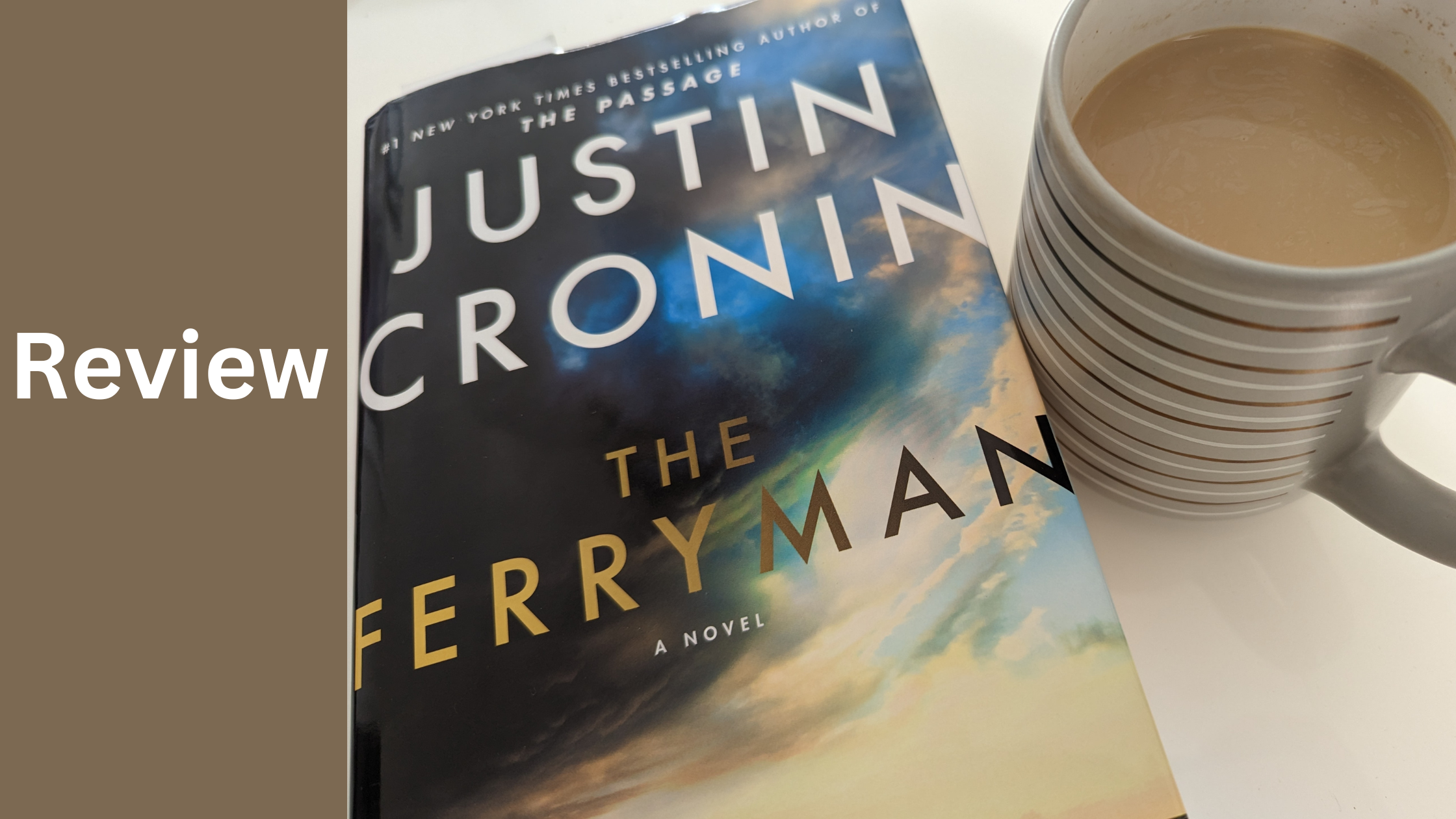
  • Book Review: The Ferryman by Justin Cronin

    Book Review: The Ferryman by Justin Cronin

    Any Justin Cronin release is an event. The books of the Passage trilogy are among my favorites (oh, that first hundred pages), and The Ferryman shows the author at the top of his form with this stand-alone.

    His latest resonates with the motifs readers will recognize from his earlier works: falling, the wonder of stars, fathers and daughters, grief.

    Cronin’s work is often that of return and reevaluation, and these narrative echoes deepen his themes and their effect on the audience. The payoff of a specific sequence of foreshadowing, for example, had me in tears as it opened up my understanding of what he was orchestrating in the larger story.

    The Ferryman examines big existential questions, and Cronin is particularly adept at using the micro to suggest the macro, and vice versa. In a work that largely hinges on the characters’ attempts to understand their reality, it would have been easy to lose the grounding that keeps the reader invested, but the story never loses its narrative drive (and this with a protagonist who is necessarily not always likable).

    Cronin is a true prose stylist. The man flat-out knows his way around a semicolon, and the most startling element of the author’s craft is that you’d stop every other moment to admire his turns of phrase if you weren’t so consistently absorbed by the story.

  • The Second Time Through

    In preparation for this week’s release of Justin Cronin’s The Twelve, I spent a good part of last weekend rereading its predecessor, The Passage. Here is a sentence from Cronin’s epic work:

    “By nightfall they were fifty miles past Oklahoma City, hurtling west across the open prairie toward a wall of spring thunderheads ascending from the horizon like a bank of blooming flowers in a time-lapse video.”

    A number of things struck me about this sentence. There’s tremendous movement, for one thing, and there’s the use of the word thunderheads, which seems to me suggestive of someone who’s spent a great deal of time looking at the sky over an open landscape. The imagery of flowers is beautiful and also cinematic (time-lapse photography has been employed with weather quite effectively in numerous films). Writers are correct to exhibit concern over using too many prepositional phrases, which can suck the life from a sentence, but I think they work here.

    Though obviously outside the realm of authorial intent, the sentence did put me in mind of these lyrics from the Alice in Chains song “Brother”:

    Roses in a vase of white

    Bloodied by the thorns beside the leaves

    That fall because my hand is

    Pulling them hard as I can

    Something I picked up during my second time through the book is the theme of falling that follows the character Wolgast. At one point, Wolgast is carrying the girl Amy, who is unconscious, up a ladder in an air shaft. He has to lean out with her and maneuver her into a duct above him, and there’s this line:

    “He began to fall. He’d been falling all along.”

    Caught in the moment, I only read this the first time as coinciding with the physical action of the scene. But on my second reading, it brought tears to my eyes, because it said so much more.

    And then there is this line, which I found devastating the first time through and just as affecting the second. Notice again the reference to falling.

    Amy, he thought as the stars began to fall, everywhere and all around; and he tried to fill his mind with just her name, his daughter’s name, to help him from his life.”

    This sentence is dear to me, and I have trouble speaking it aloud without being overcome. Cormac McCarthy, whose stunning work The Road was frequently referenced in reviews for The Passage, is famously quoted as saying that semicolons and exclamation points have no place in literature. McCarthy is a brilliant writer, but I think the semicolon works well here, and I also enjoy the way exclamation points are used in the works of Sarah Langan (a writer whose fiction blows me away) and Swamplandia! author Karen Russell.

  • Grammar Questions

    Early in his career, English footballer Michael Owen celebrated goals by rubbing his hands together in a joyous “Goody! Goody! Goody!” show of enthusiasm. Book lovers feel something similar when learning of a book that captures their imagination and produces a swell of anticipation that is almost inevitably more expansive than whatever pleasures the book has in store.

    I felt such a surge after reading reviews for a collection of stories by Lydia Davis, an author whose works I was unfamiliar with. I particularly enjoy short stories, and she is a short story writer of much acclaim, as evidenced by the following praise for The Collected Stories of Lydia Davis:

    “A body of work probably unique in American writing . . . I suspect that The Collected Stories of Lydia Davis will in time be seen as one of the great, strange American literary contributions” (James Wood, The New Yorker).

    “Magnificent . . . Davis has made one of the great books in recent literature, equal parts horse sense and heartache” (Dan Chiasson, The New York Review of Books).

    One of the reviews for the collection mentioned the story “Grammar Questions,” in which the narrator, whose father is dying, employs a kind of grammatical logic to explore her emotional landscape. A father of two wonderful children, I have a disastrous relationship with my own father, so I am drawn to stories of fathers for two very different reasons. (Not surprisingly, I was greatly affected by both the father-and-son relationship in Cormac McCarthy’s The Road and the fatherly role Wolgast establishes with Amy in Justin Cronin’s The Passage.)

    And the story involves grammar. Goody! Goody! Goody!

    “Grammar Questions” is a damn good story, and I would recommend exploring Lydia Davis’s work. In addition to being a finely wrought contemplation of death, the story provides numerous examples of the proper use of punctuation with quotation marks. At the end of a sentence, a question mark or exclamation point goes inside the quotation marks if it applies to the quoted material. The mark goes outside the quotation marks if it applies to the sentence as a whole.

    Look at the following examples from the story:

    Now, during the time he is dying, can I say, “This is where he lives”?

    and

    If someone asks me, “Where does he live?” should I answer, “Well, right now he is not living, he is dying”?

    Style Note: Titles of novels, albums, and collections, such as The Collected Stories of Lydia Davis, are generally set in italics. Short stories, poems, and songs are generally enclosed by quotation marks.

  • I Can’t Take Any More of This! I Can’t Take It Anymore!

    Early Saturday on my balcony. September. Over the horizon, the sun idles, seemingly as cool as the morning air. My coffee steams. I treasure this time for reading and shouldn’t let anything spoil my enjoyment of an entertaining tale. Yet even the smallest editing mistakes can do just that.

    When the scene above played out, I was reading a horror anthology on my Kindle, where one can expect to find a host of errors: missing hyphens, random hyphens, words run together, and other such issues. (To be fair, some e-books are better edited and formatted than others, and this is a problem with e-books in general and not with any particular device.)

    The errors, though, were particularly bothersome because they occurred in a story written by a crime writer of immense talent. It’s much easier to dismiss these kinds of glitches when you’re not thoroughly enthralled by the story.

    The first error was the misuse of anymore, which is properly employed as an adverb: “I don’t eat meat anymore.” However, when used as an adjective, one should write it as two words: “I can’t eat any more meat.”

    The other thing that caught my eye (and took me out of the book!) was an incorrect punctuation mark. An apostrophe is used to indicate the omission of letters, such as in the contraction can’t. When letters are omitted at the beginning of the word, such as with ’Stang (if, for instance, you wanted to shorten Mustang), then you place an apostrophe at the beginning of the word. You do not place a single opening quote; the apostrophe always faces in the same direction and always looks like a single end quote.

    The difficulty is that word-processor programs assume that you want a single opening quote even when you want an apostrophe, so pasting in the proper mark requires a little bit of effort. I know of one reader, however, who will appreciate that effort, and he’s sitting in my chair. ’Tis true!

    Fall Reading: I’ve decided to wait (or at least attempt to wait) until January to read the two most recent books in George R.R. Martin’s Song of Ice and Fire series. Reading those novels in the dead of winter is too delicious a prospect to pass up. I’m currently reading the gonzo horror novel John Dies at the End by David Wong and am fairly salivating at the thought of two upcoming releases: Ian McEwan’s Sweet Tooth and Justin Cronin’s The Twelve. Both are major publishing events. I’ve already placed my order for the signed, limited edition of The Twelve being released by Cemetery Dance, who produced a beautiful edition of the book’s predecessor, The Passage.