Tag: interview

  • Scene It First with L. Marie Wood (Ep. 8)

    Scene It First with L. Marie Wood (Ep. 8)

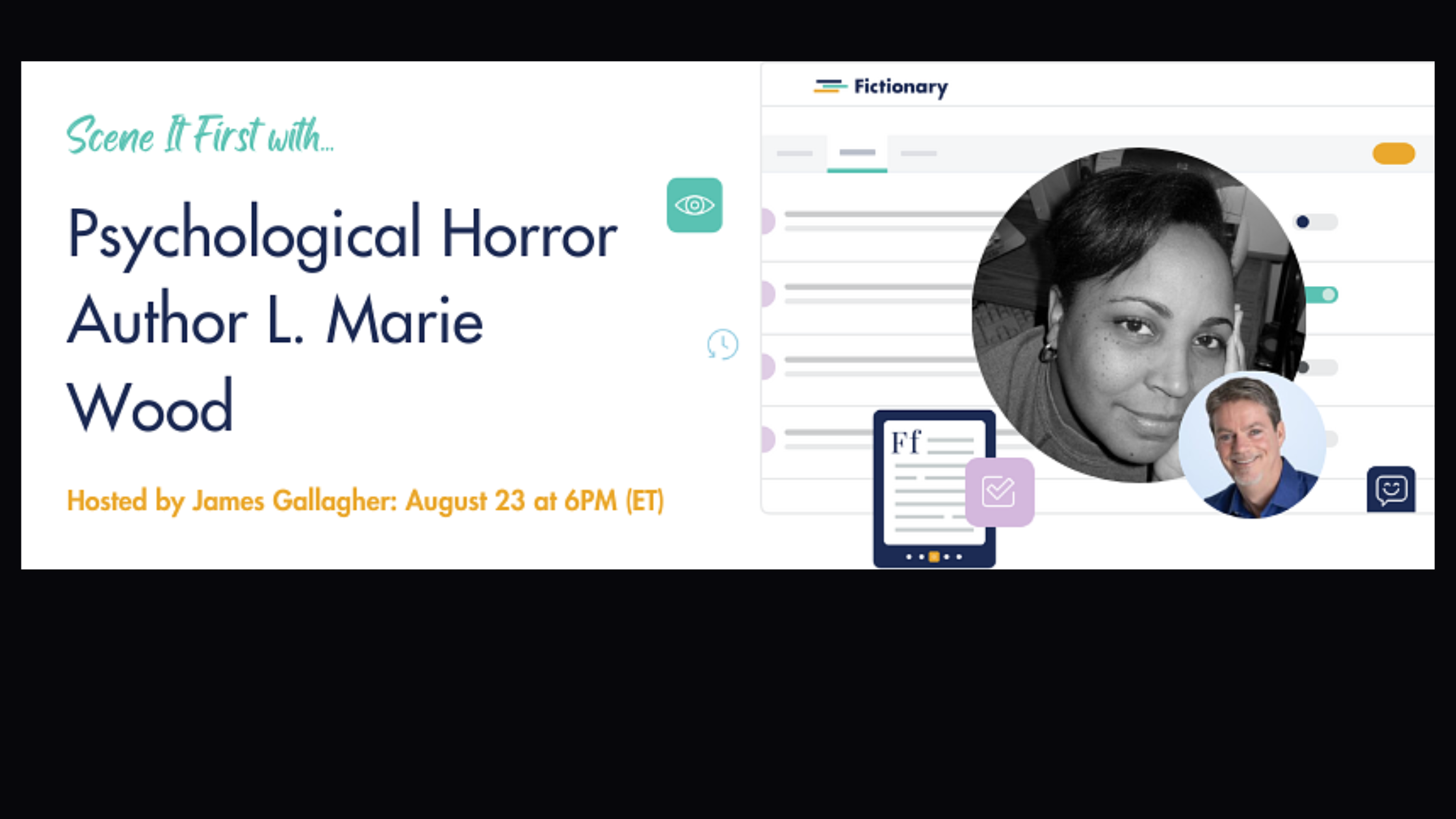
    On August 23, 2023, award-winning psychological horror author L. Marie Wood joined me for the eighth episode of the Scene It First series, sponsored by Fictionary. In this series, I speak with bestselling, award-winning authors to talk about first scenes, share secrets of writing craft, and celebrate the stories that thrill and inspire us all.

    In this episode, we talked about the similarities of horror and romance, psychological horror, Black women in horror, and the first scene of her novella Telecommuting. See more about Lisa below.

    Upcoming interviews can be joined live by registered members of the Fictionary community, and it’s always free to register.

    In addition to hosting the Scene It First series, James Gallagher is the owner of Castle Walls Editing, a Fictionary-Certified StoryCoach Editor, and the copy editor, developmental editor, or proofreader of more than 300 books.

    About L. Marie Wood

    Lisa has written six novels, 150 short stories, seven feature-length screenplays, and several short screenplays.

    Lisa’s novel The Promise Keeper won the Golden Stake Award for Literature at the International Vampire Film and Arts Festival. Lisa won Best Horror Screenplay at the NOVA International Film Festival, Best Afrofuturism/Horror/Sci-Fi Screenplay at Urban Media Makers Film Festival, and Best Short Screenplay Indo-Global International Film Festival.

    Lisa’s first novel and first short story collection were on the long list for the coveted Bram Stoker award. Her short story “The Ever After” was part of the Bram Stoker Finalist anthology Sycorax’s Daughters, and Lisa was recognized in The Mammoth Book of Best New Horror, Vol. 15 (2004) and as one of the 100+ Black Women in Horror Fiction (2018).

    Website: Lmariewood.com

    About Fictionary

    Fictionary is a story-editing software that allows writers and editors to glean insights and perform developmental edits on their works using Fictionary’s 38 story elements for character, plot, and setting.

    The software also provides attractive visual reports, including the story arc (showing location of the inciting incident, plot point 1, midpoint, plot point 2, and climax), as well as reports illustrating such items as the story map, character list, and word count per scene.

    More information can be found at Fictionary.co.

    The Fictionary community can be found here (free to register).

  • Scene It First Interview with Rio Youers (Ep. 3)

    Scene It First Interview with Rio Youers (Ep. 3)

    The third episode of the Fictionary Scene It First interview series welcomed bestselling author Rio Youers on March 22, 2023.

    In this episode, Rio talked about his graphic adaptations (Sleeping Beauties, Refrigerator Full of Heads) and novels such as The Forgotten Girl, Halcyon, Lola on Fire, and No Second Chances.

    Just before the seven-minute mark, Rio shares his experience writing Westlake Soul, and it absolutely gave me chills. You won’t want to miss it.


    Upcoming interviews can be joined live by registered members of the Fictionary community, and it’s always free to register.

    In addition to hosting the Scene It First series, James Gallagher is the owner of Castle Walls Editing, a Fictionary-Certified StoryCoach Editor, and the copy editor of more than 250 books.

    About Rio Youers

    Rio Youers is the British Fantasy and Sunburst Award–nominated author of Westlake Soul and Lola on Fire. His 2017 thriller, The Forgotten Girl, was a finalist for the Arthur Ellis Award for Best Crime Novel. He is the writer of Refrigerator Full of Heads, a new six-issue series from DC Comics, and Sleeping Beauties, based on the best-selling novel by Stephen King and Owen King. Rio’s new novel, No Second Chances, is available now from William Morrow.

    About Fictionary

    Fictionary is a story-editing software that allows writers and editors to glean insights and perform developmental edits on their works using Fictionary’s 38 story elements for character, plot, and setting.

    The software also provides attractive visual reports, including the story arc (showing location of the inciting incident, plot point 1, midpoint, plot point 2, and climax), as well as reports illustrating such items as the story map, character list, and word count per scene.

    More information can be found at Fictionary.co.

    The Fictionary community can be found here (free to register).

  • Scene It First with Jonathan Janz (Ep. 1)

    Scene It First with Jonathan Janz (Ep. 1)

    The first episode of the Fictionary Scene It First interview series kicked off with my interview of horror author Jonathan Janz on January 25, 2023.

    Janz is one of my favorite authors, so it was a true pleasure to speak with him about his celebrated career, his upcoming works, and his insights on scene construction.  

    Upcoming interviews can be joined live by registered members of the Fictionary community, and it’s always free to register. 

    In addition to hosting the Scene It First series, James Gallagher is the owner of Castle Walls Editing, a Fictionary-Certified StoryCoach Editor, and the copy editor of more than 250 books.

    About Fictionary

    Fictionary is a story-editing software that allows writers and editors to glean insights and perform developmental edits on their works using Fictionary’s 38 story elements for character, plot, and setting.

    The software also provides attractive visual reports, including the story arc (showing location of the inciting incident, plot point 1, midpoint, plot point 2, and climax), as well as reports illustrating such items as the story map, character list, and word count per scene.

    More information can be found at Fictionary.co.

    The Fictionary community can be found here (free to register).

  • Four on the Floor with CD Miller

    Four on the Floor with CD Miller

    Bio: CD Miller is a fantasy and horror author. Dark Heights is his first published novel, now available from Serial Box. He is hard at work on many projects, including an epic-fantasy-remix series of novels, literary superhero fiction, and a novel of character-driven, alternate-universe fantasy. 


    James Gallagher: Who are your main influences, and how do they work their way into your fiction?

    CD Miller: I’ll start with Alan Moore, since he’s definitely one of my top influences, though I think my writing tends to be much less political than his. 

    In terms of narrative structure there’s really no one better — that feeling, when you finish reading Watchmen, that you have to reread it right away because you missed so many allusions and connections — and there’s a real playfulness with the reader, the way Moore employs so many tricks and traps. Something I love to do. 

    The other major influence on my writing is Joss Whedon’s Buffy the Vampire Slayer. For me, watching that series really changed the way I approach character, in particular how the world of Buffy, fantastical and kind of ridiculous, becomes so firmly grounded just through characterization and the stubbornness of those writers refusing to treat their characters as anything other than real people.

    James: What do you find most exciting about the serial format? What are its challenges?

    CD: Writing serial fiction can be stressful because each chapter or episode has to hook the reader in all over again. You can’t take a chapter off to do some world-building, like you’d be able to do in a big old traditional fantasy novel. 

    I don’t think it’s necessary to have each chapter end in a cliffhanger, though that’s certainly an easy way to approach it. If you read Dickens’s serial novels closely, in every single chapter he’s carefully adding one more brick to the building, and this consistency guarantees the reader’s buy-in: “Well, I need to read this serial next week to see how everything takes shape.” This kind of storytelling is in fact great discipline for any writer, and it’s a lot of fun.

    James: What role has editing played in your development as a writer?

    CD: Dark Heights went through professional editing at Serial Box, and it was an absolutely essential process. My early drafts tend to be spare and lean, and my rewrites usually involve adding weight and detail to the skeleton. 

    However, even when I was blithely happy with the finished fiction, the editing process was like a flashlight that illuminated all the dark corners where things were still underwritten. Without some objective distance from the writing, which is what an editor has, it’s simply impossible to pick up on all the elements of your story that don’t have clarity, that don’t belong, that need a little more help to achieve expression. 

    James: What recent books, movies, or TV series have you singing their praises?

    CD: Like a lot of people, I really enjoyed Stranger Things 3. That mix of ’80s nostalgia and horror/monster fantasy is something I’ll never be tired of. 

    There has been a lot of criticism of Hopper’s toxic masculinity, but I kind of loved how flawed and wrong they made him. I don’t think the writers were suggesting his behavior was acceptable — rather, the opposite. 

    The book I’ve most enjoyed recently is City of Devils by Paul French, a snapshot of Shanghai in the 1930s. I can’t really recall reading a nonfiction book where the prose style was so aggressively tuned in to the subject material. 

    French’s sentences, loaded with slang from the time and place, are wielded like the sharp edge of a weapon, cutting you out of wherever you are, replacing your reality with his. What an amazing read.

    To learn more about CD Miller, visit the Dark Heights website or follow him on Twitter. You can also jump over to Patreon to support CD’s writing projects. 

  • Four on the Floor with Dea Poirier

    Four on the Floor with Dea Poirier

    I’m pleased to present the following interview with Dea Poirier. Enjoy!

    Bio: Dea (D.H) Poirier was raised in Edmond, Oklahoma, where she got her start writing in creative writing courses. She attended the University of Central Oklahoma for Computer Science and Political Science. Later, she spent time living on both coasts, and traveling the United States, before finally putting down roots in Central Florida. She now resides somewhere between Disney and the swamp.

    She spends her days at her day job as a director of email and lifecycle marketing, and her nights writing manuscripts. Dea is represented by Jill Marsal of Marsal Lyon Literary Agency and is a member of ITW.

    James: Bringing a book into the world is a long journey filled with twists and turns and unexpected ups and downs. What has been the most surprising part of the process?

    Dea: For me, it was having my first contract fall through. Next Girl to Die was originally sold to a different publisher, but they ended up dropping a substantial portion of their list. My book was a casualty and was canceled. I was lucky enough that my book sold very quickly once it had to go on sub.

    James: Who are your major influences?

    Dea: Loreth Anne White and Gillian Flynn.

    James: What role did editing play in the shaping of your work?

    Dea: Editing really helped change the face of Next Girl to Die. The project started as more of a romantic suspense, but as it was edited, it took on far more mystery elements and ended up with far less romance than the original draft.

    James: What recent books, shows, or movies have you found particularly inspiring? 

    Dea: 
    Law & Order: SVU is my biggest inspiration when I’m writing mystery. Also, Sharp Objects by Gillian Flynn was a big inspiration for Next Girl to Die.


    To learn more about Dea, visit her website, like her on Facebook, or follow her on Twitter.

  • Four on the Floor with Mary SanGiovanni

    Four on the Floor with Mary SanGiovanni

    Mary SanGiovanni is an award-winning American horror and thriller writer of over a dozen novels, including the Hollower trilogy, ThrallChaos, the Kathy Ryan series, and others, as well as numerous novellas, short stories, and nonfiction.

    Mary is a member of the Authors Guild, the International Thriller Writers, and Pennwriters. She is a cohost on the popular podcast The Horror Show with Brian Keene and hosts her own podcast on cosmic horror, Cosmic Shenanigans. Born and raised in New Jersey, she currently resides in Pennsylvania.

    James Gallagher: Genres such as Western and crime fiction spring to mind as blending well with horror, and it could be argued that horror is the most accommodating and adaptive genre. Outside of horror, what genres do you gravitate toward most, and are there any writers in those genres who have had a particular influence on your work? 

    Mary SanGiovanni: I tend to gravitate toward fantasy, actually. I’m a sucker for high fantasy, epic fantasy, science fantasy, and anything just a little surreal. I also used to read a lot of science fiction as a child — probably not what people would consider “hard sf” or “military sf” — I don’t think I would have understood the science very much — but the kind of stuff that dealt with aliens and alien worlds, alien cultures, that sort of thing. 

    The classic fantasy authors I read as a child had a huge influence on me, on my desire to build worlds around the monsters in my horror, and in fantasy stories I write on the side. Tolkien, C. S. Lewis, L. Frank Baum, Lloyd Alexander, William Sleator, Isaac Asimov — they were all great world builders.

    JG: Fans can now experience your voice both through your fiction and through the podcasts Cosmic Shenanigans and The Horror Show with Brian Keene. What’s the experience of podcasting been like, and has it changed your view of your audience?

    MS: It was a little daunting doing podcasts at first. Sometimes you talk into a microphone and forget that anyone is even listening, and in essence you’re just having a conversation with your friends. Sometimes it’s more like being in a dark room filled with people you can’t see, watching and listening to you as a single spotlight shines down on you, and you’re aware of the responsibility of what you’re saying and how people might react to it. 

    It’s definitely had an impact on my career, though, in terms of visibility. It’s raised awareness of my presence and my books to a wider audience. What I’ve found most satisfying, though, is the feedback I get from listeners who say the show helps them get through tough times or entertains them at work, or even teaches them something they didn’t know or realize before. I’ve come to enjoy podcasting very much. 

    JG: It’s hard to put your work in someone else’s hands. In what ways has the editing process (both editing your own work and putting your work in front of an editor) helped to shape your writing? Have there been frustrations? 

    MS: I’ve been (knock on wood) incredibly lucky to have been paired primarily with editors who understand and appreciate my style and can anticipate my goals in writing and help me better reach them. I tend to edit as I write, bits at a time, paragraph by paragraph, so I like to think the manuscripts are mostly formed the way I want them by the time they’re submitted, but I’m always grateful to editors who catch my typos, my awkward phrases, my continuity issues, etc. 

    Where it may seem intimidating at first to hand over one’s manuscript to editors, it’s important to remember that they aren’t rewriting your book, but rather helping you fine-tune it and make it as perfect as possible. It’s an invaluable service, and I’d feel very vulnerable, almost naked, sending a book out into the world that hasn’t been edited by someone else. 

    JG: Readers love to know what the writers they admire are reading and viewing. What recent books, TV series, or movies are going to stick with you for years to come?

    MS: As far as movies go, I recently saw The Endless and Hereditary. I loved those. I love movies that can still surprise me, creep me out, or genuinely unnerve me. I’ve also watched The Haunting of Hill House (the series), and while I had a few issues with the last episode, I found the series had some genuinely horrifying and heartbreaking moments. 

    As far as books go, I’m reading T.E.D. Klein’s The Ceremonies now. I tend to have a TBR pile that threatens to topple over and bury the cats, as I’m not as quick a reader as I used to be, and so I’m behind in reading new stuff, but it’s there. I’m looking forward to several books that have recently come out from Paul TremblayVictor LaValleStephen Kozeniewski, and others. It’s an exciting time to be reading horror.


    For more information about Mary SanGiovanni, visit her website at marysangiovanni.com or follow her on Twitter or Facebook.

  • Four on the Floor with Stevie Kopas

    Four on the Floor with Stevie Kopas

    In the previous Four on the Floor interview, we were treated to insights from one of horror’s leading new lights, Stephen Kozeniewski. For this interview, we get the perfect follow-up: Kozeniewski’s Slashvivor! coauthor Stevie Kopas.

    Bio: Stevie Kopas was born and raised in New Jersey. She is a gamer, a writer, and an apocalypse enthusiast. Stevie will never turn down a good cup of coffee and might even be a bit of a caffeine addict. Stevie is the managing editor of the website Horror Metal Sounds, and she is also a writer/reviewer for the site.

    Stevie’s works include the Breadwinner trilogy (The BreadwinnerHaven, and All Good Things), Never Say Die (collection), Slashvivor! (with Stephen Kozeniewski), and Madness Burns (collection).

    Now here’s the interview!

    James Gallagher: Horror can be beautiful, unsettling, terrifying, universal. If a Cenobite were forcing you to choose one thing you love about the genre, what would it be?

    Stevie Kopas: Look, if a Cenobite were talking to me, I’d probably piss my pants. But I guess if I have to choose just one thing from the horror genre that I’m in love with, it would be the apocalypse. The reminder that humans aren’t invincible and we are more problematic than we think is great. I seem to always gravitate toward apocalyptic fiction of every media type, so that’s definitely my thing.

    JG: Writers are always told to pen tales that only they could write. What do you bring to your writing that’s pure Stevie Kopas?

    SK: I suppose I try to incorporate personality elements of people I know or have interacted with in my life into the characters I create. That makes them feel more real to me. Plus, I can take out my frustrations on anyone I feel like in any way that I want when I’m writing, so it’s definitely therapeutic. I also think I have a tendency to play on the sarcastic side of things. Writing is just more fun that way.

    JG: How have your feelings about editing and the editing process changed since you began writing? 

    SK: I have a huge respect for editors and the editing process. It’s a lot of work for both the writer and the editor (mostly the editor lol) and that respect increases with each thing that I write.

    JG: What’s a recent book that you think everybody should be reading? Are there any movies or series that you can’t stop talking about?

    SK: A recent book everyone needs to read? Well, I’m going to take this opportunity to shamelessly promote myself here! lol My most recent release, Never Say Die: Stories of the Zombie Apocalypse, was super fun to write and I think it’s a fresh and unique collection of zom-poc fiction for lovers of the genre.

    As far as recent movies, I’m totally obsessed with Alex Garland’s Annihilation. It’s a beautiful horror film with stunning visuals and a haunting story, so people need to watch it!


    For more information about Stevie Kopas, look for her on TwitterFacebook, and her website

  • Four on the Floor with Stephen Kozeniewski

    Four on the Floor with Stephen Kozeniewski

    Stephen Kozeniewski’s novel The Hematophages was named by horror legend Brian Keene as the number one book of 2017, so I was thrilled to have Stephen take part in one of our Four on the Floor interviews. Enjoy!

    Bio: Stephen Kozeniewski lives in Pennsylvania, the birthplace of the modern zombie. During his time as a field artillery officer, he served for three years in Oklahoma and one in Iraq, where due to what he assumes was a clerical error, he was awarded the Bronze Star. He is also a classically trained linguist, which sounds more impressive than saying his bachelor’s degree is in German.

    James Gallagher: Who are your writing heroes, and has mentoring played a role in your development as an author?

    SK: Well, barring your Douglas Adamses and your Dostoevskys, Tolkiens, and Vonneguts, my greatest writing hero is Brian Keene. The others being dead, I felt it incumbent upon me to tell him at a signing once. I guess he liked the cut of my jib or something, because I haven’t been able to get rid of him since.

    His mentorship has opened many doors for me, as he’s introduced me to editors and publishers, and given me opportunities to work with people and on projects I never would have broken into alone.

    Networking is absolutely vital in this business, and at the end of the day it’s never really stopped being an apprenticeship industry. Other authors have helped me get to where I am, and I always try to pass along what I can to aspiring authors as well.

    JG: What do you find particularly exciting about the horror genre, and what do you most hope readers take away from your writing?

    SK: After decades of being the rented mule of the redheaded stepchild of literature, it definitely seems like horror is finally having its day in the sun. It was the highest grossing horror film of all time last year—a genuine horror blockbuster.

    Meanwhile, films like Get Out and The Shape of Water are getting critical respect and taking home awards. The Walking Dead is still a major television phenomenon, and shows like Black Mirror and Stranger Things are blowing up Netflix. I think it’s a terribly exciting time for the horror genre and I’m just pleased to be a part of it.

    I hope my readers enjoy themselves. I hate to be pat about it, but that’s the long and short of writing for publication. If you’re not writing with the hopes of bringing your audience some pleasure—whether it be intellectual, vicarious fright, or even just titillation—then there’s no point publishing. Just keep it on your computer.

    JG: In what ways has editing (both editing your own work and having it edited by others) sharpened your writing or contributed to the evolution of your writing process?

    SK: Not in the slightest. No, I’m just kidding. Before my first professional edit I didn’t know what I didn’t know, if that makes sense. Now I feel fairly confident when doing self-edits that I can identify the major flaws in the piece as well as some of my personal tics. It’s really something you can only learn by doing, I think.

    JG: Speaking of your process, do you more often outline your stories or do you start with a more general image or idea and then just let it rip?

    SK: Primarily the latter. I’ve tried numerous methods, such as writing extemporaneously (Braineater Jones, Billy and the Cloneasaurus), plotting heavily (The Ghoul Archipelago), and outlining on a whiteboard (Every Kingdom Divided). But when it comes to the debate between pantsing and plotting, I remain firmly agnostic. I just do whatever feels best for the project.

    ***

    Check out Stephen’s blog or follow him on Twitter and Facebook.

  • Four on the Floor with Kathe Koja

    Four on the Floor with Kathe Koja

    My Four on the Floor interview with Kathe Koja appears below. I first discovered Koja’s writing in the early ’90s, when as a college student I visited a bookstore (remember those?) and picked up the Dell/Abyss paperback edition of her novel The Cipher. (If you’ve seen either this edition or the Abyss edition of her novel Bad Brains, you’ll likely remember the stunning cover art by Marshall Arisman).

    You can probably easily count the number of times a writer has truly opened your eyes, and reading Koja had that effect on me. Thematically, stylistically, this was a horror novel (though Koja’s writing defies genre) unlike any horror novel I’d ever read. 

    If you haven’t experienced her writing, that glittering promise nestled in 2018 is the experience of reading one of her novels for the very first time. Enjoy!

    About: Kathe Koja’s books include Under the Poppy, The Bastards’ Paradise, The Cipher, and Skin; her young adult novels include Buddha Boy, Talk, and Kissing the Bee. Her work has been honored by the ALA, by the ASPCA, and with the Bram Stoker Award. She’s a Detroit native and lives with her husband, artist Rick Lieder. She also runs Loudermilk Productions, creating site-specific immersive events, including performances of Faustus and her own adaptation of Under the Poppy.

    1. A Library Journal reviewer once wrote that your prose reads like “a collaboration between Clive Barker and William S. Burroughs.” Are there any writers (or artists in other mediums) whose works have exerted a particular influence on your writing?

    The great, fierce, subtle Shirley Jackson was a lasting influence on me as a beginning writer—her “Notes for a Young Writer,” in Come Along with Me, is really a fiction master class in less than 20 paragraphs. And the work, her novels and her stories, pretty much defies category: it’s Shirley Jackson’s work, period.

    David Bowie was a tremendous influence too—not just his genius as a musician, but his indelible example of fidelity to his own instincts and interests, his courage in making the work he wanted to make; he transcended categories, too, his music was Bowie music, first and always.

    I’ve written YA novels, horror novels, historical novels, and what stays constant is my voice, so I very much took those examples to heart.

    2. The beautifully styled and richly atmospheric nature of your prose would require a deft editorial hand. What has been your experience with editors?

    Whenever I send a manuscript to any editor, it’s always complete, or as complete as I can possibly make it—I wouldn’t send it otherwise!—so I don’t invite much in the way of collaborative editing, but I’m of course wide open to close and critical reading and comments: the writer and editor have identical goals, to bring the book (or story) to its highest level of completion, so I listen very carefully to all editorial notes.

    My best editorial experience? I was so fortunate to be able to work with Frances Foster at Farrar, Straus & Giroux: she was thorough, she was subtle, and whenever we disagreed, which was seldom, she was always open to honest argument. We worked on seven YA novels together and the process was utterly seamless. It’s no wonder she was a publishing legend.

    3. In what ways do you play with the overall structure of your novels and at what point in your process are you most aware of structure?

    All my fiction begins with a character—for The Cipher it was Nicholas, the failed poet; for Skin it was Tess, the stubborn sculptor; for Talk it was Kit Webster, the thoughtful and watchful young actor; for the Under the Poppy trilogy it was Istvan the puppeteer and his cadre of fantastic mecs—and the story just accretes around that person, through research, and notes, in a very hands-off kind of process, just letting the thing grow and find its shape until it’s time, finally, to start writing.

    I’m not able to work with outlines, I need to discover what’s being made in and by the making itself. So the structure is never imposed, it’s always organic to whatever’s being written—for one example, I had no idea the Poppy trilogy would be a trilogy, but the story just kept growing, kept showing itself to have more and more facets, until it became three books.

    4. Are there any recent books or films that have frightened or inspired or opened your eyes to something new in the world?

    A true life-changing example is Anthony Burgess’s A Dead Man in Deptford, his biographical novel about the sui generis Elizabethan poet and playwright Christopher Marlowe. I read it, fell head over heels for Marlowe, read all his poems and plays, and ended up writing a novel about him called Christopher Wild that’s also turning itself into a performance piece. A creative force of nature, Marlowe, that’s for certain.

    Recent work I’ve loved: Carter Scholz’s short novel Gypsy, the Netflix series Dark, and Perfume Genius’s album No Shape.

    Kathe Koja can be found online on Twitter, on Facebook, and at her website.

    Readers will also want to check out this interview conducted by Jeff VanderMeer for the Weird Fiction Review and this New Yorker piece about her novel Headlong.
  • Four on the Floor with Sophie Playle

    Four on the Floor with Sophie Playle

    A specialist fiction editor who provides editorial services directly to writers, Sophie Playle also trains other editors through her online courses and is the author of the short story collection The Hours of Creeping Night—which I recommend highly!

    I’ve enjoyed following Sophie on Twitter and am also a fan of her newsletter, Liminal Letters (particularly of her approach of writing the letters as if they were letters to a friend). More information about Sophie and about her services can be found at her website, Liminal Pages.

    Now enjoy the interview!

    Do you find that being a writer as well as an editor makes you better at each craft? How so?

    Yes, definitely. Though, for me, being a writer has helped me be a better editor more than being an editor has helped me be a better writer. I believe I’m a more sensitive editor because I know how difficult it is to transfer your vision to the page. But my brain can get stuck in editor mode, which can make it difficult to be creative and free in my own writing.

    Are there any recurring themes you’ve consciously or unconsciously developed in your fiction?

    Hmm, interesting question. I’m not sure. I think I often explore the nature of fear—what can cause it, how it can manifest, what it makes us do. On the surface, I enjoy writing stories about strange beings—monsters, zombies, mythical animals, living trees and all that jazz. So much fun to be had there.

    What is your favorite part of editing?

    I provide two main services: manuscript critiquing (where I provide feedback on the story as a whole) and line/copyediting (where I help improve the artistry of the sentences and fix mechanical issues). I love it when an author hires me for both services and I get to see the improvements they make between drafts. It’s really satisfying to polish a solid story and see the author’s vision take shape.

    Is there an editing strength that you’re particularly proud of?

    My years of literary analysis, studying writing craft theory and being a creative writer myself have made me an excellent line editor, if I do say so myself. I feel I’ve got a pretty good grasp of how much I should intervene and how much I should hold off to preserve the author’s voice and style, but I know exactly the effect a comma placement or word choice will have on a sentence.