Tag: hyphens

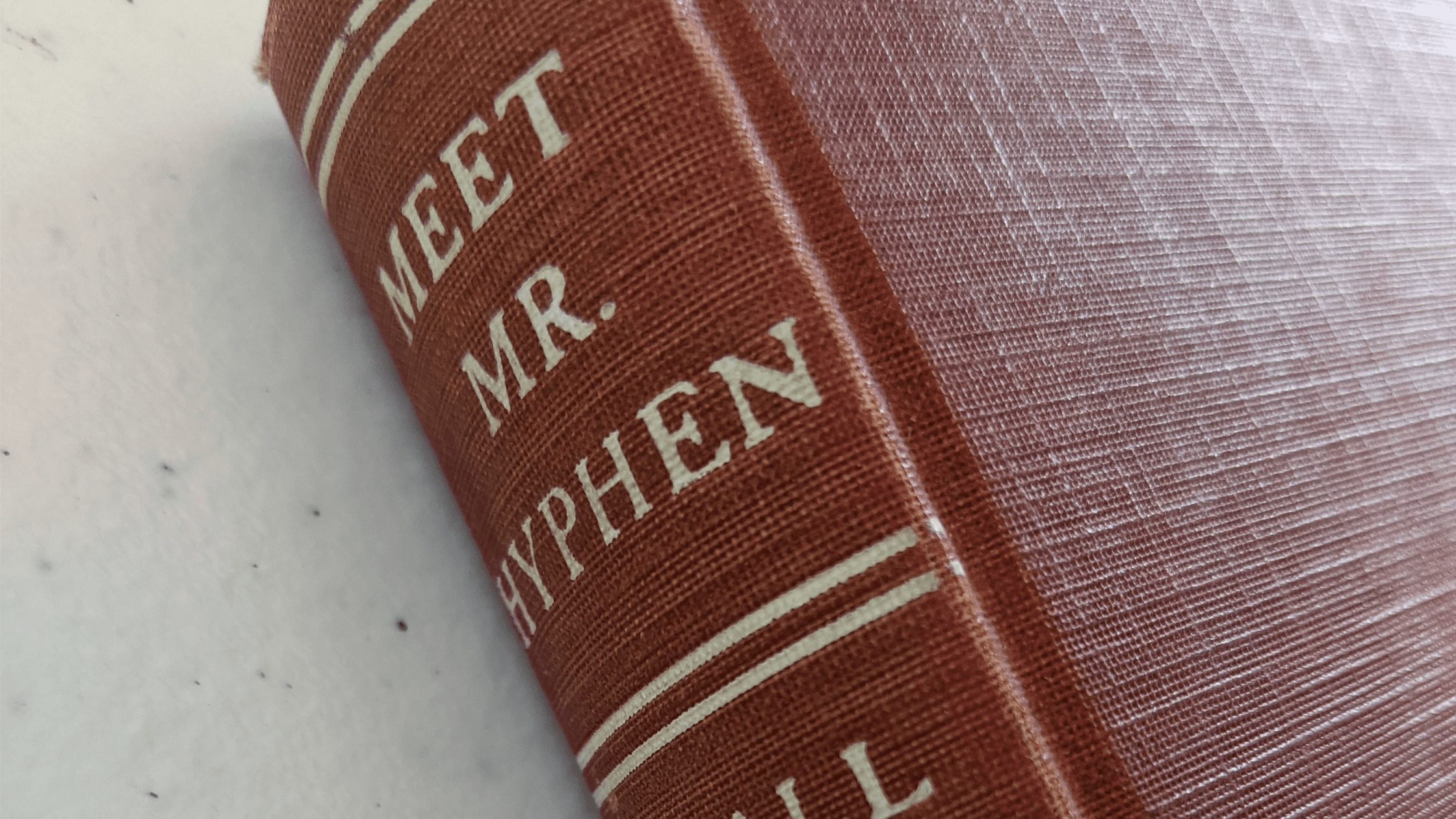
  • Review: “Meet Mr. Hyphen (And Put Him in His Place)”

    Review: “Meet Mr. Hyphen (And Put Him in His Place)”

    [vc_row][vc_column][vc_column_text]In a post from Merriam-Webster’s Words at Play, Mary Norris (Between You & Me) called Meet Mr. Hyphen the “best thing ever written about hyphens.”

    First: All hail the Comma Queen!

    Second: If Norris’s assessment intrigues you, then you’re probably a copy editor. 

    I read that post years ago, and because the book was out of print, I had to go to some trouble to track it down—which I did happily. But then life got busy and it sat on my bookshelf for far too long.

    I always liked that Mr. Hyphen was there, though. You might know the feeling of having a book, especially a book with a tinge of mystery because of its relative unavailability, that you purposefully put off reading to retain the magic.

    Eventually, however, I could savor the want of it no more, and I traded mystery for experience.

    The Context

    Edward N. Teall, a proofreader on the 1934 Webster’s New International Dictionary, Second Edition, wrote Meet Mr. Hyphen in 1937 after years of studying compounding. So when he refers to the ’90s, he’s referring to the 1890s. 

    In other words, you won’t find any references to two of my favorite bands, Faith No More and Soundgarden (and even my ’90s are feeling more and more distant).    

    This was before macros. Before crtl+F. Before PerfectIt.

    Hats off to editors past.

    Teall may have written nearly a century ago, but his concerns will strike you as modern. Teall talks about the challenges of compounding (open, closed, or hyphenated) because of the rapid addition of new words related to automobiles, airplanes, movies, and radio. He notes language’s “superabundance of material.”

    Sound familiar?

    You imagine his joy and wonder if he were to see the pace of language change today.

    “We are putting words together in a way that multiplies their power and widens their scope,” he wrote.

    And we still are.

    No Easy Answers

    Teall exhibits a childlike enthusiasm for the art of compounding (“an art, because personal preferences and individual judgments will always be decisive”).

    Speaking of childlike—the word, that is—Teall has a wonderful aside about the practice academics had apparently proposed of hyphenating -like words based on whether they were literal or metaphorical (when combined with child or death, for example).

    Teal dismisses the practice as impractical, but it gets at the kind of thinking Teall employs, a kind of double-clicking* on the logic of the compound itself instead of a strictly grammatical, role-based determination that can be applied broadly and mechanically. Though wouldn’t that be easier, we weep.

    * I hadn’t heard double-clicking used this way until a recent episode of the fabulous That Word Chat, featuring Anne Curzan. Apparently it’s business jargon, but I kind of like it.

    As Teall says, “The English language simply is not logical,” so easy answers are likely in short supply. (Have you checked the page count on the Chicago Manual’s hyphenation table?)

    Teall: “The compounding of words is not sport for specialists, not a freakish, fantastic field of theory; not academic, not aristocratic. It is part of the plain business of conveying ideas through writing or print. It has value in private and professional correspondence; it affects the worth, in accuracy and in validity, of legislative enactments and state documents. It is important to all who write or print.”

    He goes on: “Clean compounding is a source of strength. Slack, untidy compounding is in itself a weakness.”

    And later the most important point: “[Good compounding] prevents ambiguity and misunderstanding.”

    Teall’s Method

    It’s unlikely many have thought more about compounding and hyphens than Teall. What may strike the reader is the love he brings to this peculiar passion. He seems dedicated to a task he knows will forever elude ironclad laws or rules one can apply without thought and across circumstance.

    And he revels in the chase.

    “Cultivate his acquaintance—but keep him in his proper place. Don’t let him crowd in where he doesn’t belong, but insist on his doing what is expected of him. He’s a good fellow, but he has to be watched.”

    There’s also a kindness in his approach, and his practice is one we might do well to apply to all areas of editing:

    “First, analysis. The formulation of principles. Next, the casting of rules. Finally, determination not to let any rule override consideration of clarity and exactness of statement in any situation that may arise in the course of composition.”

    For us, words of assurance:

    “This is salvation for the stylesheet makers—for writers, editors, secretaries—for all who put words on paper. First, the making of a workable system; then, clear perception and effective acceptance of the fact that any rule may be laid aside in emergency—and criticism on the ground of inconsistency may be heavily discounted.”

    Stick Around, Mr. Hyphen

    My copy of Meet Mr. Hyphen is a handy five-by-seven hardcover that smells—delightfully—of its age. The book concludes with a working guide and a “Glimpse of the Compounder’s Workshop,” both of which can be dipped into from time to time.

    I’ll note that I didn’t cover Teall’s deeper analysis of compounding, such as his look at modifiers that are descriptive versus those that serve the function of identification. I still need to work my mind around that and around his other musings, but the book is there, on my shelf, and it’s not going anywhere.

    If there were one thought from the book I’d tattoo on my arm, it’s probably this:

    “Complete consistency is impossible. Good style is attainable.”


    References

    Norris, Mary. Between You & Me: Confessions of a Comma Queen. New York: W. W. Norton & Company, 2015.

    Teall, Edward N. Meet Mr. Hyphen (And Put Him in His Place). New York: Funk & Wagnalls Company, 1937.

    Words at Play: https://www.merriam-webster.com/words-at-play/comma-queen-meets-mr-hyphen.[/vc_column_text][/vc_column][/vc_row]

  • Hyphens, Hauntings, and the Architecture of Sentences

    Outside the James Brice House, purportedly the most haunted structure in Historic Annapolis, night had nearly fallen, and it felt as though the brick-lined streets—once trod by no less than Founding Fathers—were themselves absorbing the last of the daylight.

    I stood among the skeptics and believers assembled for one of the city’s nightly ghost tours, and emerging wraith-like from the guide’s tales of hauntings past and present, a particular word caught my attention.

    The guide had referred to the connecting passages between the wings of the “Big Brice House” as hyphens.

    Apparently I love horror and punctuation matters in equal measure.

    Far from a student of architecture, I’d never heard the term hyphen refer to part of a structure, but of course it made complete sense. The hyphens I work with are connectors as well, connecting syllables and words, prefixes and suffixes to roots, fragments ripped unceremoniously apart by end-of-line breaks.

    Even creepier, suspended hyphens appear to connect words to thin air, but those seemingly empty spaces are in fact haunted by words that aren’t visible, but which nonetheless occupy that space, if only in our mind’s eye.

    Mr. Hyphen, I Presume

    For a book, going out of print can be a kind of death, and while digitization has made books more accessible, even instantly accessible, printed works can still (and do) go missing from the world—or they become exceedingly rare, moving into that hard-to-find territory you used to reserve for absinthe or Cuban cigars.

    Such was the case with Meet Mr. Hyphen and Put Him in His Place by Edward N. Teall. In her book Between You and Me: Confessions of a Comma Queen, Mary Norris mentioned this work, calling it the “best thing ever written about hyphens.”

    Teall’s book was also referenced on the Merriam-Webster website, where I learned that the folks at my favorite dictionary had introduced Norris to Mr. Hyphen.

    I searched for the book in vain, finding it had gone out of print, but earlier this year, at the American Copy Editors Association (ACES) conference in St. Petersburg, Florida, I bumped into Merriam-Webster’s Peter Sokolowski on an elevator and asked him about it. He responded that he had a copy of the book sitting on his office desk, and he encouraged me to continue my search, insisting that I should have no trouble finding it.

    Reenergized, I did indeed locate a copy, though obtaining it was a bit pricey. I work with a number of talented typesetters and would like to make it more easily available, but from what I can see there are some concerns about whether the 1936 work is in the public domain (in that time period, it hinges on whether the book’s copyright was renewed, and I haven’t been able to research that yet).

    The search for Mr. Hyphen made obtaining it all the more enjoyable, though, and I would encourage anyone who is able to lay hands on it to give it a read. Its corporal form may be fading from the world, but its spirit is strong, and Mr. Hyphen should be rattling his chains and bumping around the attic for years and years to come.

    The Blueprint of a Sentence

    While an architect might use a blueprint to assemble a structure, a writer can refer to a sentence diagram to see the underlying grammatical arrangement. Earlier this year, at the above-mentioned ACES conference, a ghost from the past—sentence diagramming—leapt out at me in the form of a session (“How to Diagram Sentences—and Why”) conducted by Bremner Editing Center coordinator Lisa McLendon.

    Someone outside the editing community might harbor an understandable skepticism about a group of adults having a grand old time while diagramming sentences, but I witnessed the phenomenon firsthand, and if you haven’t diagrammed a sentence since childhood (or ever) I’d highly recommend grabbing a blank sheet of paper and a writing implement.

    If you want a little help getting started, pick up a copy of Sister Bernadette’s Barking Dog: The Quirky History and Lost Art of Diagramming Sentences by Kitty Burns Florey. You can almost hear the cackling of that elementary school teacher, that terror of your youth, can’t you?

    Bigger on the Inside

    Elaborate literary construction entwined with a fictional structure hiding infinite space can be found in Mark Z. Danielewski’s masterpiece House of Leaves. Incorporating unreliable narrators, found manuscripts, academic study, extensive footnotes, letters from a psychiatric hospital, and references to a documentary film that may or may not exist, House of Leaves is as haunting a novel, if it can be called a novel, as I’ve ever read.

    Haunting as well is Danielewski’s proposed 27-volume series, The Familiar. Four volumes have been released to date, with another scheduled to be published this Halloween. Beautiful works constructed to replicate the viewing experience of such bingeable TV shows as Breaking Bad, fans of typography (and all readers) should not deny themselves the pleasure of exploring this ambitious series.

    Hauntings and Structure

    In Ghostland: An American History in Haunted Places, Colin Dickey explores the idea that unusual architectural features are closely connected to hauntings.

    “Ghosts fester in places untended to, where the usual patterns of behavior aren’t or can’t be enforced, where once-regular places become strange, where it’s no longer clear what a building’s function was, where the shadows multiply and nothing restricts your mind from projecting your thoughts and dreams and nightmares onto the walls and corridors.”

    That passage puts me in mind of the great writer Peter Straub, whose literary stylings and intricate constructions birth horrors both supernatural and all too real. Writers can look to the structure of their sentences, their paragraphs, their chapters, to see how that architecture serves as a viewing screen for the projections of their readers’ fears and deepest desires.

    Sentences are built, like homes, with words as the materials of construction. Sometimes a structure has a good foundation but needs to be knocked flat so the writer can build anew on the palimpsest-like ghost of the old. Writers should never be afraid to tear down their homes and build grander mansions. Those previous structures remain, if unseen, haunting always the new works they have spawned.

    [twitter-follow screen_name=’CastleWallsEdit’]

  • Bring Out Your Dead!

    While reading Mary Roach’s fascinating and surprisingly humorous Stiff: The Curious Lives of Human Cadavers, I came across this sentence:

    “A series of modern-day Burke-and-Hare–type killings took place barely ten years ago, in Barranquilla, Colombia.”

    In the 1820s, William Burke and William Hare became notorious for selling corpses to Edinburgh anatomist Robert Knox, who eagerly bought the cadavers for the purposes of dissection. While grave-robbing was common enough, the problem here is that the two Williams, shall we say, hastened along the deaths of the cadavers they then sold to Knox.

    * Notice the proper way to make a plural of the name “William”—the plural of the last name “Williams” would be “Williamses.”

    Of interest to us, though, is the use of hyphens and en dashes in the sentence. Grouping adjectival expressions before a noun is simple enough. We hyphenate “modern-day” to hold it together so the reader can more easily see that it’s modifying “killings.” But what of “Burke-and-Hare–type”?

    We hold “Burke-and-Hare” together with hyphens: no problem there. But then we tack “type” onto the end with the en dash, which might look a bit odd to some. Why do we do this? “Type” has to apply to the full expression “Burke-and-Hare,” so we need something stronger than a hyphen: the en dash. Were we to use the humble hyphen there, “type” could be read as applying to “Hare” only. And we wouldn’t want to let Burke off the hook.

    So . . . you dissect a line of text. A dangling participle might make one think of a criminal hanging from the end of a rope. What is a full stop but the death of a sentence? An ellipsis might suggest a gradual slipping away from this world.

    Are there any other deathly (and grammar related) allusions you’d like to contribute?