Tag: horror

  • Four on the Floor with Stevie Kopas

    Four on the Floor with Stevie Kopas

    In the previous Four on the Floor interview, we were treated to insights from one of horror’s leading new lights, Stephen Kozeniewski. For this interview, we get the perfect follow-up: Kozeniewski’s Slashvivor! coauthor Stevie Kopas.
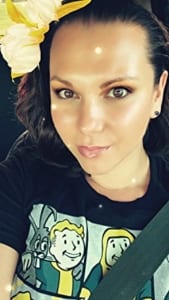
    Bio: Stevie Kopas was born and raised in New Jersey. She is a gamer, a writer, and an apocalypse enthusiast. Stevie will never turn down a good cup of coffee and might even be a bit of a caffeine addict. Stevie is the managing editor of the website Horror Metal Sounds, and she is also a writer/reviewer for the site.

    Stevie’s works include the Breadwinner trilogy (The BreadwinnerHaven, and All Good Things), Never Say Die (collection), Slashvivor! (with Stephen Kozeniewski), and Madness Burns (collection).

    Now here’s the interview!

    James Gallagher: Horror can be beautiful, unsettling, terrifying, universal. If a Cenobite were forcing you to choose one thing you love about the genre, what would it be?

    Stevie Kopas: Look, if a Cenobite were talking to me, I’d probably piss my pants. But I guess if I have to choose just one thing from the horror genre that I’m in love with, it would be the apocalypse. The reminder that humans aren’t invincible and we are more problematic than we think is great. I seem to always gravitate toward apocalyptic fiction of every media type, so that’s definitely my thing.

    JG: Writers are always told to pen tales that only they could write. What do you bring to your writing that’s pure Stevie Kopas?

    SK: I suppose I try to incorporate personality elements of people I know or have interacted with in my life into the characters I create. That makes them feel more real to me. Plus, I can take out my frustrations on anyone I feel like in any way that I want when I’m writing, so it’s definitely therapeutic. I also think I have a tendency to play on the sarcastic side of things. Writing is just more fun that way.

    JG: How have your feelings about editing and the editing process changed since you began writing? 

    SK: I have a huge respect for editors and the editing process. It’s a lot of work for both the writer and the editor (mostly the editor lol) and that respect increases with each thing that I write.

    JG: What’s a recent book that you think everybody should be reading? Are there any movies or series that you can’t stop talking about?

    SK: A recent book everyone needs to read? Well, I’m going to take this opportunity to shamelessly promote myself here! lol My most recent release, Never Say Die: Stories of the Zombie Apocalypse, was super fun to write and I think it’s a fresh and unique collection of zom-poc fiction for lovers of the genre.

    As far as recent movies, I’m totally obsessed with Alex Garland’s Annihilation. It’s a beautiful horror film with stunning visuals and a haunting story, so people need to watch it!


    For more information about Stevie Kopas, look for her on TwitterFacebook, and her website

  • Four on the Floor with Stephen Kozeniewski

    Four on the Floor with Stephen Kozeniewski

    Stephen Kozeniewski’s novel The Hematophages was named by horror legend Brian Keene as the number one book of 2017, so I was thrilled to have Stephen take part in one of our Four on the Floor interviews. Enjoy!

    Bio: Stephen Kozeniewski lives in Pennsylvania, the birthplace of the modern zombie. During his time as a field artillery officer, he served for three years in Oklahoma and one in Iraq, where due to what he assumes was a clerical error, he was awarded the Bronze Star. He is also a classically trained linguist, which sounds more impressive than saying his bachelor’s degree is in German.

    James Gallagher: Who are your writing heroes, and has mentoring played a role in your development as an author?

    SK: Well, barring your Douglas Adamses and your Dostoevskys, Tolkiens, and Vonneguts, my greatest writing hero is Brian Keene. The others being dead, I felt it incumbent upon me to tell him at a signing once. I guess he liked the cut of my jib or something, because I haven’t been able to get rid of him since.

    His mentorship has opened many doors for me, as he’s introduced me to editors and publishers, and given me opportunities to work with people and on projects I never would have broken into alone.

    Networking is absolutely vital in this business, and at the end of the day it’s never really stopped being an apprenticeship industry. Other authors have helped me get to where I am, and I always try to pass along what I can to aspiring authors as well.

    JG: What do you find particularly exciting about the horror genre, and what do you most hope readers take away from your writing?

    SK: After decades of being the rented mule of the redheaded stepchild of literature, it definitely seems like horror is finally having its day in the sun. It was the highest grossing horror film of all time last year—a genuine horror blockbuster.

    Meanwhile, films like Get Out and The Shape of Water are getting critical respect and taking home awards. The Walking Dead is still a major television phenomenon, and shows like Black Mirror and Stranger Things are blowing up Netflix. I think it’s a terribly exciting time for the horror genre and I’m just pleased to be a part of it.

    I hope my readers enjoy themselves. I hate to be pat about it, but that’s the long and short of writing for publication. If you’re not writing with the hopes of bringing your audience some pleasure—whether it be intellectual, vicarious fright, or even just titillation—then there’s no point publishing. Just keep it on your computer.

    JG: In what ways has editing (both editing your own work and having it edited by others) sharpened your writing or contributed to the evolution of your writing process?

    SK: Not in the slightest. No, I’m just kidding. Before my first professional edit I didn’t know what I didn’t know, if that makes sense. Now I feel fairly confident when doing self-edits that I can identify the major flaws in the piece as well as some of my personal tics. It’s really something you can only learn by doing, I think.

    JG: Speaking of your process, do you more often outline your stories or do you start with a more general image or idea and then just let it rip?

    SK: Primarily the latter. I’ve tried numerous methods, such as writing extemporaneously (Braineater Jones, Billy and the Cloneasaurus), plotting heavily (The Ghoul Archipelago), and outlining on a whiteboard (Every Kingdom Divided). But when it comes to the debate between pantsing and plotting, I remain firmly agnostic. I just do whatever feels best for the project.

    ***

    Check out Stephen’s blog or follow him on Twitter and Facebook.

  • Four on the Floor with Kathe Koja

    Four on the Floor with Kathe Koja

    My Four on the Floor interview with Kathe Koja appears below. I first discovered Koja’s writing in the early ’90s, when as a college student I visited a bookstore (remember those?) and picked up the Dell/Abyss paperback edition of her novel The Cipher. (If you’ve seen either this edition or the Abyss edition of her novel Bad Brains, you’ll likely remember the stunning cover art by Marshall Arisman).

    You can probably easily count the number of times a writer has truly opened your eyes, and reading Koja had that effect on me. Thematically, stylistically, this was a horror novel (though Koja’s writing defies genre) unlike any horror novel I’d ever read. 

    If you haven’t experienced her writing, that glittering promise nestled in 2018 is the experience of reading one of her novels for the very first time. Enjoy!

    About: Kathe Koja’s books include Under the Poppy, The Bastards’ Paradise, The Cipher, and Skin; her young adult novels include Buddha Boy, Talk, and Kissing the Bee. Her work has been honored by the ALA, by the ASPCA, and with the Bram Stoker Award. She’s a Detroit native and lives with her husband, artist Rick Lieder. She also runs Loudermilk Productions, creating site-specific immersive events, including performances of Faustus and her own adaptation of Under the Poppy.

    1. A Library Journal reviewer once wrote that your prose reads like “a collaboration between Clive Barker and William S. Burroughs.” Are there any writers (or artists in other mediums) whose works have exerted a particular influence on your writing?

    The great, fierce, subtle Shirley Jackson was a lasting influence on me as a beginning writer—her “Notes for a Young Writer,” in Come Along with Me, is really a fiction master class in less than 20 paragraphs. And the work, her novels and her stories, pretty much defies category: it’s Shirley Jackson’s work, period.

    David Bowie was a tremendous influence too—not just his genius as a musician, but his indelible example of fidelity to his own instincts and interests, his courage in making the work he wanted to make; he transcended categories, too, his music was Bowie music, first and always.

    I’ve written YA novels, horror novels, historical novels, and what stays constant is my voice, so I very much took those examples to heart.

    2. The beautifully styled and richly atmospheric nature of your prose would require a deft editorial hand. What has been your experience with editors?

    Whenever I send a manuscript to any editor, it’s always complete, or as complete as I can possibly make it—I wouldn’t send it otherwise!—so I don’t invite much in the way of collaborative editing, but I’m of course wide open to close and critical reading and comments: the writer and editor have identical goals, to bring the book (or story) to its highest level of completion, so I listen very carefully to all editorial notes.

    My best editorial experience? I was so fortunate to be able to work with Frances Foster at Farrar, Straus & Giroux: she was thorough, she was subtle, and whenever we disagreed, which was seldom, she was always open to honest argument. We worked on seven YA novels together and the process was utterly seamless. It’s no wonder she was a publishing legend.

    3. In what ways do you play with the overall structure of your novels and at what point in your process are you most aware of structure?

    All my fiction begins with a character—for The Cipher it was Nicholas, the failed poet; for Skin it was Tess, the stubborn sculptor; for Talk it was Kit Webster, the thoughtful and watchful young actor; for the Under the Poppy trilogy it was Istvan the puppeteer and his cadre of fantastic mecs—and the story just accretes around that person, through research, and notes, in a very hands-off kind of process, just letting the thing grow and find its shape until it’s time, finally, to start writing.

    I’m not able to work with outlines, I need to discover what’s being made in and by the making itself. So the structure is never imposed, it’s always organic to whatever’s being written—for one example, I had no idea the Poppy trilogy would be a trilogy, but the story just kept growing, kept showing itself to have more and more facets, until it became three books.

    4. Are there any recent books or films that have frightened or inspired or opened your eyes to something new in the world?

    A true life-changing example is Anthony Burgess’s A Dead Man in Deptford, his biographical novel about the sui generis Elizabethan poet and playwright Christopher Marlowe. I read it, fell head over heels for Marlowe, read all his poems and plays, and ended up writing a novel about him called Christopher Wild that’s also turning itself into a performance piece. A creative force of nature, Marlowe, that’s for certain.

    Recent work I’ve loved: Carter Scholz’s short novel Gypsy, the Netflix series Dark, and Perfume Genius’s album No Shape.

    Kathe Koja can be found online on Twitter, on Facebook, and at her website.

    Readers will also want to check out this interview conducted by Jeff VanderMeer for the Weird Fiction Review and this New Yorker piece about her novel Headlong.