Tag: grammar

  • Beyond Spell-Check: Ten Catches Copy Editors Make

    Beyond Spell-Check: Ten Catches Copy Editors Make

    [vc_row][vc_column][vc_column_text css=””]Spell-check will fail to catch an almost unlimited number of writing miscues. In addition to spelling, copy editors address grammar, punctuation, style (hello, Chicago Manual), clarity, and consistency.

    The following ten items will give you some idea of what spell-check won’t catch.

    (Also note that I’m not addressing punctuation here and that while Word’s Editor function features a grammar check that will occasionally offer good suggestions, the many false positives and sometimes downright bizarre suggestions mean that you cannot accept any of the suggestions without a high level of discernment.)

    1. Wrong homophone. I can’t bare to see another picture of a bare. (Read: I can’t bear to see another picture of a bear.)
    2. Missing words. I can’t bear see another picture of a bear. (Read: I can’t bear to see another picture of a bear.)
    3. Transposed words. I can’t bear see to another picture of a bear. (Read: I can’t bear to see another picture of a bear.)
    4. Repeated words. This one’s obvious, and while spell-check will flag repeated words, it can’t determine whether the repetition was intentional.
    5. Repeated endings. Our brains sometimes do a funny thing where they inappropriately repeat an ending while typing: They keeping walking toward … (Read: They keep walking toward …)
    6. Echoes. Words repeated in proximity can clang against the ear of the listener. Often words like up and back (two prime offenders) can be deleted or switched out when they repeat too closely.
    7. Danglers. Dangling participles and other modifiers can cause problems, especially at the beginning of a sentence: Running into the classroom, the trash can caused me to trip. (The trash can wasn’t running into the classroom, so the person needs to be the subject instead.)
    8. Noninclusive language. Copy editors can call authors’ attention to potentially problematic language. The Conscious Style Guide and Crystal Shelley’s Conscious Language Toolkit are two great resources.
    9. Continuity issues. If a character’s eyes change color halfway through a manuscript, there should probably be a reason. Copy editors will comment on a wide range of continuity issues that can occur in a manuscript.
    10. Inconsistently applied style. Writers face a host of decisions for how they will style such things as thoughts and the words on signs, buttons, and other objects. The copy editor will help maintain consistency, keeping in mind author preference and style guidance from the big style guides (hello again, Chicago Manual) and publisher house styles, if working with a publisher.


    These often seemingly easy catches pose problems because writers (and editors too!) have a difficult time editing their own work. They simply know their work too well and see what should be there rather than what is actually there.

    Another set of eyes does wonders![/vc_column_text][/vc_column][/vc_row]

  • Fictionary Interview with Ellen Jovin

    Fictionary Interview with Ellen Jovin

    On March 4, 2023, I had the honor of interviewing Ellen Jovin, author of Rebel with a Clause: Tales and Tips from a Roving Grammarian. In this lively discussion we talked about her adventures with the Grammar Table, her approach to language, and the wonders of the English language.


    Upcoming interviews can be joined live by registered members of the Fictionary community, and it’s always free to register.

    In addition to hosting the Scene It First series, James Gallagher is the owner of Castle Walls Editing, a Fictionary-Certified StoryCoach Editor, and the copy editor of more than 250 books.

    About Ellen

    Ellen Jovin is a cofounder of Syntaxis, a communication skills training consultancy, and the author of four books on language, most recently Rebel with a Clause: Tales and Tips from a Roving Grammarian (HarperCollins, July 2022). She is also the creator of a traveling pop-up grammar advice stand called the Grammar Table, whose adventures serve as the basis of this book. Ellen has a B.A. from Harvard College in German studies and an M.A. from UCLA in comparative literature, and has studied twenty-five languages for fun. She lives with her husband, Brandt Johnson, on the Upper West Side of Manhattan.

    About Fictionary

    Fictionary is a story-editing software that allows writers and editors to glean insights and perform developmental edits on their works using Fictionary’s 38 story elements for character, plot, and setting.

    The software also provides attractive visual reports, including the story arc (showing location of the inciting incident, plot point 1, midpoint, plot point 2, and climax), as well as reports illustrating such items as the story map, character list, and word count per scene.

    More information can be found at Fictionary.co.

    The Fictionary community can be found here (free to register).

  • What Are Zombie Rules in Grammar?

    What Are Zombie Rules in Grammar?

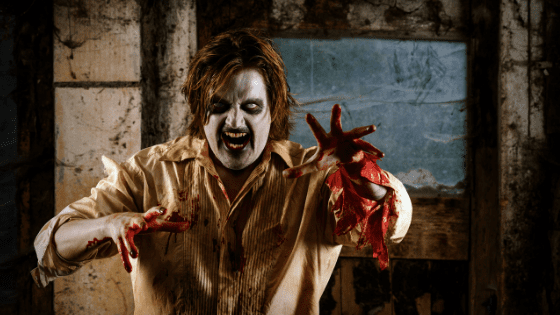
    Zombies are fueled by mindless hunger, and this mindlessness is part of what makes them scary.

    If you have a choice between reasoning with a zombie and bashing one in the head with a shovel, the latter approach is more likely to help you avoid becoming one of the undead yourself.

    Zombie rules in grammar (“rules” that have no grammatical basis but nonetheless refuse to die) are frightening because they’re driven by much the same brand of mindlessness.

    You can probably reel off your favorite zombie rules the same way you’d reel off your favorite zombie flicks. “Never end a sentence with a preposition,” “Never start a sentence with a conjunction,” and “Never split infinitives” are the Night of the Living Dead, 28 Days Later, and Shaun of the Dead of the grammar world.

    More obscure zombie rules stalk the landscape as well: the number of items between can apply to and the use of double negatives (think Dead Alive and Cemetery Man).

    People faced with zombie rules generally arm themselves with reasonable arguments that often involve Latin, John Dryden, and Winston Churchill quotes (“This is the type of errant pedantry up with which I will not put”).

    But zombie rules wouldn’t be zombie rules if they were easy to kill (though people won’t stop trying, and there are seemingly billions of blog posts devoted to grammar rules that aren’t really rules).

    Why do people hold on to zombie rules?

    (1) They were learned as absolute truths during one’s formative years and have never been questioned. If pressed, most will cop to their certainty about a grammar “rule” as coming from an elementary school teacher or some other distant authority.

    So changing one’s stance on ending a sentence with a preposition might involve a slight shifting of a long-held world view. Doing so might cause a little tremor in your foundations. But evaluating and resetting your world view is a good thing, and we should all reevaluate our beliefs on a regular basis.

    (2) It’s hard to admit you were wrong. Changing your view on rules such as these can feel like you’re admitting you’ve been wrong for years, possibly decades. But this is a sting that can be lessened by the realization that most “rules” aren’t rules, and that what we’re really talking about are styles and conventions.

    Audience and levels of formality and register often determine the guidelines you’ll follow. Language conventions are ever changing, and embracing this can be quite freeing (while there was no shortage of debate sparked by the major style guides’ lowercasing of internet, a good number of copyeditors undoubtedly felt a rebellious thrill when they first started taking down that I).

    (3) The “rule” makes you feel superior. People love to correct other people’s grammar. Check any comments thread and you’ll quickly find someone attempting to invalidate someone else’s argument by pointing out a misstep in grammar, spelling, or punctuation.

    People’s use of grammar is also tied up in their self-perception and it’s used to broadcast their level of education. It’s also used as a barricade to prevent others from accessing their realm.

    But people can love grammar and not be an ass about it. Inflexibility and a rigid adherence to “rules” across all situations are probably your best ways of advertising how little you actually know about language. Let’s try not to use our knowledge to hurt or exclude others. Let’s try to be kind, share knowledge generously, and open ourselves to the idea that we have much to learn.

    I suppose I could say more, but I’m off to watch Return of the Living Dead III.

    ABOUT JAMES GALLAGHER

    I’m a copyeditor and the owner of Castle Walls Editing. If you have a manuscript and need a copyeditor, contact me through this site or email me at James@castlewallsediting.com.

  • Three Quick Tips for Grammar Quizzes

    Three Quick Tips for Grammar Quizzes

    Online grammar quizzes pop up all over the place, and I often find them hard to resist.

    I’m a copyeditor, so why bother with quizzes I should breeze through? Isn’t it like shooting fish in a barrel?

    Yes, but it always feels good to ace something, and people working outside traditional office settings often need all the pick-me-ups they can get.

    Indie editors work largely in isolation. Positive feedback from our authors is one of the best parts of the job, but we may or may not get any feedback at all, even when the author is ecstatic.

    And we certainly don’t have the daily face-to-face interactions you find in an office, so even getting a little positive feedback from a quick electronic quiz can provide a mental boost.

    I won’t go into any irritation over grammar quizzes that are more concerned with spelling or less strictly grammatical matters. Or how they often promote zombie rules. Or how they are sometimes poorly edited. Or how sometimes the “correct” answer is, at the very least, debatable.

    Oh, look at that. I guess I just made those points in a decidedly cowardly manner. To be fair, for the first point, most see the grammar umbrella as covering a wide area. And there’s nothing wrong with that.

    The following are three quick tips for nailing high marks on grammar quizzes. (For a giant measure of extra credit, you can also grab a copy of Bryan A. Garner’s The Chicago Guide to Grammar, Usage, and Punctuation, an excellent resource.)

    1. Read carefully.

    People read differently online and are much more likely to scan for information. But this isn’t a good practice for multiple-choice quizzes, and it’s easy to start to read the question, think you know what’s being asked, and move on to the answers.

    More often than not, the reason you made an incorrect choice is because you misread the question and selected the first answer that matched the question you thought was being asked. Questions also contain words like “does not” or “never” or “always,” and these will change the answer you select.

    1. Get that nonsense outta here!

    With online quizzes, the process of elimination makes your task a whole lot easier. You can normally throw out an answer or two that you’re absolutely certain isn’t correct. So on quizzes with four possible answers, you can easily increase your odds of getting the answer correct from 25 percent to 50 percent.

    As mentioned above, read all the answers carefully. You might think the answer has to do with comma placement and find yourself going back and forth between two possible choices — until you see that one of those answers has a “their” that should be “there.” Problem solved.

    1. Don’t overthink it.

    Unless you’ve failed to read the entire question carefully and are thus either operating under a false assumption or not seeing something obvious, going with your gut is usually a good thing. Most of the time your first thought is the correct one.

    Don’t let the quiz masters get in your head. Madness lies down the road of “They are probably thinking I’ll think this, and so I should think this, but they might anticipate my thinking that as well.” Don’t succumb to it. Choose the best answer and let the chips fall where they may.

    ABOUT JAMES GALLAGHER

    Copy editor and writer James Gallagher is the owner of Castle Walls Editing. To hire James, email him at James@castlewallsediting.com.  

  • Now I’m Lookin’ at a Flashback Sunday

    Quite some time ago, I was critiquing catalog write-ups, some of which I’d written, in a roomful of writers and marketers. A particular piece contained a phrase that read something like this: “A tale where such and such . . .” I made the suggestion that we change “where” to “in which.”

    One of the people in the room smirked and said, “So you’re an ‘in which’ guy.”

    Freeze-frame.

    I don’t recall my response, but I remember being taken aback. Like most people, I don’t cotton* to those who assume things about me and smugly cast me as a certain type. The implication was worse than that I didn’t know a specific grammar point. The implication was that there was a rule governing a usage and that I was blindly following that rule, even if a less formal usage would have been perfectly suitable, and maybe even preferred, in the context.

    To set your mind at ease, this film does not resume with me turning that room into The Wild Bunch. The comment did stick with me, though, most likely because I’m sensitive to how I’m perceived. It’s bad to be thought incompetent, but it’s far worse to be thought ridiculous, and I like to think of myself as the opposite of someone who mindlessly enforces rules across all situations, no matter the appropriateness.

    Intermission.

    I’d meant this blog post to be about the attitude one takes toward grammar, and I had thought to compare that attitude to one that a person might take toward politics. I was going to levy charges against marrying oneself to a viewpoint, whether it be right, left, prescriptivist, or descriptivist. I meant to talk about my self-loathing in regard to the scornful “reasonable” view. I was even going to talk about free will, but all that will have to wait for another post. I’ve realized that this post (admittedly a self-serving one in many ways) is about something more basic: why one edits.

    Return to the Theatre.

    Many years ago, my office mates and I were charged with assembling going-away gifts for a colleague named Lars, who was leaving our group to strike out on his own. Someone in the office (an accountant, not an editor, mind you) had decorated and labeled a container as “Lars’ Jar.” I don’t remember what was to go in the jar, but it was likely to be filled with well-wishing notes or something of the like.

    One of my other coworkers, fancying herself a grammar guru, made a showy display of hand-wringing over her contention that it should be written “Lars’s Jar.” She was sorely aggrieved that anyone who saw the jar would assume that Lars, in essence, had worked with a group of slack-jawed yokels, presumably because it was such an eye-poppingly huge punctuation gaffe.

    First things [deleted] last: The manner of forming the possessive of a singular noun ending in s is a style decision. Chicago recommends apostrophe-s, while Associated Press style, for instance, recommends the apostrophe alone (saving even a single space in a newspaper column can be a big deal). But even if it were something as uncontestable as misusing “its” for “it’s,” longtime fans of Steven Goff’s informative soccer blog would recognize the woman’s outrage as nothing short of “overegging the pudding.”

    The point isn’t the right or wrong of the matter but why the comment was made in the first place. It seems clear that it was meant to mark the commenter as in some way superior while at the same time disparaging the person who’d taken the trouble to craft the jar. In the workplace or out, correcting other people’s grammar is often done for similar reasons, and many have undoubtedly witnessed someone wielding the “Never end a sentence with a preposition!” stick to carry out just this form of tyranny.

    It’s not why I edit.

    In the Robert Rodriguez vampire flick From Dusk Till Dawn, murdering thief Seth Gecko (George Clooney) discovers that his brother Richie (Quentin Tarantino) has brutally assaulted an innocent cleaning woman. Horrified, Seth tells Richie, “Do you think this is who I am? I am a professional thief. I don’t kill people I don’t have to.”

    When I see an editor lording his or her knowledge (or supposed knowledge) over someone else for the purpose of belittling that person, I think, This is not who I am.

    I like to imagine that copy editors are much like trash men, who during their largely unseen, early-morning rounds clean up our towns and cities. Copy editors, also largely unseen, clean up our text. I’m comfortable with the blue-collar nature of both jobs, and the world is a better place without garbage overflowing bins or dangling modifiers confusing our text.

    I recently interviewed someone for an editing position, and during the interview I allowed as to how I enjoy editing, how I enjoy being alone with a stack of pages and keeping at my desk. In an attempt to be ingratiating, the person said something along the lines of, “It’s good to correct other people, isn’t it?”

    No, that isn’t me. I’d rather think that what I’m doing is helpful to other people. I like to do a good job and be acknowledged for it, sure. I can’t deny a certain self-congratulatory impulse to pat myself on the back every time I mark an edit. I’m not proud of it, but it’s there. At the same time, I’d like to think the majority of that impulse stems not from a feeling of superiority but from a sense of satisfaction at doing my job well. I can also remind myself that as editors, it’s easy to feel superior when we’re registering all the good catches we’ve made, but none of us are immune from that embarrassing gut-punch when someone finds something we’ve missed (and all editors miss from time to time).

    I’m not an “in which” guy, although there are any number of times I’ll recommend using those two words over “where.” I have to imagine that “in which” guys, if they exist, don’t quote Robert Rodriguez movies. I do try to keep an editing mindset that’s consistent with being a decent person. As Seth said, “I may be a bastard, but I’m not a [deleted] bastard.”

    PS: A hearty congratulations to anyone who gets the reference in the title. My only justification is that it made me laugh.

    * As for the use of the word cotton: some of the write-ups were for Western novels, you lousy coffee boiler.
  • Have You Seen My Towel?

    The hyphen is an unassuming little bugger, isn’t he?

    He’s happy to break a word between lines, but he doesn’t expect you to take much notice of him. He seems content to say, “The rest of the word is down there, on the next line.” The hyphen practically waves his hands in the air, bashful as always: “Really, just pretend I’m not here.”

    Hyphens are also known to disappear over time. Words such as “teen-ager,” which once used hyphens, eventually abandon them: “teenager.” It’s as if the hyphen eventually begins to feel extremely uncomfortably and simply says, “Well, I’m not needed here any longer. Don’t worry, I’ll show myself out.”

    Hyphens will even stand in for their bigger brother the en dash (–) when a typeface won’t accommodate the lesser-known mark. An en dash is the length of a capital N and is used for number ranges (1940–1960) and to hold together certain compound expressions that require a mark stronger than the hyphen to hold the expressions together (a Nobel Prize–winning scientist, for instance). Because the vast majority of the population can’t pick the en dash out of a lineup, the hyphen all too often gets away with this impersonation.

    A mark more people are familiar with is the em dash (—), which is the length of a capital M and is often just called the dash. The em dash can be used in a sentence in place of parentheses, to indicate an interruption in dialogue, or, as more and more seems to be the case today, to set off dramatic statements—or supposedly dramatic statements.

    Unlike the unassuming hyphen, the em dash is all bravado. Increasingly, writers are using em dashes with a frequency they can’t seem to control. These em dashes are like spontaneous erections. The writer might be a bit embarrassed by them, but that doesn’t stop them from popping up all over the place—quite frankly, it’s enough to give anyone a headache!

    It’s not that the em dash doesn’t have its uses, but with its almost ubiquitous presence in today’s writing—especially on the Web—a little propriety might be in order.

    One might also think just how all this celebration of the em dash makes the humble hyphen feel. You can hardly blame him for wanting to avoid public showers.

    Note: Although en dashes and em dashes are commonly understood to correspond to the lengths of upper-case N’s and M’s, respectively, their actual lengths vary by font.

    Reading Update: Last night I began reading The Double by the extraordinary writer José Saramago. I have always been fascinated by doppelgangers, so you can imagine my excitement.

  • Grammar Questions

    Early in his career, English footballer Michael Owen celebrated goals by rubbing his hands together in a joyous “Goody! Goody! Goody!” show of enthusiasm. Book lovers feel something similar when learning of a book that captures their imagination and produces a swell of anticipation that is almost inevitably more expansive than whatever pleasures the book has in store.

    I felt such a surge after reading reviews for a collection of stories by Lydia Davis, an author whose works I was unfamiliar with. I particularly enjoy short stories, and she is a short story writer of much acclaim, as evidenced by the following praise for The Collected Stories of Lydia Davis:

    “A body of work probably unique in American writing . . . I suspect that The Collected Stories of Lydia Davis will in time be seen as one of the great, strange American literary contributions” (James Wood, The New Yorker).

    “Magnificent . . . Davis has made one of the great books in recent literature, equal parts horse sense and heartache” (Dan Chiasson, The New York Review of Books).

    One of the reviews for the collection mentioned the story “Grammar Questions,” in which the narrator, whose father is dying, employs a kind of grammatical logic to explore her emotional landscape. A father of two wonderful children, I have a disastrous relationship with my own father, so I am drawn to stories of fathers for two very different reasons. (Not surprisingly, I was greatly affected by both the father-and-son relationship in Cormac McCarthy’s The Road and the fatherly role Wolgast establishes with Amy in Justin Cronin’s The Passage.)

    And the story involves grammar. Goody! Goody! Goody!

    “Grammar Questions” is a damn good story, and I would recommend exploring Lydia Davis’s work. In addition to being a finely wrought contemplation of death, the story provides numerous examples of the proper use of punctuation with quotation marks. At the end of a sentence, a question mark or exclamation point goes inside the quotation marks if it applies to the quoted material. The mark goes outside the quotation marks if it applies to the sentence as a whole.

    Look at the following examples from the story:

    Now, during the time he is dying, can I say, “This is where he lives”?

    and

    If someone asks me, “Where does he live?” should I answer, “Well, right now he is not living, he is dying”?

    Style Note: Titles of novels, albums, and collections, such as The Collected Stories of Lydia Davis, are generally set in italics. Short stories, poems, and songs are generally enclosed by quotation marks.