Tag: EFA

  • A Look Back at EFACON 2023

    A Look Back at EFACON 2023

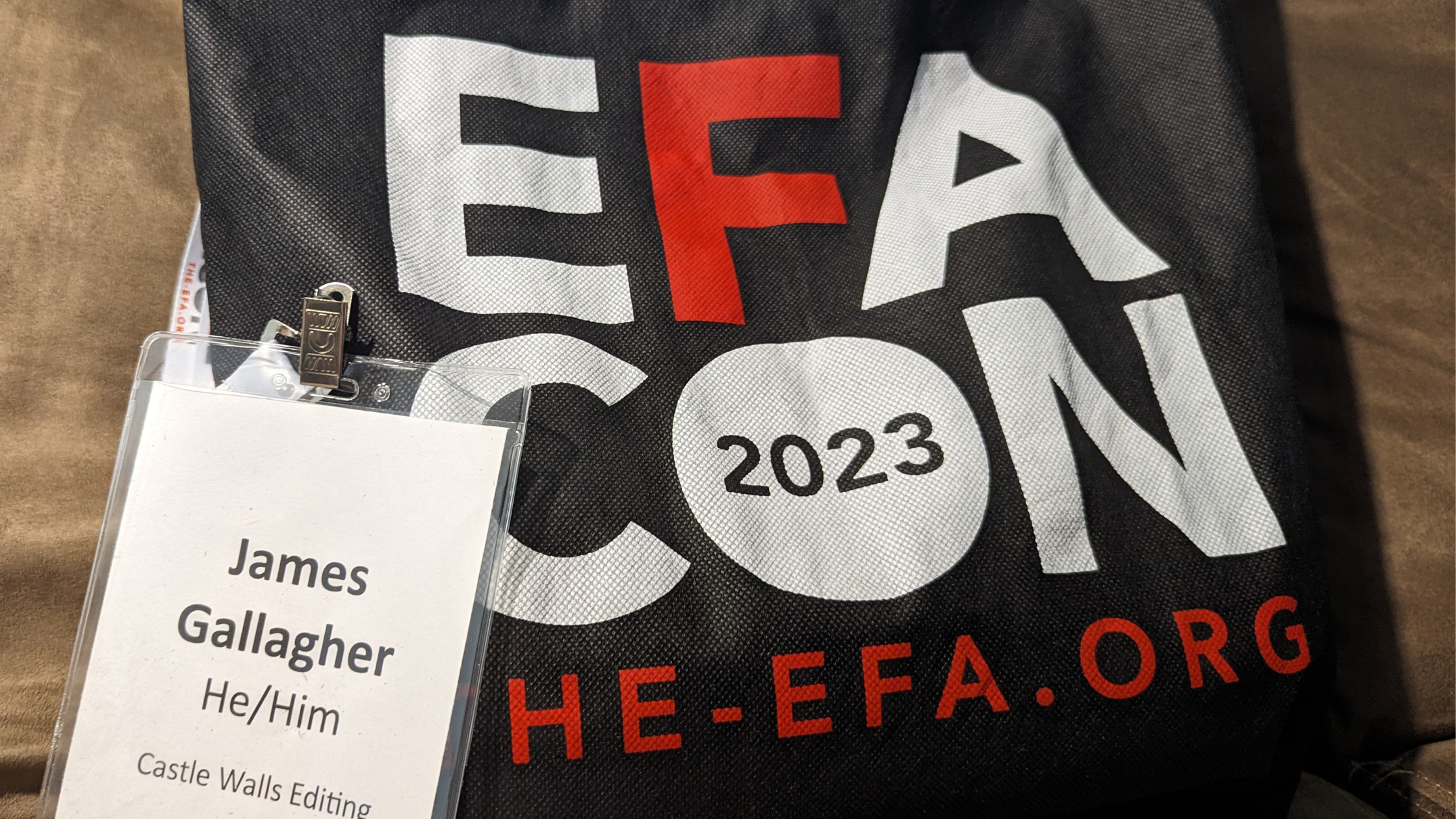
    Attending EFACON 2023 on August 18 and 19 in Alexandria, Virginia, increased my editorial knowledge and strengthened my ties in the editorial community. I left the conference with renewed enthusiasm for my work and already look forward to future events from the Editorial Freelancers Association (EFA).

    In the following I discuss benefits of the conference and provide a high-level lesson from each of the eight sessions I attended. I’ll also add here that the keynotes from Dr. Cathy Hannabach, Cecilia Tan, and Ran Walker were all excellent, and the EFA did a praise-worthy job selecting these speakers.

    People

    Like many editors, I’m introverted, and it’s all too easy to hide in a corner, keep my eyes down to avoid interaction, or look for the empty table at meals. But I’d promised myself that I would engage with people at the conference and am proud that I interacted more than I ever have at similar events.

    As freelance editors, we generally work alone and can often feel isolated, so building that sense of community and expanding our network does wonders for increasing our opportunities for learning from others, sharing job opportunities, and enjoying the camaraderie of like-minded professionals.

    A common theme at the conference was that you never know how a connection will pay off, even years later, so with every interaction you’re planting seeds. Perhaps more important, you’re interacting with the kind, generous people in the editing community, and that’s something to appreciate in and of itself.

    I certainly learned from all my interactions, even in terms of broadening my conception of what people do and how they work, and I was also able to share what I’ve learned since going full-time freelance at the end of 2017.

    I already knew some of the attendees from online venues, and it’s a wonderful experience to finally meet people in person. There’s a unique thrill to Oh, that’s so-and-so!

    Friday and Saturday entailed two long days of sessions, and by the end of the second day I was mentally and socially at my end, so I headed out before the final reception. While that would have been a nice capper, it’s important to recognize your limits, and I left feeling good about all aspects of the conference.

    Processes

    The EFACON sessions provided a wonderful opportunity to learn from editing superstars and to improve my processes.

    The following are the sessions I attended at EFACON, with a takeaway for each. Multiple sessions were scheduled for each time slot, and I’m looking forward to catching ones I missed once the recordings become available.


    Diversify Your Business: From Building Communities to Teaching—How to Provide Editing-Adjacent Services to Authors (presented by Jessica Snyder)

    This provided an excellent start to my conference, especially because it challenged me to think differently. Jessica talked about how coaching, online courses, and consulting can help you serve clients and increase your income to protect against lost income due to disability or illness. She also explored options for better work-life balance.

    TAKEAWAY: It’s easy for me to get in an editing groove and move from one job to the next, but you never know what’s around the corner, and you should never stop thinking about how your business can change and adapt.


    An Editor’s Guide to Assessing and Addressing Problematic Content (presented by Crystal Shelley)

    I’ve long been a fan of Crystal Shelley and have learned much from all the helpful resources she provides, so Crystal was at the very top of presenters I was excited to see. In her session Crystal looked at the ways biased and exclusive language renders text ineffective or harmful. She offered practical tips for offering guidance on problematic language or representation, flagging content, crafting clear queries, providing feedback, and handling client resistance.

    TAKEAWAY: More than anything, I left Crystal’s session wanting to embody her approach of knowing that we’re all human and capable of mistakes, but by listening and learning we can do better, show kindness to others through language, and help to better serve our clients.


    Client Interactions and Relationship Management (presented by Katie Chambers)

    Katie Chambers is a wonderful presenter, lively, funny, and engaging. In this session Katie shared her processes for template emails, e-mail management, client intake, data and systems, and client management.

    TAKEAWAY: Data, data, data! Collecting data on clients and the associated work is vital, and refining processes for doing so should be ongoing.


    Oops! Finding and Fixing Bloopers in Fiction (presented by Amy J. Schneider)

    The author of “that little yellow book,” Amy Schneider was another presenter I was greatly looking forward to seeing. Amy discussed language bloopers (pet phrases, danglers, redundancy), action bloopers (Chekhov’s gun, drop-in characters), and factual bloopers (body position, anachronisms, geography).

    TAKEAWAY: Easy takeaway here. When one of the best copyeditors anywhere shares insights into her craft, you sit up and take notes on every observation.


    One on One: Coaching for Creativity and Craft (presented by Christina M. Frey)

    I’ve taken two line editing classes from Christina Frey, and I’m convinced she’s a genius. In this session Christina discussed how an editorial coach can provide support beyond the typical editor-writer relationship, the qualities of a good editorial coach, approaches, and techniques for listening and adjusting.

    TAKEAWAY: Clients have needs beyond your service offerings, so expanding your thoughts on how you might meet those needs could open all-new areas for your business.


    Find Your NICHE: How to Niche Down and Market Your Specialty (presented by Jeanette Smith)

    I know Jeanette from an EFA chapter and was beyond excited to be there to support her and see her deliver her presentation. She nailed it! Jeanette examined all aspects of NICHE: natural talents, interests, characteristics, heart, and environment.

    TAKEAWAY: Again, it’s easy to get lost in the work and let the marketing side of your business flag. Thinking about your niche can help you better direct your services at the clients you most desire.


    Talking Points: Copyediting Dialogue in Fiction (presented by Amy J. Schneider)

    Here Amy addressed handling the mechanics of dialogue to maintain character voice while keeping dialogue understandable for the reader and letting the story shine. She looked at dialogue tags, verbs of utterance, action beats, punctuation, unspoken dialogue, informal dialogue, sounds and other nonverbal expressions, non-English language and translated dialogue, and electronic communication.

    TAKEAWAY: With The Chicago Guide to Copyediting Fiction, Amy literally wrote the book on copyediting. I’m just smart enough to realize when to pay attention and take lessons from one of the best in the field.


    Retreats: Build Your Business with a Getaway (presented by Laura Poole)

    Here Laura Poole delved into business retreats and professional getaways, discussing benefits, logistics, and suggested activities for group, solo, and virtual retreats. By the end of the session, I think everyone in the room was dreaming of a getaway to ponder all aspects of their businesses.

    TAKEAWAY: This is the third time I’ve said this, but it’s incredibly easy to get caught up in your work. However, stepping away and changing your environment can inspire you with new ideas that might completely revamp how you do business—and make happier clients in the process.


    What We Wish We’d Known Before We Started Freelancing (panel discussion presented by Lori Paximadis, Jeanette Fast Redmond, and Amy J. Schneider)

    This esteemed panel shared insights on building a steady client base, marketing strategies, business policies and boundaries, contracts, client acquisition, automation tools, and efficiency. As a means of both looking back and looking forward, this was a fantastic way to end my conference, head spinning with ideas and hopes for my business.

    TAKEAWAY: Never ever ever stop thinking about new ways to approach your business.

    Final Thought

    EFACON 2023 benefited me personally and professionally. I’ll do my best to continue to build on what I learned there, and I’m thankful for new and deepened editing relationships among my peers.
  • Training and Its Many Benefits

    Training and Its Many Benefits

    Professional associations such as the Editorial Freelancers Association (EFA) and ACES: The Society for Editing offer many resources that help editors excel in their work and run successful businesses.

    I particularly appreciate the access to quality training provided by these organizations, which offer courses at discounted fees to members. 

    Courses are generally either learn-at-your-own-pace (where you’re given access to the materials for a set period, typically six months) or instructor led (in which instructors deliver training materials each week for a designated stretch, providing students with weekly feedback on graded assignments).

    The EFA and ACES have also made free webinars available to members during the pandemic.

    The benefits of training are many:

    • Refresh your knowledge
    • Stay current with trends in the profession
    • Expand your editorial offerings
    • Get feedback from world-class professionals
    • Meet other editing professionals
    • Reinvigorate your enthusiasm for the profession
    • Fill gaps in your schedule in a positive way 


    Refresh your knowledge

    Most editing skills are picked up through hard-earned experience, and basic courses may seem below your current skill level. But even 101-type courses can fill a gap in your knowledge or cause you to rethink an aspect of your editing business.

    Stay current with trends in the profession

    Language is always changing, along with electronic tools, editing trends, and publisher requirements. Continued training keeps you current and enables you to incorporate new tools and fine-tune your processes.

    Expand your editorial offerings

    Proofreading is very different from copy editing, and copy editing is different from line editing, and line editing is different from developmental editing. Training lets you get your feet wet in new areas under the guidance of a seasoned professional.

    Get feedback from world-class professionals

    Your instructors are generally respected members of the editing community (and in my experience they care deeply both about the profession and about helping others). Learning from the best is never a bad idea.

    Meet other editing professionals

    Most classes contain forums where you can meet your classmates and learn from those at all levels. The editing community is wide and welcoming, and the fellow editors you meet will prove invaluable for sharing both knowledge and work opportunities.

    Reinvigorate your enthusiasm for the profession

    Learning something new almost always fires you with enthusiasm for putting your knowledge into practice. It’s easy to get caught up in the grind of job after job, and stepping back for a moment can remind you of what you love about editing.

    Fill gaps in your schedule in a positive way 

    For those running their own businesses, any downtime between jobs can feel like lost time and fill you with anxiety. Though there is never a shortage of marketing, accounting, or other nonediting work to tackle, training is a particularly satisfying way to bridge gaps between jobs.


    The following is a selection of courses I’ve taken from my professional organizations (and from the amazing Jennifer Lawler):

    Copyediting: Beginning (EFA)

    Copyediting: Intermediate (EFA)

    Copyediting: Advanced (EFA)

    Developmental Editing of Fiction: Beginning (EFA)

    Developmental Editing of Fiction: Intermediate (EFA)

    Developmental Editing of Mystery, Thriller, Suspense (Jennifer Lawler)

    Editing the Romance (Jennifer Lawler)

    Essentials of Conflict (Jennifer Lawler)

    Truby’s Masters Studio: Horror, Sci-Fi, and Fantasy (Audio)

    How to Edit Marketing Materials with Savvy and Sense (ACES/Poynter)

    The Art and Science of Editing (ACES/Poynter)

    The Web’s Best Editing Resources (ACES/Poynter)

    Language Primer: Basics of Grammar, Punctuation and Word Use (ACES/Poynter)

    Writing Online Headlines: SEO and Beyond (ACES/Poynter)

    Getting It Right: Accuracy and Verification in the Digital Age (ACES/Poynter)

    Fundamentals of Editing (ACES/Poynter)

    Clarity Is Key: Making Writing Clean and Concise (ACES/Poynter)

  • Staying Connected during Isolation

    Staying Connected during Isolation

    Isolating in our homes during the COVID-19 pandemic has undoubtedly increased the amount of time we’re spending in virtual spaces for business, pleasure, and education. 

    Before the pandemic, I had weekly meetings with clients on Google Hangouts and Skype, but since the shelter-in-place guidance I’ve seen a big increase in meetings via Zoom (not to mention sessions with friends and family on Houseparty).

    I’ve also participated in more online collaboration on Miro, and it’s hard to imagine that virtual collaboration will do anything but increase — whether or not we return to something approaching our old normal. 

    The following fun and informative offerings have popped up in recent weeks:


    That Word Chat with Mark Allen

    Former newspaper reporter and longtime copy editor Mark Allen (@EditorMark) has launched That Word Chat on Zoom. 

    Described as a “video chat with lovers of all things lexical,” the episodes air Tuesdays at 4:30 p.m. ET. The first episode featured a conversation with Mary Norris, the author of Between You & Me: Confessions of a Comma Queen and Greek to Me: Adventures of the Comma Queen.

    During the first episode, I looked from attendee to attendee and was struck by the number of respected editors in the virtual room — a real who’s who of Editor Twitter. It felt good to hang for a bit with these great editors.

    The second episode welcomed Word by Word: The Secret Life of Dictionaries author Kory Stamper and Steve Kleinedler, author of Is English Changing? At one point, the two took word suggestions and wrote on-the-fly definitions. 

    Though they made clear that coming up with definitions off the top of their heads was far from the real dictionary-writing process, it was still fascinating to get a glimpse of how they think — and it was also a lot of fun.


    Sentence Diagramming with Ellen Jovin

    Known on Twitter for her traveling Grammar Table, Ellen Jovin (@GrammarTable) has launched a series of classes on sentence diagramming.

    Whatever your reaction to sentence diagramming — be it a quizzical Huh? or a nostalgic Oh yes, I remember doing that — the first two classes have been a blast, and I look forward to the third.

    (I remember sentence diagramming from grade school nearly four decades ago and haven’t thought about it a lot since, so I’ve greatly enjoyed the creativity of drawing out sentences with a group of fellow editors.)


    ACES and EFA Webinars

    I value my memberships in ACES: The Society for Editors and the Editorial Freelancers Association (EFA), and both have offered free webinars to members during the pandemic (with ACES offering free webinars to nonmembers as well).

    Whether for learning something new or reinforcing knowledge, ongoing education is an important part of being an editor who provides the best possible service to clients. 

    I also find it can be a boost to mental health, because it feels like such a productive use of time (and while I’ve been lucky to maintain steady work during the crisis, the uncertainty around book publishing is just one of many stressors in this new world).


    ACES Annual Conference

    For many, ACES is almost synonymous with the organization’s annual convention, and I’ve been fortunate enough to attend past conventions in St. Petersburg, Portland, and Chicago.

    This year’s convention in Salt Lake City was canceled because of the pandemic, but ACES has scheduled a day of online sessions for May 1. Session topics include the following:

    • The Invention of the Modern American Dictionary with Peter Sokolowski, editor-at-large, Merriam-Webster
    • Grammar Arcana with Lisa McLendon, coordinator of the Bremner Editing Center at University of Kansas
    • Developing a Quality Editorial Process End-to-End with Samantha Enslen, president, Dragonfly Editorial, and Cynthia Williams, editor and project manager, Dragonfly Editorial
    • What’s New in the AP Stylebook with Paula Froke, lead editor, AP Stylebook, and Colleen Newvine, product manager, AP Stylebook


    I’m looking forward to these sessions and am grateful that the people at ACES have done what they can to replace their beloved convention.


    Evident Ink with Nancy Smay

    In addition to serving clients through Castle Walls Editing, I edit romance as a guest editor through editor Nancy Smay’s company Evident Ink, and I am happy to report that Nancy has launched a wonderful series of free live video sessions on Facebook (https://www.facebook.com/EvidentInk/). 

    Nancy welcomes new guests every week, with upcoming sessions including topics such as boosting your writing productivity and using tropes in fiction. The classes take place on Thursdays at 4:30 p.m. ET and are well worth checking out.


    Corona Con

    Because of the cancellation of the Scares That Care horror convention in Wisconsin, author Kelli Owen led the charge to put together a live stream replacement con on April 18.

    Guests included Jonathan Janz, Kelli Owen, Brian Keene, Mary SanGiovanni, Robert Ford, Tim Meyer, Matt Hayward, Wes Southard, Somer Canon, Wile E. Young, Stephen Kozeniewski, Aaron Dries, Bracken MacLeod, and moderators Sadie Hartman (MotherHorror of Nightworms), Bob Pastorella (This Is Horror), Steve Pattee (Horror DNA), and Shane Keene (Ink Heist).

    A link to the day’s events can be found here: 

    https://www.youtube.com/watch?v=GDnXscKJ4nY&feature=youtu.be

    All the sessions are worth watching, but the Jonathan Janz reading stands out as perhaps the day’s biggest bring-down-the-house moment. Reading from his forthcoming work The Raven, Janz delivered a master class in live reading.

  • Taking the Plunge: Running an Editing Business

    Taking the Plunge: Running an Editing Business

    Last Wednesday I said my goodbyes as senior editor at Recorded Books and embarked on a new life running an editing business.

    Even after fourteen years with a company I love . . .

    Even after forming personal and professional relationships I hope will continue indefinitely . . .

    Even after spending nearly a third of my life as a Recorded Books employee . . .

    Even after all that, those first steps into my new endeavor felt . . .

    EXHILARATING!

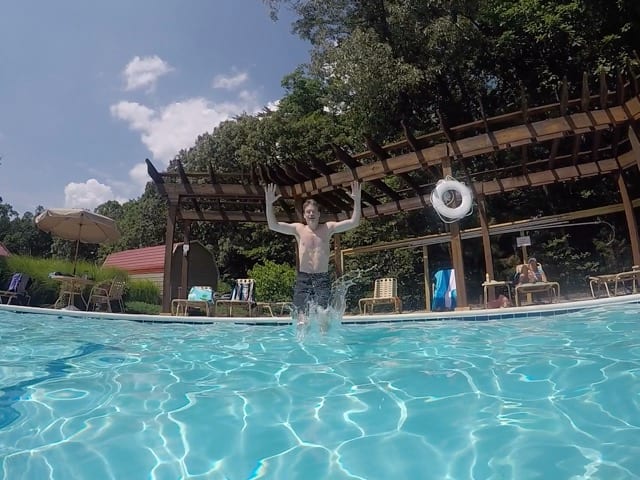
    Me earlier this summer, jumping right in

    What I Accomplished

    I’m happy with my time at Recorded Books and happy to have left on my terms, with no regrets. The company sells mostly to libraries, and I’ve always felt that my late grandmother, a fixture in her local library, would have been proud of me for serving that market.

    The sun has set on my time at Recorded Books

    Of all the projects I tackled while working for the world’s premier audiobook company, these are a few of my favorites:

    • Shepherding large-print books from art acquisition to typesetting to cover creation to proofreading and printing.
    • Editing the guidebooks that accompanied the Modern Scholar series of university lectures.
    • Proofing A Prairie Home Companion Pretty Good Joke Book.
    • Writing jacket copy for hundreds and hundreds of audiobook covers.
    • Crafting catalog copy (the ability to write in small spaces is a useful tool!).
    • Creating text for marketing materials, press releases, and web pages.
    • Writing and editing materials for children’s reading programs.

    Then there was the day I picked up the phone and found film producer Robert Evans (Rosemary’s Baby, The Godfather, Chinatown) on the other end. We were publishing his autobiography (The Kid Stays in the Picture) and he wanted extra copies of the large-print edition.

    So that’s how I found myself having a nice chat with one of Hollywood’s most legendary figures.

    Pretty cool.

    Running a Business v. Freelancing Full-Time

    Notice above that I said “running an editing business” rather than “freelancing full-time,” a thought voiced just this past weekend by respected editor Dick Margulis (of Dick Margulis Creative Services) at Communication Central’s Be a Better Freelancer conference.

    Despite freelancer being in the name of the conference, the thought is that freelancer evokes someone dabbling in the work, perhaps on weekends, while a person running a business is fully invested and wholly dedicated to the craft.

    The terminology sends a message to clients, and, perhaps equally as important, it sends a message to the business owners themselves and sets the tone for how they project themselves to the world.

    And, yes, I left my in-office gig on Wednesday, traveled Thursday, and attended the conference on Friday and Saturday. The conference came at an opportune time, to be sure!

    The conference was everything I hoped it would be: packed with helpful new tricks for marketing yourself, mastering Word, editing proposals, writing contracts, and assembling epubs. I would highly recommend it, and Ruth E. “I can write about anything!” Thaler-Carter did a hell of a job organizing the event.

    Bonus: I also stopped by Niagara Falls before heading home to begin my new life. Spectacular.

    Three Reasons I Started My Own Business

    Lists of reasons to go it on your own (or not) are everywhere, but here are my big three:

    My Work
    I can’t complain about the experience I gained in the office, and I enjoyed working on such a wide variety of projects, but at some point I felt the need to go after my own work. I love to edit, and I love horror fiction, and more than anything I hunger to pore over horror and dark fiction manuscripts. I also enjoy literary fiction, other genres, and even corporate work, but horror has been my jam since I first encountered Stephen King and Clive Barker thirty-some years ago.

    My Schedule
    For personal reasons, I’m going to be splitting time between Maryland and Dallas, not an easy thing when you need to be in the office five days a week. I also crave the thrill of waking up every day and thinking, “What do I need to do?” Balancing the work itself with marketing and accounting and all other aspects of the business can be overwhelming, but what a charge!

    My Life
    Running my own business has always been a dream, and I’m going for it, aiming to accomplish my editing goals, my writing goals, my life goals. At twenty, my son is now older than my sister was when she died. At forty-six, I’m now older than my mother was when she died. So I’m not convinced there’s a safe path through this life. Risks abound, but so do the rewards.

    Three Lessons I’ve Learned from the Experience

    As much information is out there on starting your business as there are reasons for doing so, but these are three lessons I found especially helpful:

    Lay the Groundwork
    I’ve done freelance work with my company for quite a while, so that was a tremendous help when making the jump. But with a full-time gig, not to mention two children, the time for that work was limited. Still, getting comfortable carrying out freelance work greases the skids, as does having at least a few clients who can help pay the bills while you establish yourself.

    Being as involved as possible in the greater editing community is also reassuring. A host of good editors are available to follow on social media, and joining the American Copy Editors Society (ACES) and the Editorial Freelancers Association (EFA), as well as attending ACES and other conventions, helps place you in that community.

    Exit Gracefully
    This was an easy one. People often cite office politics as one of the main reasons for going it on their own, but I genuinely liked and respected my coworkers. Those politics did exist on some level, but I was able to form cherished, lasting relationships. So no burned bridges, and as paths continue to cross, my former office mates and I can continue to help each other in any number of ways.

    Manage Expectations
    We all want to take the world by storm, but this rarely happens overnight. Running my own business is likely to put me in feast-and-famine cycles. I hope there’s always plenty of work to keep my business humming, but if not, there are a million things I can do to market myself, learn new skills, or interact with and help colleagues.

    Parting Thought

    Before I left the office for the last time, the director of the publications department (a great friend) gave me this card, along with a touching message inside. I think this says it all.