
Tag: editing business

  • My First Annual Report for Castle Walls Editing

    My First Annual Report for Castle Walls Editing

    [vc_row][vc_column][vc_column_text]I finally did it. For the first time since committing to full-time freelancing at the end of 2017, I’ve drafted an annual report for Castle Walls Editing.

    While the report is for my eyes only, putting it together has been tremendously helpful, and I’ve already started my 2022 report, which I’ll be updating throughout the year.

    Benefits of Creating an Annual Report

    I didn’t create a report for the first three full years of my business. For the most part, I am my business, and no one was asking for it. I had work in front of me, and creating such a report required time I could spend earning money and completing jobs.

    But now that I have the report (printed, in fact, and within easy reach), I couldn’t be happier that I put it together, and I’d encourage anyone else, no matter how small their business, to do the same.

    The following are the main benefits I found from creating an annual report:

    • The report made me take a hard look at my business. It’s easy to ignore realities when they’re not staring you in the face. It’s easy to work and work and work and focus only on the job in front of you. Creating this report forced me to take a hard look at my business, the good and the bad. Seeing the bad isn’t easy, but it’s the first step toward addressing what isn’t working and heading in a better direction.
    • The report captured all areas of my business in one place. The report gives me a comprehensive scan of all areas of my business in one easy-to-access resource. I expand more below on the areas of the report, so I’ll just say here that having a quick resource for reviewing and thinking about finances, training, clients, and other areas of the business helps me keep those areas top of mind. And this has already prompted me to think more about the business even while I’m working in the business.
    • The report made me feel more businesslike. I was working at home even before the pandemic, and I do my best to create a businesslike atmosphere. I maintain fairly regular work hours, and I have a professional properly outfitted workspace. But I’m working alone in my home, and it can be easy to lose sight of the business as a BUSINESS. The report lends weight to the significance of what I’m doing, and it encourages me to think of the business as a business, something that’s often a challenge for freelancers.
    • The report let me celebrate my successes. I could do better in many areas of the business, and that will always be true. I never want to stop growing and learning and doing better. But it’s not easy to run an editing business and pay your bills and make your clients happy. And I’ve done this for four full years since leaving in-house employment to pursue this dream. That’s a hell of an accomplishment, and I’m proud of it. 

    What I Included in the Report

    Although I didn’t create a report for 2018, 2019, or 2020, I added income and client information for those years in the appendixes. For each year I created a pie chart with share by client, and this let me see areas of the business that have grown or shrunk over those years.

    Another helpful visual was a line graph of my income by year. I dipped a bit in 2021, but in terms of income, 2020 and 2021 were both well above 2018 and 2019, so the graph is still satisfying.

    The following are the main areas I addressed in my report. In my overview, I spoke honestly, in a conversational tone. In a sense, I am indeed having a conversation with myself about my business. I wanted to be honest, I wanted to be fair, and I wanted to be kind.

    • Overview
    • 2021 Income
    • Clients
    • Training
    • Equipment and Tools
    • Insurance
    • Appendix A: 2018
    • Appendix B: 2019
    • Appendix C: 2020
    • Appendix D: Books Edited in 2021
    • Appendix E: All Courses

    Going Forward

    The 2021 report served as a good start for my 2022 report. I simply carried over information that would apply and moved around information that could shift (for example, I moved my 2021 financial information into an appendix).

    I didn’t break my 2021 report down by quarter, but I plan to do that this year, and it will be fairly easy because I’ll be doing it each quarter rather than at the end of the year.

    For items like training, I can add courses as I go.

    The report is and always will be a work in progress. This year I plan to add a section on my web presence and social media. I hope to take a more in-depth look at my clients. I’d like to add a section on lessons learned and goals for the following year.

    I’ve also rededicated myself to consistent time tracking, and next year’s report will contain more breakdowns of that data, so helpful in estimating fees for clients and seeing the kinds of jobs that are most profitable.

    Have you run an annual report for your business? If not, I’d highly recommend doing so. It’s been wonderful for me, and that should translate into a better business for my clients.[/vc_column_text][/vc_column][/vc_row]

  • Taking the Plunge: Running an Editing Business

    Taking the Plunge: Running an Editing Business

    Last Wednesday I said my goodbyes as senior editor at Recorded Books and embarked on a new life running an editing business.

    Even after fourteen years with a company I love . . .

    Even after forming personal and professional relationships I hope will continue indefinitely . . .

    Even after spending nearly a third of my life as a Recorded Books employee . . .

    Even after all that, those first steps into my new endeavor felt . . .

    EXHILARATING!

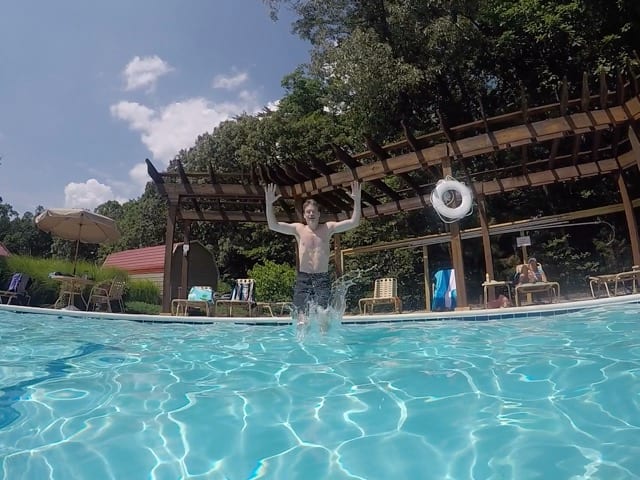
    Me earlier this summer, jumping right in

    What I Accomplished

    I’m happy with my time at Recorded Books and happy to have left on my terms, with no regrets. The company sells mostly to libraries, and I’ve always felt that my late grandmother, a fixture in her local library, would have been proud of me for serving that market.

    The sun has set on my time at Recorded Books

    Of all the projects I tackled while working for the world’s premier audiobook company, these are a few of my favorites:

    • Shepherding large-print books from art acquisition to typesetting to cover creation to proofreading and printing.
    • Editing the guidebooks that accompanied the Modern Scholar series of university lectures.
    • Proofing A Prairie Home Companion Pretty Good Joke Book.
    • Writing jacket copy for hundreds and hundreds of audiobook covers.
    • Crafting catalog copy (the ability to write in small spaces is a useful tool!).
    • Creating text for marketing materials, press releases, and web pages.
    • Writing and editing materials for children’s reading programs.

    Then there was the day I picked up the phone and found film producer Robert Evans (Rosemary’s Baby, The Godfather, Chinatown) on the other end. We were publishing his autobiography (The Kid Stays in the Picture) and he wanted extra copies of the large-print edition.

    So that’s how I found myself having a nice chat with one of Hollywood’s most legendary figures.

    Pretty cool.

    Running a Business v. Freelancing Full-Time

    Notice above that I said “running an editing business” rather than “freelancing full-time,” a thought voiced just this past weekend by respected editor Dick Margulis (of Dick Margulis Creative Services) at Communication Central’s Be a Better Freelancer conference.

    Despite freelancer being in the name of the conference, the thought is that freelancer evokes someone dabbling in the work, perhaps on weekends, while a person running a business is fully invested and wholly dedicated to the craft.

    The terminology sends a message to clients, and, perhaps equally as important, it sends a message to the business owners themselves and sets the tone for how they project themselves to the world.

    And, yes, I left my in-office gig on Wednesday, traveled Thursday, and attended the conference on Friday and Saturday. The conference came at an opportune time, to be sure!

    The conference was everything I hoped it would be: packed with helpful new tricks for marketing yourself, mastering Word, editing proposals, writing contracts, and assembling epubs. I would highly recommend it, and Ruth E. “I can write about anything!” Thaler-Carter did a hell of a job organizing the event.

    Bonus: I also stopped by Niagara Falls before heading home to begin my new life. Spectacular.

    Three Reasons I Started My Own Business

    Lists of reasons to go it on your own (or not) are everywhere, but here are my big three:

    My Work
    I can’t complain about the experience I gained in the office, and I enjoyed working on such a wide variety of projects, but at some point I felt the need to go after my own work. I love to edit, and I love horror fiction, and more than anything I hunger to pore over horror and dark fiction manuscripts. I also enjoy literary fiction, other genres, and even corporate work, but horror has been my jam since I first encountered Stephen King and Clive Barker thirty-some years ago.

    My Schedule
    For personal reasons, I’m going to be splitting time between Maryland and Dallas, not an easy thing when you need to be in the office five days a week. I also crave the thrill of waking up every day and thinking, “What do I need to do?” Balancing the work itself with marketing and accounting and all other aspects of the business can be overwhelming, but what a charge!

    My Life
    Running my own business has always been a dream, and I’m going for it, aiming to accomplish my editing goals, my writing goals, my life goals. At twenty, my son is now older than my sister was when she died. At forty-six, I’m now older than my mother was when she died. So I’m not convinced there’s a safe path through this life. Risks abound, but so do the rewards.

    Three Lessons I’ve Learned from the Experience

    As much information is out there on starting your business as there are reasons for doing so, but these are three lessons I found especially helpful:

    Lay the Groundwork
    I’ve done freelance work with my company for quite a while, so that was a tremendous help when making the jump. But with a full-time gig, not to mention two children, the time for that work was limited. Still, getting comfortable carrying out freelance work greases the skids, as does having at least a few clients who can help pay the bills while you establish yourself.

    Being as involved as possible in the greater editing community is also reassuring. A host of good editors are available to follow on social media, and joining the American Copy Editors Society (ACES) and the Editorial Freelancers Association (EFA), as well as attending ACES and other conventions, helps place you in that community.

    Exit Gracefully
    This was an easy one. People often cite office politics as one of the main reasons for going it on their own, but I genuinely liked and respected my coworkers. Those politics did exist on some level, but I was able to form cherished, lasting relationships. So no burned bridges, and as paths continue to cross, my former office mates and I can continue to help each other in any number of ways.

    Manage Expectations
    We all want to take the world by storm, but this rarely happens overnight. Running my own business is likely to put me in feast-and-famine cycles. I hope there’s always plenty of work to keep my business humming, but if not, there are a million things I can do to market myself, learn new skills, or interact with and help colleagues.

    Parting Thought

    Before I left the office for the last time, the director of the publications department (a great friend) gave me this card, along with a touching message inside. I think this says it all.