Tag: copyediting

  • Five Book Mentors for Editors

    Five Book Mentors for Editors

    While there’s no substitute for a mentor of the flesh-and-blood variety, the five “book mentors” below provide indispensable advice on the processes, philosophy, and business of editing.

    (Note that these are not writing or style guides. Click here for my look at the major style guides.)
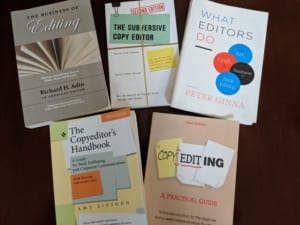
     

    The Business of Editing by Richard H. Adin

    A collection of essays by Richard Adin (aka the American Editor), The Business of Editing: Effective and Efficient Ways to Think, Work, and Prosper collects Adin’s sage advice on these key aspects of the profession:

    • Roles
    • Tools
    • Processes
    • Profits
    • The Career of Editing
    • The Future of Editing

    While these essays are free at the American Editor blog, the handy arrangement of selections helps lead you through the above topics, and I thought it well worth the purchase.

    Of late, editor Ruth E. Thaler-Carter has taken over most writing duties on the site, including this post on backups for files and equipment. Thaler-Carter also organizes Communication Central’s Be a Better Freelancer conference, which I attended last fall.

    The Subversive Copy Editor by Carol Fisher Saller

    As senior editor at Recorded Books, I ensured that all the editors had a copy of The Subversive Copy Editor (or, How to Negotiate Good Relationships with Your Writers, Your Colleagues, and Yourself).

    In the book, Saller shares her kind, helpful approach to editing. Her “subversiveness” refers to her belief that editors are not the writer’s adversary but people who work in service to the author (and reader).

    The second part of her subversiveness is her belief that editors often need to look beyond the “rules” and do what makes most sense for the work at hand.

    Not so subversive at all!

    The Subversive Copy Editor is broken into two parts: “Working with the Writer, for the Reader” and “Working with Your Colleagues and with Yourself.”

    Saller also edits the Chicago Manual of Style Online’s Q&A. More about her can be found here.  

    What Editors Do Edited by Peter Ginna

    With essays from the best editors in the field (including the above-mentioned Carol Fisher Saller), What Editors Do: The Art, Craft & Business of Book Editing provides a host of insights into the profession.

    The book is broken into the following parts:

    • Part I: Acquisition: Finding the Book
    • Part II: The Editing Process: From Proposal to Book
    • Part III: Publication: Bringing the Book to the Reader
    • Part IV: From Mystery to Memoir: Categories and Case Studies
    • Part V: Pursuing an Editing Career: Varieties of Editorial Experience

    Many independent editors don’t have the opportunity to work in-house for a major publisher, and this books opens a window into that world.

    Peter Ginna has been an editor and publisher for Bloomsbury Press, Oxford University Press, Crown Publishers, St. Martin’s Press, and Persea Books.

    The Copyeditor’s Handbook by Amy Einsohn

    The following quote from Kim Hawley of the Chicago Book Clinic says it all about The Copyeditor’s Handbook: A Guide for Book Publishing and Corporate Communications:

    “A definite ‘must have’ for the beginning to intermediate editor or author, and even the experienced editor. An indispensable reference tool.”

    The book, which includes exercises and answer keys, is broken into these parts:

    • Part 1: The ABCs of Copyediting
    • Part 2: Editorial Style
    • Part 3: Language Editing

    A professional editor for scholarly, trade nonfiction, and corporate publishing, Amy Einsohn also taught copyediting courses. A tribute to the late Einsohn can be found on Copyediting.com here.

    Copyediting: A Practical Guide by Karen Judd

    The oldest title on my list, Karen Judd’s Copyediting: A Practical Guide is still a well respected resource for copy editors and a good addition to any editor’s shelf.

    The book begins with “What Is Copyediting?” and runs through the subjects of copyediting and proofreading symbols, punctuation and grammar, style and word usage, notes and bibliography, specialized copyediting, and other aspects of copyediting.

    ***

    These are all books that have helped me in my copyediting career. I hope you find them useful as well.


  • Getting to the Why of Editing

    Getting to the Why of Editing

    In his wildly popular TED Talk video How Great Leaders Inspire Action, author Simon Sinek maintains that most businesses know what they do, and that some businesses even understand how they do it, but that few businesses truly understand why they do it.

    Why does your organization exist? he asks. Why do you get out of bed in the morning? Why should anyone care?

    I spent almost 15 years working an in-house gig as an editor at Recorded Books (a company that will always have a special place in my heart). But nearly six months ago, I left behind regular paychecks and benefits to begin an adventure running my own editing business.

    I’m a copy editor.

    I love copyediting.

    But that’s what I do.

    I’m learning all the time and refining my processes (something I hope and expect will always be the case). But even so, I can give you a good breakdown of how I do what I do.

    But why do I do it?

    Sinek makes a compelling case for answering this question, and I’m sold on the importance of doing so.

    I should answer it for myself, certainly.

    But perhaps more importantly, I should answer it for my clients and for my potential clients. In truth, they shouldn’t just ask the question. They should demand an answer.

    So here goes.

    Anyone who’s chosen the freelance route can rattle off the usual reasons for going it on your own:

    • Being your own boss
    • Setting your own schedule
    • Pursuing the kind of work you want
    • Avoiding office politics

    These are all compelling, but they don’t actually strike at the why of what I do.

    So how do I get to why?

    My Castle Walls Editing home page features rotating images with these slogans:

    • Serving the Author
    • Serving the Audience
    • Serving the Work

    Each represents a different aspect of my why.

    Serving the Author

    In The Subversive Copy Editor (a must-read for any editor), Carol Fisher Saller expresses her philosophy that editors and authors are not adversaries vying for control of the text. They are instead partners working in service to the reader.

    As an editor, I want to help the author. Helping is important to me, and on a basic level it makes me feel good. I have a strong need to please, and editing lets me do this in a direct way.

    Serving the Audience

    I’m a reader as well as an editor, and reading has always been a place of shelter and warmth (Clive Barker, Ramsey Campbell, and all the other writers I admire have gotten me through a lot of tough times, and reading to my children was one of the great pleasures of my life).

    In a blog post, Baltimore Sun editor John McIntyre wrote, “And to be an editor, you must first be an avid reader. You have to hear all the voices to know which one is appropriate for your writer, your subject, your publication, your reader.”

    So reading is important for both personal and professional reasons. And as an editor, I’m able to help deliver text to readers everywhere—and this is a mission I can believe in, heart and soul.

    Serving the Work

    As a child, one of the chief ways I pleased my mother was by tidying up my room. I’ve carried this desire for neatness—and the psychological rewards of tidying up—into my profession. My mother died when I was not yet out of my teens, but I think she would be proud of the work I do.

    Certain kinds of editing appeal to me more than others, but at the heart of all jobs is that sense of straightening up. Addressing a reference list, for example, can be tedious work, but seeing a final product that appears just the way it should, down to the smallest detail, is extremely satisfying.

    My Why

    So why do I edit? It comes down to three things:

    1. I enjoy helping people.
    2. I enjoy being part of the book-making process.
    3. I enjoy cleaning up text.

    Those are simple reasons, but they feel honest and they work for me. I hope they work for you too.


  • Mind the Gap

    Looking at the spaces between vertical railings on my friend’s just-built deck, I could only say, “This can’t adhere to any code.” The spaces were a good two feet apart, so any child under the age of six could easily walk right off the deck.

    Needless to say, my friend had words with her contractor.

    The existing railing might even have been worse than no railing at all, because the illusion of safety might have given a false sense of security, whereas if there were no railing whatsoever, people (presumably even children) would be afraid to go near the edge.

    Editing can be like that.

    I’ve noticed that the more professional the design, whether that means typesetting of the text or pictorial or illustrative elements surrounding the text, the more likely the editor is to have a false sense that everything is okay.

    It rarely is.

    I’ve seen good editors miss what should be obvious mistakes on book covers in part, I have to think, because the design looks so nice that it’s hard to believe there could be an error.

    A corollary is that editors can easily fail to fact-check something because of the thought that the writer intended a piece of information to be there and must know what he or she is talking about.

    Trust in editing is a dangerous thing, while skepticism more often than not saves the day.

    But editors should be skeptical of their own impulses as well. Before making any change, editors have to counter the little thrill of making a correction by asking themselves whether there’s any way that the original instance could in fact be correct. Young editors especially can be so fired up with confidence in their abilities that they introduce errors by misreading a usage and making a bad edit.

    So we have to always be skeptical of the text, of our writers, and, perhaps most particularly, of ourselves. As always, do no harm!

    And don’t go stepping off any decks, metaphorical ones or otherwise.  

    [twitter-follow screen_name=’CastleWallsEdit’]

  • Toast

    I’ve never applied eye black before tackling a manuscript. My reading glasses, I’ll readily admit, don’t even come close to saying badass the way that eye black does. Still, with the kickoff of the NFL season scant hours away, it occurs to me that there’s a position on the gridiron not all too dissimilar to that of copy editor: the cornerback.

    Strange, you might think (or passing strange), to compare a position held by one of the world’s finest athletes to the role of copy editor, but there’s one obvious link: a copy editor, like a cornerback, can only screw up. We can only get burned.

    If a copy editor does his or her job correctly, no one notices. By the same token, if a cornerback shuts down a receiver, the ball doesn’t get thrown to that side of the field, and the corner and receiver might as well be invisible. It’s only when the receiver slips behind the defense and hauls in a big gain that the now-hapless-looking corner gets his name called. Any editor who’s missed something (and all editors miss from time to time) knows that feeling of getting schooled. (Thankfully, our moments of shame aren’t broadcast on national television.)

    Like a corner who’s just bitten on a really good fake, all we can do is shake it off, try to learn something from the experience, and remind ourselves that we’re damned good at what we do. What just happened won’t happen again. Not on my watch.

    I don’t want to completely discount our moments of glory, either. Snagging an interception and taking it to the house is a surefire way to bring a crowd (happily spilling beer and overpriced concessions) to its feet. Copy editors enjoy their own time in the limelight, even if pointing out a dangling participle isn’t likely to make any sports channel’s top-ten plays of the day.

    These moments, however, are few and far between. Our lot is to toil in obscurity, the garbage men of publishing, cleaning up unsightly errors while the rest of the world sleeps.

    I enjoy my work. I think it a noble profession. I like leaving a manuscript in better shape than I found it.

    I’m happy to play my position.