
“Only by thoughtful concentration on details can fiction be satisfactorily edited.”
—Words into Type
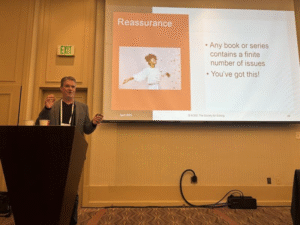
[On April 4, 2025, I presented “The Case of Ever-Changing Eye Color: Tracking Continuity in Manuscripts” to a live audience at ACES 2025 in Salt Lake City. This series of posts is largely based on that presentation.]
What Are Continuity Issues?
Continuity issues refer to discrepancies among details an author has provided in their manuscript.
Usually these issues relate to physical character traits, nonphysical character traits, plot events, and matters of time, place, and distance.
When the author provides information about a character, that information should be consistent throughout the manuscript unless there’s a good reason (a character’s hair might change color because they’ve dyed it).
Discrepancies in the passage of time, the physical properties of setting, and the distance between settings (and the time it would take to travel between places) all present innumerable opportunities to introduce continuity issues.
Continuity issues are present when the reader asks questions such as the following:
- Didn’t this character have blue eyes in chapter 3?
- How is it Saturday when four days have passed since Thursday?
- How did this character just enter the room when they were already in the room?
Continuity issues may occur within scenes, across scenes and chapters, and across books in a series. So copy editors face a daunting task when helping authors maintain good, uninterrupted continuity in their stories.
Why Are Continuity Issues a Problem?
Readers are savvy at picking up continuity issues—and they often aren’t shy about sharing them online. So it’s well worth it for authors and editors to do what they can to address continuity before a book makes its way into the world.
Continuity gaffes can do the following:
- Break the spell of an author’s storytelling and take the reader out of the work.
- Diminish author authority and lessen the reader’s faith in the author.
- Weaken the story.
Depending on the reader and the magnitude of the continuity issue, reader response might range from indifference to mild amusement to slight irritation to a refusal to finish the book.
For the author, the response might be embarrassment, awareness that they’ve taken a hit to their reputation, or irritation with their editor for not catching the issue.
For the editor, the response might be mortification (no one is harder on the editor than that editor), awareness that they’ve taken a hit to their reputation, and even fear that they could lose their client.
Next time we’ll look at why continuity issues occur, and we’ll explore how we can prevent them.
Note: Presenting a session on continuity live and in person to a room of editors at a national conference is something I’ll never forget. Organizations such as ACES: The Society for Editing provide learning opportunities and access to an inspiring community of editors.