Tag: Chicago Manual of Style

  • Castle Walls Update: New Edition of the Chicago Manual & Other News

    Castle Walls Update: New Edition of the Chicago Manual & Other News

    This fall is full of exciting happenings in my editing world!

    • Style alert! CMOS 18 hits the streets
    • My appearance on Club Ed Discussions
    • My upcoming course on editing horror
    • My upcoming presentation for ACES VCON24

    The Chicago Manual of Style releases a new edition

    While the Associated Press frequently updates its style guide to accommodate the fast pace of delivering up-to-the-minute news, The Chicago Manual of Style is updated approximately every seven years in deference to the much longer development times for book-length projects.

    So the recent release of the style guide’s eighteenth edition is big news for editors, who are eagerly educating themselves on the style changes in the new edition.

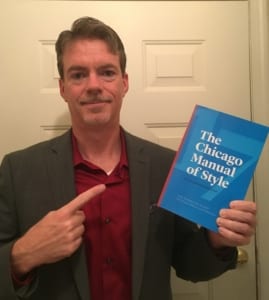
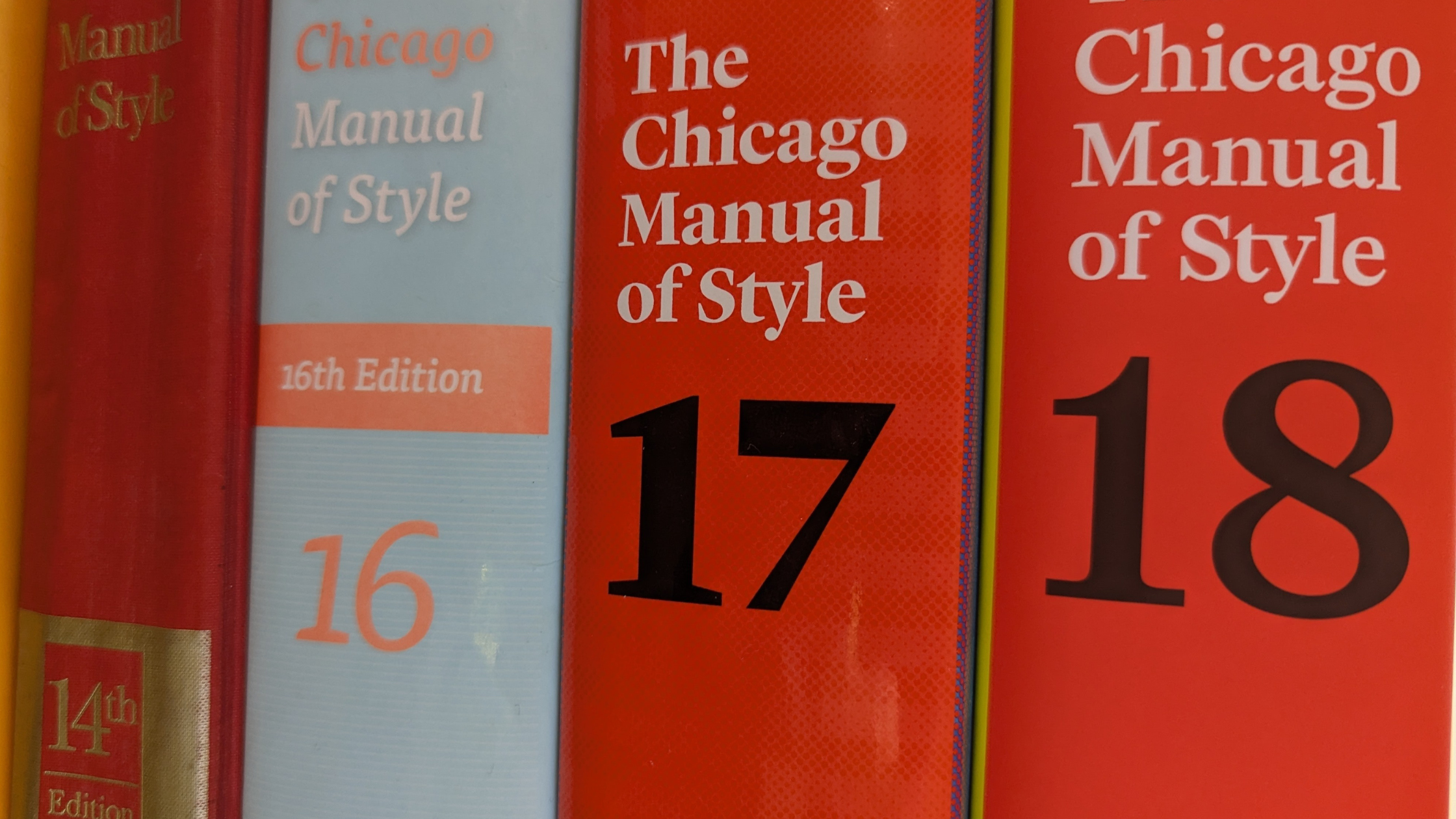
    I have a subscription to the online edition, and generally that’s my go-to resource because of its search capabilities. But I couldn’t resist purchasing the print edition (and its strikingly yellow cover) to sit beside my print editions going back to the fourteenth (my first edition). With the number of years between editions, it’s a good investment, and it’s comforting to have it on my shelf.

    Some changes will take some getting used to (I’ve spent too many years avoiding numerals at the beginning of a sentence to not look askance). But most I’m on board with.

    Always use a capital letter for complete sentences after a colon? Sounds good to me. Check Merriam-Webster for capitalization of adjectives derived from proper nouns (think french fries or Dutch oven)? Even better.

    I talk horror, romance, and copyediting on Club Ed Discussions

    On August 13 I was thrilled to join Jennifer Lawler on Club Ed Discussions, a discussion series she hosts for editors in her Club Ed membership. While the discussions are recorded, they’re reserved for her members, so I can’t share the link here, but I had a blast talking about the similarities between horror and romance, working with authors and publishers, and other aspects of copyediting.

    Jennifer is one of my favorite people in the editing world, and taking her classes has been an important part of my editing journey. Through Club Ed, Jennifer offers classes, community, and other resources to support editors and help them deliver quality services to authors and publishers.

    I’m teaching a class on editing horror!

    Speaking of Club Ed, Jennifer Lawler has long wanted to add a horror course to her offerings but doesn’t herself edit horror. Knowing my love of the genre, Jennifer asked me to develop a course for her platform, and this October students will be able to participate in Editing Horror with James Gallagher.

    The class begins with a one-hour live webinar that will be available for later viewing and also includes an online forum and feedback on a sample chapter edit. I am beyond excited!

    I’ll be presenting a session for ACES VCON24

    ACES: The Society for Editing is hosting a virtual conference from September 25 to 27, and I’ll be presenting the session “How to Create an Annual Report for Your Editing Business.”

    Presenting before a national conference of my peers is a huge honor and will be one of my highlights for the year. I’m also looking forward to all the other informative sessions from the fantastic editors at the conference.

    Other news

    I’ll just add that I’ve been busy with copyediting, proofreading, and developmental editing work for indie authors and publishers. This year I’ve been pleased to add Hachette Book GroupPenguin Random House, and Catapult to my clientele.

    Happy writing!

  • I Like Your Style! A Quick Look at the Major Style Guides

    I Like Your Style! A Quick Look at the Major Style Guides

    Style guides promote consistency for clear and accurate communication. A consistent approach to style shows professionalism and builds trust with the reader.

    Consistency also helps readers understand what is being communicated without having to question whether inconsistencies were intentional or a case of sloppiness or inattention. If two instances of the same term are styled differently, the reader might wonder if she’s being presented with two different meanings or if she’s missing something.

    Fiction authors don’t want these questions to break the spell of the reading experience, as can also happen with typos or poor construction. 

    In academics, writing represents a kind of conversation that promotes knowledge and the spread of ideas. Standard citations, for example, help this conversation by creating a common language that can be easily understood and used.

    But styles are almost always better thought of as “guidelines” rather than “rules,” and writers might break style for any number of reasons, not least to help the reader when a slavish adherence to style might do the reader a disservice.

    The following are major styles you may encounter (there are, of course, many more, and links to free online style guides appear at the end of the post):

    • AP
    • Chicago
    • Turabian
    • MLA
    • APA
    • AMA
    • CSE


    The Associated Press Stylebook and Briefing on Media Law

    Current edition: printed yearly and updated regularly online

    Audience: newspapers, magazines, and public relations offices 

    Website: www.apstylebook.com

    The Associated Press is an independent, not-for-profit news cooperative with teams in over 100 countries. AP style helps ensure consistency across worldwide distribution. Much of AP style is based on the premiums of space, so, for example, AP does not use the Oxford comma (except for clarity) or an s after the apostrophe when forming the possessive of singular nouns ending in s.

    The 2017 edition of The Associated Press Stylebook and Briefing on Media Law contains new entries on fact checks and fake news, guidance on the use of cyberattack, a new entry on gender, a new entry on addictions, and revised drug-related entries.

    You may buy a print copy (updated yearly) or subscribe to the AP Stylebook Online.

    The AP Stylebook Online gives you choices for

    • One or multiple users
    • Subscription to Webster’s New World College Dictionary
    • Twenty percent savings when signing up for automatic renewal


    The Chicago Manual of Style: The Essential Guide for Writers, Editors, and Publishers

    Current edition: seventeenth (2017)

    Audience: writers, editors, proofreaders, indexers, copywriters, designers, and publishers

    Website: www.chicagomanualofstyle.org

    For more than 100 years,  the Chicago Manual has been the go-to reference for style, usage, and grammar.

    While AP style meets the needs of a daily, 24-hour news cycle, the Chicago Manual addresses the longer planning cycles of the publishing industry. Editions may therefore be separated by six years or more.

    Among the changes in the seventeenth edition are the lowercasing of internet and the dropping of the hyphen from email.

    The manual is divided into three main parts:

    • Part I: The Publishing Process
    • Part II: Style and Usage (including a chapter on grammar by Bryan A. Garner)
    • Part III: Source Citations and Indexes


    A Manual for Writers of Research Papers, Theses, and Dissertations: Chicago Style for Students & Researchers (Kate L. Turabian)

    Current edition: ninth (2018)

    Audience: students and researchers

    Website: www.chicagomanualofstyle.org/turabian
    Since Kate L. Turabian assembled guidelines for students at the University of Chicago in 1937, Turabian style has been a reference standard.

    The manual’s ninth edition covers the research and writing process, from planning to production; all aspects of source citation, including both notes-bibliography style and author-date style; and style matters, offering guidance on spelling, punctuation, and numbers.

    The notes-bibliography style is frequently used in the humanities and social sciences, while the notes-bibliography style is more often used in the natural and physical sciences.

    The eighth edition diverged in small ways from the Chicago Manual, but the ninth edition aligns completely with the Chicago Manual.

    Turabian/Chicago style paper-formatting tip sheets can be found here.


    Modern Language Association (MLA)

    Current edition: eighth (2016)

    Audience: scholars, journal publishers, and academic and commercial presses

    Website: www.mla.org/MLA-Style

    As expressed in the preface by Kathleen Fitzpatrick, the purpose of this edition is to offer a “truly flexible documentation practice that will continue to serve writers well in a changing environment.”

    The handbook is divided into two main parts. The first part addresses the principles of MLA style and covers the reasons for documenting sources, plagiarism, and the Think, Select, Organize model.

    The second part addresses the details of MLA style, including treatments for names, titles, quotations, numbers, works cited, and in-text citations.


    Publication Manual of the American Psychological Association (APA)

    Current edition: sixth (2009)

    Audience: scholars and others writing in the the social and behavioral sciences

    Website: www.apastyle.org

    Maintaining styles for scientific communications, the Publications Manual of the American Psychological Association is favored by writers, editors, students, and educators in the social and behavioral sciences.

    The contents include the following:

    • Writing for the Behavioral and Social Sciences
    • Manuscript Structure and Content
    • Writing Clearly and Concisely
    • The Mechanics of Style
    • Displaying Results
    • Crediting Sources
    • Reference Examples
    • The Publication Process

    APA Style employs the author-date system for citations.


    AMA Manual of Style: A Guide for Authors and Editors

    Current edition: tenth (2007)

    Audience: authors, researchers, institutions, medical editors, publishers, and members of the news media who cover scientific research

    Website: http://www.amamanualofstyle.com/

    The AMA Manual of Style is geared at the medical and scientific publishing community: authors, researchers, institutions, medical editors, publishers, and members of the news media who cover scientific research.

    The tenth edition features expanded electronic guidelines, increased attention on ethical and legal issues, and guidelines on authorship, conflicts of interest, scientific misconduct, intellectual property, and individuals’ rights in scientific research and publication. The manual examines research ethics and editorial independence and features new material on indexing and searching as well as medical nomenclature.

    The manual is also available online.


    Scientific Style and Format: The CSE Manual for Authors, Editors, and Publishers

    Current edition: eighth (2014)

    Audience: authors, editors, publishers, students, and translators in science and related fields

    Website: www.councilscienceeditors.org/publications/scientific-style-and-format/

    Scientific Style and Format is aimed at authors, editors, publishers, students, and translators in science and related fields (physics, chemistry, genetics, biological sciences, and astronomy). The eighth edition was updated for electronic and online environments and for changes in international standards and policies.

    The manual contains style instructions for numbers, units, mathematical expressions, and statistics; information on managing tables, figures, and indexes; guidance on plagiarism and other aspects of academic integrity; and information on copyright law and Creative Commons.

    With coverage ranging from style conventions to publishing procedures to citation practices, Scientific Style and Format offers clear guidance on both print and electronic publications.

    Scientific Style and Format is available in print and online. You can visit scientificstyleandformat.org for a free trial.

    Free Online Style Guides
  • Book Rec: ‘Vex, Hex, Smash, Smooch’ by Constance Hale

    Book Rec: ‘Vex, Hex, Smash, Smooch’ by Constance Hale

    Wired Style and Sin and Syntax author Constance Hale inspires an infectious appreciation for verbs in Vex, Hex, Smash, Smooch: Let Verbs Power Your Writing. While the book dropped in 2012, its not-so-hot-off-the-presses status doesn’t diminish its readability, power, or utility for writers and editors.

    Deep into the book, Hale relates that, while serving as an editor at Wired and Health, she would circle the verbs in the first two or three paragraphs of clips writers sent in. If the verbs struck her as dynamic and made the sentences jump, the writers got a call.

    If not, not.

    How’s that for scaring you into checking your verbs?

    (Now that’s a phone you could slam to end a call!)

    GREAT ADVICE: Circle your verbs to see if your sentences crackle.

    On opening sentences with “there are” or “it is” constructions, Hale calls out the “phantom subject” (as termed by Patricia O’Conner in Woe Is I) as a bad idea, a “false start,” before also deriding throat-clearing constructions such as “I think” and “It seems like.”

    Evenhanded throughout, Hale also writes that the authors of A Comprehensive Grammar of the English Language and usage expert Bryan Garner defend the “existential there” in certain contexts, specifically those pushing the emphasis to the end of a sentence (hard to argue with her example from Shakespeare: “There is no terror, Cassius, in your threats”).

    The best of books like Hale’s enrich our understanding of language and provide readers with tools for making writing and editing decisions.

    Hale succeeds on all counts.

    The Structure

    As the author says early on, the book dips into “a little evolution, a little history, a lot of grammar, a little usage.” To explore these areas, Hale divides each chapter into four sections:

    • Vex, in which Hale explores confusing aspects of language, syntax, and verbs
    • Hex, in which the author tackles persistent myths about writing
    • Smash, in which Hale showcases poor usage and demonstrates how to avoid it
    • Smooch, in which Hale showcases good writing (and gets just a tad mischievous)

    I read the book cover to cover, but as Hale herself asserts in the introduction, Vex, Hex works equally well, and perhaps better, when one picks and chooses sections to explore.

    The book is designed in a way that facilitates this grab-bag approach, with the early chapters focused on linguistics and cultural history, the middle chapters on the grammar of verbs, and the late chapters on usage and style.

    Wherever you enter the work, though, you’re bound to find something well worth your time.

    Collective Soul

    While I enjoyed the book, I do have a minor disagreement with the author over the treatment of collective nouns. Hale wrote that she always treats singular collective nouns as singular for verb agreement, whereas I prefer the strategy of treating the noun as singular when the members of the group are acting as a group and plural when the members of the group are acting as individuals.

    Hale’s strategy is simpler and cleaner for editors, as no decisions need be made. In Garner’s Modern English Usage, we read that there is “little ‘right’ and ‘wrong’ on the subject,” but that one should be consistent and not flip-flop between singular and plural verbs in a piece.

    These gray areas should excite editors, should glint with a bit of magic. I like having the leeway to make those decisions. Everything can’t be one thing or the other, and I’m thankful for areas of language that require flexible thinking (though these areas do come with the knowledge that no matter what you do, someone will inevitably think you’re wrong).

    The Wait Is Over!

    I have to admit, this week I’m all about Chicago. I just got back from Dallas (where I saw both Dawn of the Dead and Hot Fuzz at the Alamo!) and upon my return I found a little something on my doorstep.

    Hello, Seventeen!

  • The Five Stages of CMOS 16 Grief

    The Five Stages of CMOS 16 Grief

    The seventeenth edition of the Chicago Manual of Style will soon be in the hands of editors everywhere. The sixteenth edition was released way back in 2010, so you can’t blame Ol’ Sixteen for thinking its reign would last forever.

    Let’s check in on how it’s handling the transition (and you can click here for a history of the manual).

    Denial

    “I’m built to last, baby!”

    As Constance Hale wrote in Vex, Hex, Smash, Smooch, “Vocabulary is not all that changes in the linguistic melting pot. Punctuation changes. Spelling changes. Meaning changes. Even grammar changes.”

    Over the coming weeks, editors will be poring over Seventeen to see just what these changes entail. We were given some early teases: internet is being lowercased, email is losing the hyphen, hyphenation guidance in general is supposedly being relaxed a tad. We’re all eager to see what else is in store!

    [UPDATE: Click here for a more detailed look at the changes in the new edition.]

    Anger

    “Back off, man! I’m serious!”

    We can hardly blame Sixteen for being a little miffed. No one likes to be replaced, especially when you were held in such esteem, and it’s entirely natural to have a little resentment toward the new kid on the block.

    Editors also have to learn to deal with change, and this is helped tremendously by understanding that style is style, not an immutable set of laws, and all “rules” are subject to change.

    Bargaining

    “C’mon, I can change. I can lowercase internet!”

    It’s a done deal, Sixteen. You served us all well, but Seventeen is happening.

    I’m looking forward to the print copy. The online version of Chicago is really handy, but there’s nothing like having a big, thick, beautiful reference at your fingertips. That turning of pages, mixed with the anticipation of discovery, activates pleasure centers in the brain that no online search can replicate.

    Or maybe I’m just getting old!

    Depression

    “E-mail, email, whatever. Nothing matters anyway.”

    The fourteenth edition (1993) of the manual was my first, and somewhere along the way my copy’s book jacket went missing. I now look at the battered old thing with fondness and just a tinge of sadness. A lot has changed in my life since 1993. I’ve gained much and lost much as well. Life moves inexorably forward.

    Acceptance

    “It was bound to happen eventually. Good luck, Seventeen.”

    Someday Seventeen too will be replaced, and what a glorious thing it is to watch the marvelous march of language.

    Personally, professionally, I’m embracing change all over the place, and I’ll say this: it’s invigorating!