
Tag: book review

  • Book Review: ‘Because Internet’ by Gretchen McCulloch

    Book Review: ‘Because Internet’ by Gretchen McCulloch

    If all the cool kids on Editor Twitter are gushing over a book on language, then I should probably read it too.

    Because peer pressure.

    But also because I follow other editors for good reasons: to learn from them, to stay current on trends in the industry, to feel part of a community even while working largely in isolation.

    I haven’t been steered wrong when jumping on the latest reading trend and picking up books such as Benjamin Dreyer’s Dreyer’s English, Emmy J. Favilla’s A World without “Whom” and Kory Stamper’s Word by Word.

    Gretchen McCulloch’s Because Internet: Understanding the New Rules of Language is the latest it book in the editorial realm, and rave reviews and brisk sales have backed up the hype.

    In her book, McCulloch skillfully examines language change via electronic forums, from the days of ARPANET to today’s Snapchatters, breaking down Internet People into three waves characterized by

    • Old Internet People (First Wave)
    • Full Internet People (Second Wave)
    • Semi Internet People (Second Wave)
    • Pre Internet People (Third Wave)
    • Post Internet People (Third Wave)

    I’m nearing fifty, so it’s safe to say I’ve lived through most of these waves, and I enjoyed the bursts of nostalgia as McCulloch walked readers through BBSs and listservs and AIM and MySpace, all the way through Facebook, Gchat, and Instagram.

    Beyond a simple evocation of days gone by, however, the grouping of internet users serves a useful function: allowing readers to place themselves — and their attitudes toward internet communication — in a greater context, thereby encouraging readers to examine how and why they communicate before turning their eye toward how others do so.

    Any preconceived notions of internet language as a bastardization of more formal language are quickly shattered as McCulloch explores nuance in internet communication, whether through capitalization or punctuation or use of emoticons and emoji.

    I can imagine someone, exhausted by charges of laziness about the way people communicate on the internet (ruserious?), presenting Because Internet as a gift to a text-speak derider. The highest praise for the book might lie in how quickly it opens the eyes of the most resolute of the kids-these-days, get-off-my-lawn crowd.

    In other words, as the author demonstrates, language use on the internet has a lot less to do with laziness than it does with complex factors developing in real time and bolstering expressiveness rather than limiting it.

    People hate-reading the book to grouse about language change may instead find themselves taking notes on why their use of the period is misunderstood or on how they can better communicate with loved ones via a new set of tools.

    At heart the book displays a generous, enthusiastic love for language and for seeing where it is leading us and how we are shaping it.

    As McCulloch writes, “When we study informal language, we open our minds wide. We step out of the library and see the complexity of the wide world that surrounds us.”

    McCulloch herself is an internet linguist and the author of the Resident Linguist column at Wired. She also runs All Things Linguistic and cohosts the Lingthusiasm podcast.

    McCulloch’s writing style combines her academic bona fides (you don’t doubt her chops) with a playfulness that shines through often enough to make it an enjoyable as well as informative read.

    Final Take

    Seeing people ridicule each other for their use of language is one of the darker sides of being online.

    Knowledge of how and why people use language is usually inversely proportional to the frequency with which people ridicule others’ language (which is why you so rarely see good editors “correcting” people’s posts and tweets; most editors prefer to limit their comments on your language to when they’re being paid to do so).

    Increasing your understanding of how people are using language is therefore reason alone to read this book.

    Because Internet is highly recommended for both outsiders looking in, hoping for a better handle on how to communicate on the internet, and the savviest of internet wordslingers, looking for insights on where the language is going and how they’re helping to shape it.
  • Book Review: ‘Our Lady of the Inferno’ by Preston Fassel

    Book Review: ‘Our Lady of the Inferno’ by Preston Fassel

    Along with the much-anticipated rebirth of Fangoria magazine came Fangoria Presents, a publishing venture that launched with the release of 2018’s critically acclaimed Our Lady of the Inferno by Preston Fassel.

    With its splashy neon-pink-accented cover art and the all-but-flickering “Fangoria Presents” signage in the paperback’s upper-right corner, Our Lady has much of the same irresistible appeal that readers of a certain age will remember from garishly designed VHS tapes in their local video-rental store.

    (Another pink book, Autumn Christian’s wonderful Girl Like a Bomb, is basking in similarly positive reviews, making one wonder if pink has become horror’s new black.)

    The Setting

    Fassel’s tale takes place over nine days in June of 1983 and is set largely on New York’s Forty-Second Street, otherwise known as the Deuce. The nineties had yet to see Times Square turned into a place where tourists could safely swing into an Applebee’s (shudder), and you were more likely to run into hookers, drug dealers, and porn theaters than a “three-for” app combo.

    For most, eighties nostalgia is a joyful blast from the past, and, as we know, it’s everywhere, seen particularly in films like It and the at-least-partly It-inspired Netflix series Stranger Things

    Readers, however, should not expect a glut of “fun” references to that decade, which isn’t to say that Our Lady doesn’t skillfully reference the eighties. It does, and talk of exploding heads and summer camp slashers attest to Fassel’s knowledge and love for the genre. But the novel is more Taxi Driver than Friday the Thirteenth, and references to Flashdance and Sally Ride and the X-Men’s Jean Grey are both intentional and essential to the story and its lead character.

    The Plot

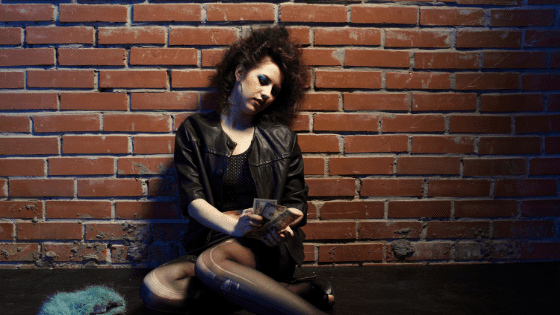
    Our Lady centers on Ginny Kurva, the bottom girl (a sort of fixer) for a group of prostitutes living at the seedy (and aptly named) Misanthrope. Having maneuvered her way into a position of influence with a grotesque pimp known as the Colonel, Ginny is able to care for her younger sister (wheelchair user Tricia) and run a type of school for the Colonel’s hookers, even as Ginny herself is subject to the pain and degradation inflicted by the life.

    Ginny has also struck up a friendship of sorts with horror-film fanatic Roger Neiderman, who tips her off to a predator stalking girls on the Deuce. We learn that the predator, assumed male, is in fact Nicolette, who works at the Staten Island Landfill by day and creates there a kind of killer-dog-prowled, Thunderdome-esque labyrinth by night, with Nicolette the Minotaur at its heart.

    As Ginny sinks deeper into alcohol-fueled self-care and is pushed to the breaking point, she nears a confrontation with both the Colonel and Nicolette, with the stakes being any hope for the future, should she even survive.

    But is it horror?

    Even as a horror fan, this is a question that usually doesn’t excite me. Yes, it’s somewhat annoying when people take the tack that anything skillfully enough realized cannot possibly be horror (Silence of the Lambs a prominent example), but I largely block out that noise. In many ways horror is the most inclusive of genres, and people who can only cast it in a restricted light are doing themselves a disservice.

    Still, I have seen people questioning whether Our Lady is horror, so I suppose it’s worth addressing. The novel doesn’t have supernatural elements, and the author doesn’t employ jump-scare-like tactics to frighten the reader. Fassel also leans on character over plot, with big issues much on his mind (the case of course with so much good horror), so those with an aversion to anything remotely literary might get nervous.

    But, as mentioned, horror references abound, specifically to films of the era, and the gore comes in sharp spikes. If you look at elements that horror must have, you can see that the book contains an attack by a monster (Nicolette), a speech in praise of the monster, a labyrinth, and a scene with the hero (Ginny) at the mercy of the monster.

    Our Lady also has a consistently bleak tone. The book is horror enough for me, but you can debate that to your heart’s content.

    The Verdict

    Fassel is one hell of a writer, and Our Lady of the Inferno is an extraordinary novel drenched in an eighties atmosphere both more true and less sanitized than many are accustomed to. The real horrors here lie in botched abortions, hopeless servitude, and the kind of arrangements one brokers with oneself to get by — and to care for those they love.

    If I have any quibbles it’s that Nicolette, in comparison with Ginny, feels underdeveloped, and the confrontation between the two is pushed so late into the novel that one might wish it had a little more room to breathe.

    But those are minor complaints, and Our Lady lives up to its place as the first book in the Fangoria Presents line, which continues with My Pet Serial Killer by Michael J. Seidlinger and Carnivorous Lunar Activities by Max Booth III. I’m looking forward to both and happy to have Our Lady on my bookshelf.

    (Fassel had apparently done a signing the week before at the store where I bought the book, so I was also lucky enough to unknowingly snag a signed copy.)