Tag: ACES

  • Continuity, Part 1: Continuity Issues and Why They Pose Problems

    Continuity, Part 1: Continuity Issues and Why They Pose Problems

    “Only by thoughtful concentration on details can fiction be satisfactorily edited.”

    Words into Type

    [On April 4, 2025, I presented “The Case of Ever-Changing Eye Color: Tracking Continuity in Manuscripts” to a live audience at ACES 2025 in Salt Lake City. This series of posts is largely based on that presentation.]

    What Are Continuity Issues?

    Continuity issues refer to discrepancies among details an author has provided in their manuscript.

    Usually these issues relate to physical character traits, nonphysical character traits, plot events, and matters of time, place, and distance.

    When the author provides information about a character, that information should be consistent throughout the manuscript unless there’s a good reason (a character’s hair might change color because they’ve dyed it).

    Discrepancies in the passage of time, the physical properties of setting, and the distance between settings (and the time it would take to travel between places) all present innumerable opportunities to introduce continuity issues.

    Continuity issues are present when the reader asks questions such as the following:

    • Didn’t this character have blue eyes in chapter 3?
    • How is it Saturday when four days have passed since Thursday?
    • How did this character just enter the room when they were already in the room?

    Continuity issues may occur within scenes, across scenes and chapters, and across books in a series. So copy editors face a daunting task when helping authors maintain good, uninterrupted continuity in their stories.

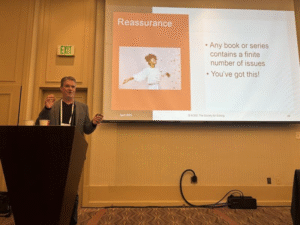
    James Gallagher speaking behind a lectern at ACES 2025 in Salt Lake City

    Why Are Continuity Issues a Problem?

    Readers are savvy at picking up continuity issues—and they often aren’t shy about sharing them online. So it’s well worth it for authors and editors to do what they can to address continuity before a book makes its way into the world.

    Continuity gaffes can do the following:

    • Break the spell of an author’s storytelling and take the reader out of the work.
    • Diminish author authority and lessen the reader’s faith in the author.
    • Weaken the story.

    Depending on the reader and the magnitude of the continuity issue, reader response might range from indifference to mild amusement to slight irritation to a refusal to finish the book.

    For the author, the response might be embarrassment, awareness that they’ve taken a hit to their reputation, or irritation with their editor for not catching the issue.

    For the editor, the response might be mortification (no one is harder on the editor than that editor), awareness that they’ve taken a hit to their reputation, and even fear that they could lose their client.

    Next time we’ll look at why continuity issues occur, and we’ll explore how we can prevent them.

    Note: Presenting a session on continuity live and in person to a room of editors at a national conference is something I’ll never forget. Organizations such as ACES: The Society for Editing provide learning opportunities and access to an inspiring community of editors.

  • Training and Its Many Benefits

    Training and Its Many Benefits

    Professional associations such as the Editorial Freelancers Association (EFA) and ACES: The Society for Editing offer many resources that help editors excel in their work and run successful businesses.

    I particularly appreciate the access to quality training provided by these organizations, which offer courses at discounted fees to members. 

    Courses are generally either learn-at-your-own-pace (where you’re given access to the materials for a set period, typically six months) or instructor led (in which instructors deliver training materials each week for a designated stretch, providing students with weekly feedback on graded assignments).

    The EFA and ACES have also made free webinars available to members during the pandemic.

    The benefits of training are many:

    • Refresh your knowledge
    • Stay current with trends in the profession
    • Expand your editorial offerings
    • Get feedback from world-class professionals
    • Meet other editing professionals
    • Reinvigorate your enthusiasm for the profession
    • Fill gaps in your schedule in a positive way 


    Refresh your knowledge

    Most editing skills are picked up through hard-earned experience, and basic courses may seem below your current skill level. But even 101-type courses can fill a gap in your knowledge or cause you to rethink an aspect of your editing business.

    Stay current with trends in the profession

    Language is always changing, along with electronic tools, editing trends, and publisher requirements. Continued training keeps you current and enables you to incorporate new tools and fine-tune your processes.

    Expand your editorial offerings

    Proofreading is very different from copy editing, and copy editing is different from line editing, and line editing is different from developmental editing. Training lets you get your feet wet in new areas under the guidance of a seasoned professional.

    Get feedback from world-class professionals

    Your instructors are generally respected members of the editing community (and in my experience they care deeply both about the profession and about helping others). Learning from the best is never a bad idea.

    Meet other editing professionals

    Most classes contain forums where you can meet your classmates and learn from those at all levels. The editing community is wide and welcoming, and the fellow editors you meet will prove invaluable for sharing both knowledge and work opportunities.

    Reinvigorate your enthusiasm for the profession

    Learning something new almost always fires you with enthusiasm for putting your knowledge into practice. It’s easy to get caught up in the grind of job after job, and stepping back for a moment can remind you of what you love about editing.

    Fill gaps in your schedule in a positive way 

    For those running their own businesses, any downtime between jobs can feel like lost time and fill you with anxiety. Though there is never a shortage of marketing, accounting, or other nonediting work to tackle, training is a particularly satisfying way to bridge gaps between jobs.


    The following is a selection of courses I’ve taken from my professional organizations (and from the amazing Jennifer Lawler):

    Copyediting: Beginning (EFA)

    Copyediting: Intermediate (EFA)

    Copyediting: Advanced (EFA)

    Developmental Editing of Fiction: Beginning (EFA)

    Developmental Editing of Fiction: Intermediate (EFA)

    Developmental Editing of Mystery, Thriller, Suspense (Jennifer Lawler)

    Editing the Romance (Jennifer Lawler)

    Essentials of Conflict (Jennifer Lawler)

    Truby’s Masters Studio: Horror, Sci-Fi, and Fantasy (Audio)

    How to Edit Marketing Materials with Savvy and Sense (ACES/Poynter)

    The Art and Science of Editing (ACES/Poynter)

    The Web’s Best Editing Resources (ACES/Poynter)

    Language Primer: Basics of Grammar, Punctuation and Word Use (ACES/Poynter)

    Writing Online Headlines: SEO and Beyond (ACES/Poynter)

    Getting It Right: Accuracy and Verification in the Digital Age (ACES/Poynter)

    Fundamentals of Editing (ACES/Poynter)

    Clarity Is Key: Making Writing Clean and Concise (ACES/Poynter)

  • Staying Connected during Isolation

    Staying Connected during Isolation

    Isolating in our homes during the COVID-19 pandemic has undoubtedly increased the amount of time we’re spending in virtual spaces for business, pleasure, and education. 

    Before the pandemic, I had weekly meetings with clients on Google Hangouts and Skype, but since the shelter-in-place guidance I’ve seen a big increase in meetings via Zoom (not to mention sessions with friends and family on Houseparty).

    I’ve also participated in more online collaboration on Miro, and it’s hard to imagine that virtual collaboration will do anything but increase — whether or not we return to something approaching our old normal. 

    The following fun and informative offerings have popped up in recent weeks:


    That Word Chat with Mark Allen

    Former newspaper reporter and longtime copy editor Mark Allen (@EditorMark) has launched That Word Chat on Zoom. 

    Described as a “video chat with lovers of all things lexical,” the episodes air Tuesdays at 4:30 p.m. ET. The first episode featured a conversation with Mary Norris, the author of Between You & Me: Confessions of a Comma Queen and Greek to Me: Adventures of the Comma Queen.

    During the first episode, I looked from attendee to attendee and was struck by the number of respected editors in the virtual room — a real who’s who of Editor Twitter. It felt good to hang for a bit with these great editors.

    The second episode welcomed Word by Word: The Secret Life of Dictionaries author Kory Stamper and Steve Kleinedler, author of Is English Changing? At one point, the two took word suggestions and wrote on-the-fly definitions. 

    Though they made clear that coming up with definitions off the top of their heads was far from the real dictionary-writing process, it was still fascinating to get a glimpse of how they think — and it was also a lot of fun.


    Sentence Diagramming with Ellen Jovin

    Known on Twitter for her traveling Grammar Table, Ellen Jovin (@GrammarTable) has launched a series of classes on sentence diagramming.

    Whatever your reaction to sentence diagramming — be it a quizzical Huh? or a nostalgic Oh yes, I remember doing that — the first two classes have been a blast, and I look forward to the third.

    (I remember sentence diagramming from grade school nearly four decades ago and haven’t thought about it a lot since, so I’ve greatly enjoyed the creativity of drawing out sentences with a group of fellow editors.)


    ACES and EFA Webinars

    I value my memberships in ACES: The Society for Editors and the Editorial Freelancers Association (EFA), and both have offered free webinars to members during the pandemic (with ACES offering free webinars to nonmembers as well).

    Whether for learning something new or reinforcing knowledge, ongoing education is an important part of being an editor who provides the best possible service to clients. 

    I also find it can be a boost to mental health, because it feels like such a productive use of time (and while I’ve been lucky to maintain steady work during the crisis, the uncertainty around book publishing is just one of many stressors in this new world).


    ACES Annual Conference

    For many, ACES is almost synonymous with the organization’s annual convention, and I’ve been fortunate enough to attend past conventions in St. Petersburg, Portland, and Chicago.

    This year’s convention in Salt Lake City was canceled because of the pandemic, but ACES has scheduled a day of online sessions for May 1. Session topics include the following:

    • The Invention of the Modern American Dictionary with Peter Sokolowski, editor-at-large, Merriam-Webster
    • Grammar Arcana with Lisa McLendon, coordinator of the Bremner Editing Center at University of Kansas
    • Developing a Quality Editorial Process End-to-End with Samantha Enslen, president, Dragonfly Editorial, and Cynthia Williams, editor and project manager, Dragonfly Editorial
    • What’s New in the AP Stylebook with Paula Froke, lead editor, AP Stylebook, and Colleen Newvine, product manager, AP Stylebook


    I’m looking forward to these sessions and am grateful that the people at ACES have done what they can to replace their beloved convention.


    Evident Ink with Nancy Smay

    In addition to serving clients through Castle Walls Editing, I edit romance as a guest editor through editor Nancy Smay’s company Evident Ink, and I am happy to report that Nancy has launched a wonderful series of free live video sessions on Facebook (https://www.facebook.com/EvidentInk/). 

    Nancy welcomes new guests every week, with upcoming sessions including topics such as boosting your writing productivity and using tropes in fiction. The classes take place on Thursdays at 4:30 p.m. ET and are well worth checking out.


    Corona Con

    Because of the cancellation of the Scares That Care horror convention in Wisconsin, author Kelli Owen led the charge to put together a live stream replacement con on April 18.

    Guests included Jonathan Janz, Kelli Owen, Brian Keene, Mary SanGiovanni, Robert Ford, Tim Meyer, Matt Hayward, Wes Southard, Somer Canon, Wile E. Young, Stephen Kozeniewski, Aaron Dries, Bracken MacLeod, and moderators Sadie Hartman (MotherHorror of Nightworms), Bob Pastorella (This Is Horror), Steve Pattee (Horror DNA), and Shane Keene (Ink Heist).

    A link to the day’s events can be found here: 

    https://www.youtube.com/watch?v=GDnXscKJ4nY&feature=youtu.be

    All the sessions are worth watching, but the Jonathan Janz reading stands out as perhaps the day’s biggest bring-down-the-house moment. Reading from his forthcoming work The Raven, Janz delivered a master class in live reading.

  • Writing Sprints for NaNoWriMo and Beyond

    Writing Sprints for NaNoWriMo and Beyond

    National Novel Writing Month (NaNoWriMo) is fast approaching, and many writers are biting their nails hoping they can find the time to pound out 50,000 words in November.

    “Not enough time” is a constant refrain among hopeful writers — and an understandable one. Day jobs, family, friends, chores, outside-of-work appointments, life(!) all come between writers and actual, honest-to-God, sitting-down-at-your-computer writing.

    But a piece of advice you’ll hear again and again from successful writers is that writers write. No one has the time, but if you really want to write, you’ll find the time. You’ll make the time.

    Sprints are one way you can do this.

    WHAT IS A SPRINT?

    If you’re familiar with the business world, you’ve probably heard about Agile and Scrum and Scrum sprints, or timeboxed activities that take place over a short time (usually a month) with a clear goal. Sprints help businesses stay on task, cope with change, and deliver better products.

    For our purposes, especially if words like deliverables and iterative processes put you to sleep, sprints are short bursts of a single, uninterrupted activity.

    You might sit down and write for half an hour, take a break, and then conduct another sprint. People also join group sprints through social media, the camaraderie adding further incentive to meet your writing goals.

    BENEFITS OF SPRINTS

    The following are ways sprints can help you during NaNoWriMo and beyond.

    You accomplish a short-term goal. Micro habits are small, achievable tasks you can do every day to give you a sense of accomplishment, which in turn increases your ability to tackle larger projects. Even making your bed in the morning lets you tick an item off your to-do list and feel better about the day’s challenges.

    Lack of confidence is a barrier writers struggle with. No one can write a novel. I mean, come on. It’s too big a task. Too daunting. But you can write for half an hour. You can pound out 500 words. And if you do this again and again, you’ve written a novel without being crushed under the enormity of mentally tackling the whole thing at once.

    You separate yourself from distractions. Writers are great procrastinators. Let’s face it: writing is hard. It requires discipline and facing our own fears. You can’t hide from yourself on the page.

    Writing is something many writers feel they were meant to do, something they feel is their calling, perhaps even the most important thing they’ll ever do. That’s a lot of pressure, and it’s easy to shy away from it. You can’t fail if you don’t try.

    But you also can’t succeed.

    Our world also presents us with more distractions than ever. (Is your Twitter feed calling?) Sprints make you block all that out, at least for the duration of the sprint. You don’t check email, Facebook, or Twitter. You don’t answer your phone. You ignore the kids. You do what you have to do.

    You instill discipline into your writing routine. Muscles develop day-by-day with exercise, and the more you exercise, the better shape you find yourself in. Your brain benefits from exercise too.

    The more writing sprints you run, the more you train your brain to jump quickly into writing mode.

    People who have trouble sleeping are told to make the bed a place for sleep only, so your mind associates it only with sleep and will therefore slip into sleep mode faster when you crawl under the sheets. Writing sprints help you do something similar when sitting down at your computer.

    You send a clear message to those around you. Has anyone ever struck up a conversation with you while you’re reading in a public place? I always feel like the person sees you reading and thinks, Oh, God, they’re reading. What a terrible fate! I better go rescue them! It’s infuriating.

    Family and friends can do the same thing while you’re writing. Hanging up your DO NOT DISTURB sign or doing whatever it takes to tell friends and family that you’re writing for the next hour (or half hour, or whatever the duration of your sprint is) helps create that space.

    Specifying a definitive amount of time also helps wall this time off, because it prevents the “as good a time as any” approach to interrupting that someone can take if there are no definitive boundaries around your time.

    WHAT ARE THE KEYS TO A SUCCESSFUL SPRINT?

    You can do a few things to get the most out of your sprints.

    Prepare. The most important thing is to work steadily and productively through the sprint. If you sit down and write nothing, you haven’t made it out of the starting blocks.

    For NaNoWriMo, you can outline your novel ahead of time (but it’s almost November and the clock is ticking!). Another trick is always ending your writing session before the end of a scene, so in the next writing session you can pick right up where you left off.

    In your free moments (washing dishes, driving home from work, conducting brain surgery), think about what you’re going to write. This prevents you from having no idea where you’re going when you sit at the computer or take out your notebook and pen.

    Commit. The busiest time of the year at any gym is usually right after New Year’s. Everyone is packing the place and is committed to New Year’s resolutions to exercise more. But check out the same gym in mid February and count the tumbleweeds blowing by.

    You have to commit to your sprints and make them productive. With NaNoWriMo, it’s easy to start strong but end up jumping ship when fatigue sets in. So the depth of your commitment will be tried.

    NaNoWriMo provides great progress reports, and that “words per day to finish” feature can help or hurt your confidence. So try to come out of the gates quickly to keep that number as low as possible. And then use sprints to manage your one-day-at-a-time approach.

    Communicate. As we talked about above, those around you can both support and hinder your writing efforts, and many times this is well meaning or unintentional. Someone who doesn’t write may want to help but end up invading your mental space.

    So it’s important to set your time boundaries and enforce your do-not-disturb policy. And then be exceedingly kind to the people who enable your writing by watching your kids, giving you that space, or providing any of the other kindnesses and allowances loved ones make for this demanding endeavor.

    ARE EDITING SPRINTS GOOD OR BAD?

    I’ve seen more and more talk online about editing sprints, which follow the same concept. A fairly recent ACES: The Society for Editing chat even centered on this topic, and a lot of great editors extolled the virtues of editing sprints for tackling their work.

    I like the sentiment. It’s hard to argue that an uninterrupted period of activity is bad for editing. There’s no doubt that ignoring email or social media while editing is a good thing, but I also feel like this should go without saying.

    More than anything, though, I don’t like the word sprint associated with editing. With writing, it’s often important to get that first draft on the page at any cost. But editing needs to be slow and methodical — never a frantic, rushed activity.

    So while I think the idea of an editing sprint is a good one, I don’t like the word in this context, and I would prefer editors use it for admin tasks or some other activity that doesn’t require the slow, methodical mindset.

    When I worked at the audiobook company Recorded Books, we proofed thousands and thousands of audiobook covers. The covers came fast and furious, and there was always temptation to rush to handle the workload.

    So I put together a sheet of Editing Rules of the Road, with the first rule being to “Slow Down!” When it comes to editing, this is always good advice.

    ABOUT JAMES GALLAGHER

    ACES and EFA member James Gallagher is owner/editor at Castle Walls Editing. If you’re in need of copyediting, send a message through the contact form on this site or email James at James@castlewallsediting.com.

  • Taking the Plunge: Running an Editing Business

    Taking the Plunge: Running an Editing Business

    Last Wednesday I said my goodbyes as senior editor at Recorded Books and embarked on a new life running an editing business.

    Even after fourteen years with a company I love . . .

    Even after forming personal and professional relationships I hope will continue indefinitely . . .

    Even after spending nearly a third of my life as a Recorded Books employee . . .

    Even after all that, those first steps into my new endeavor felt . . .

    EXHILARATING!

    Me earlier this summer, jumping right in

    What I Accomplished

    I’m happy with my time at Recorded Books and happy to have left on my terms, with no regrets. The company sells mostly to libraries, and I’ve always felt that my late grandmother, a fixture in her local library, would have been proud of me for serving that market.

    The sun has set on my time at Recorded Books

    Of all the projects I tackled while working for the world’s premier audiobook company, these are a few of my favorites:

    • Shepherding large-print books from art acquisition to typesetting to cover creation to proofreading and printing.
    • Editing the guidebooks that accompanied the Modern Scholar series of university lectures.
    • Proofing A Prairie Home Companion Pretty Good Joke Book.
    • Writing jacket copy for hundreds and hundreds of audiobook covers.
    • Crafting catalog copy (the ability to write in small spaces is a useful tool!).
    • Creating text for marketing materials, press releases, and web pages.
    • Writing and editing materials for children’s reading programs.

    Then there was the day I picked up the phone and found film producer Robert Evans (Rosemary’s Baby, The Godfather, Chinatown) on the other end. We were publishing his autobiography (The Kid Stays in the Picture) and he wanted extra copies of the large-print edition.

    So that’s how I found myself having a nice chat with one of Hollywood’s most legendary figures.

    Pretty cool.

    Running a Business v. Freelancing Full-Time

    Notice above that I said “running an editing business” rather than “freelancing full-time,” a thought voiced just this past weekend by respected editor Dick Margulis (of Dick Margulis Creative Services) at Communication Central’s Be a Better Freelancer conference.

    Despite freelancer being in the name of the conference, the thought is that freelancer evokes someone dabbling in the work, perhaps on weekends, while a person running a business is fully invested and wholly dedicated to the craft.

    The terminology sends a message to clients, and, perhaps equally as important, it sends a message to the business owners themselves and sets the tone for how they project themselves to the world.

    And, yes, I left my in-office gig on Wednesday, traveled Thursday, and attended the conference on Friday and Saturday. The conference came at an opportune time, to be sure!

    The conference was everything I hoped it would be: packed with helpful new tricks for marketing yourself, mastering Word, editing proposals, writing contracts, and assembling epubs. I would highly recommend it, and Ruth E. “I can write about anything!” Thaler-Carter did a hell of a job organizing the event.

    Bonus: I also stopped by Niagara Falls before heading home to begin my new life. Spectacular.

    Three Reasons I Started My Own Business

    Lists of reasons to go it on your own (or not) are everywhere, but here are my big three:

    My Work
    I can’t complain about the experience I gained in the office, and I enjoyed working on such a wide variety of projects, but at some point I felt the need to go after my own work. I love to edit, and I love horror fiction, and more than anything I hunger to pore over horror and dark fiction manuscripts. I also enjoy literary fiction, other genres, and even corporate work, but horror has been my jam since I first encountered Stephen King and Clive Barker thirty-some years ago.

    My Schedule
    For personal reasons, I’m going to be splitting time between Maryland and Dallas, not an easy thing when you need to be in the office five days a week. I also crave the thrill of waking up every day and thinking, “What do I need to do?” Balancing the work itself with marketing and accounting and all other aspects of the business can be overwhelming, but what a charge!

    My Life
    Running my own business has always been a dream, and I’m going for it, aiming to accomplish my editing goals, my writing goals, my life goals. At twenty, my son is now older than my sister was when she died. At forty-six, I’m now older than my mother was when she died. So I’m not convinced there’s a safe path through this life. Risks abound, but so do the rewards.

    Three Lessons I’ve Learned from the Experience

    As much information is out there on starting your business as there are reasons for doing so, but these are three lessons I found especially helpful:

    Lay the Groundwork
    I’ve done freelance work with my company for quite a while, so that was a tremendous help when making the jump. But with a full-time gig, not to mention two children, the time for that work was limited. Still, getting comfortable carrying out freelance work greases the skids, as does having at least a few clients who can help pay the bills while you establish yourself.

    Being as involved as possible in the greater editing community is also reassuring. A host of good editors are available to follow on social media, and joining the American Copy Editors Society (ACES) and the Editorial Freelancers Association (EFA), as well as attending ACES and other conventions, helps place you in that community.

    Exit Gracefully
    This was an easy one. People often cite office politics as one of the main reasons for going it on their own, but I genuinely liked and respected my coworkers. Those politics did exist on some level, but I was able to form cherished, lasting relationships. So no burned bridges, and as paths continue to cross, my former office mates and I can continue to help each other in any number of ways.

    Manage Expectations
    We all want to take the world by storm, but this rarely happens overnight. Running my own business is likely to put me in feast-and-famine cycles. I hope there’s always plenty of work to keep my business humming, but if not, there are a million things I can do to market myself, learn new skills, or interact with and help colleagues.

    Parting Thought

    Before I left the office for the last time, the director of the publications department (a great friend) gave me this card, along with a touching message inside. I think this says it all.