Category: Uncategorized

  • Four on the Floor with Writer/Producer/Director Al Gough

    Four on the Floor with Writer/Producer/Director Al Gough

    Alfred Gough III (@TheRealAlGough) is half of the prolific Alfred Gough-Miles Millar writing/producing team. Having achieved success with properties as diverse as Spider-Man 2Lethal Weapon 4SmallvilleInto the Badlands, and The Shannara Chronicles, Al has ranged far from the quiet streets of his hometown of Leonardtown, Maryland.

    I grew up in that same town and was lucky enough to spend a good portion of my childhood running elaborate Star Wars battles with Al, whose creative savvy was already coming to the fore.

    A little known fact about both our lives is that Al gave me my first job, passing on his gig selling peaches outside the Ben Franklin five-and-dime store.

    Al, you’ve come a hell of a long way! Now on to the interview:
     

    You wear a lot of hats (creator/showrunner/executive producer/writer). Which is your favorite?

    That’s a great question! When my partner and I are writing movies, we miss television, and vice versa when we are knee-deep in a new season. I would say creator and writer are my favorites because that’s the time when the idea and the story and the script are all yours. We don’t have to worry about budgets and network notes and production issues. It’s the time when the potential seems limitless.

    What is your writing routine and what are the benefits and challenges of having a writing partner?

    Miles Millar (my partner) and I have been writing together for 23 years. We’ve always treated it like a job—meaning we would write from 9 a.m. to 7 p.m. every day. And when we started out, we would write seven days a week. 

    Now, as the years have gone by and we have families, we’ve amended that to five days a week. The last few years, with both The Shannara Chronicles and Into the Badlands shooting on opposite sides of the world (Auckland and Dublin, respectively), with our writers’ rooms in LA and post-production in Toronto, we have evolved our process. Thank God for the internet, Skype and email! 

    I have only seen benefits in writing with a partner. First and foremost, we are friends who have always seen eye-to-eye creatively. It’s also nice to have someone who’s got your back in this crazy business!

    How scary is it to jump into an already established franchise or series?

    The challenges of tackling an established character or franchise are twofold—bringing a fresh point of view to the material and dealing with the fact that you can’t satisfy every fan of the source material (whether it is a comic book character or novel series). 

    The important thing to remember is that you need to honor the spirit of the source material while bringing something new to the table. We certainly found this on Smallville, where we had fans of Superman who thought we’d gone too far. But now, 17 years later, the show is considered canon. I guess one generation’s heresy is another’s gospel!

    Authors put faith in me to help cultivate their darlings. How protective are you of your work? At what point do you cede ownership of the work to other creative parties and to the audience?

    The thing about film and television that you learn early—you can’t be precious. They are both team sports. Both require a large amount of people and a large financial investment to get off the ground. 

    Again, the trick is being able to take good, constructive criticism while still sticking to your creative vision for the show.

    Also, once a movie or TV show is out in the world, it doesn’t belong to you anymore. It belongs to the people who watch it and love it and put their own emotional stamp on it. They are your fans. They are the ones sitting around the proverbial campfire listening to your story and making it their own.  

    That is actually a deeply satisfying part of doing this—when I hear from people that a show or movie we did helped get them through a tough time or was one of their favorites from childhood.

    That experience is what makes it all worthwhile.

  • Book Pick: ‘Do I Make Myself Clear?’ by Harold Evans

    Book Pick: ‘Do I Make Myself Clear?’ by Harold Evans

    Too often people perceive the work of editors as so much pedantry or needless fussiness.

    But editors help authors communicate to their audience, and, as Harold Evans demonstrates in Do I Make Myself Clear? Why Writing Well Matters, writing well does matter—and sometimes it even saves lives.


    [bctt tweet=”“Words have consequences.”—Harold Evans, author of DO I MAKE MYSELF CLEAR?” username=”CastleWallsEdit”]


    Emotional Response

    I did not expect to react emotionally to a book about writing clearly, but I did.

    Twice, in fact.

    In the chapter “Money and Words,” Evans looks at how the words customer convenience led to deaths because of an auto company’s internal language about faulty ignition switches. I lost two people I love to a car accident, so the subject will always expose raw emotions.

    Words do indeed have consequences. Careless language will not always have devastating results, but easily understandable text touches lives in myriad ways, whether helping people decide on political candidates or choosing new home appliances or almost anything else you can imagine.

    The second emotional response was to Evans’s observations on “The Weasel, Twelve Monkeys and the Shrub,” David Foster Wallace’s 2008 Rolling Stone article about John McCain.

    Evans details how Wallace’s account of McCain’s time as a prisoner of war in Vietnam transmitted that experience in a way no other account had. Evans describes Wallace’s language as “prose with the frost off,” and he points out the techniques, such as asking questions, that make the piece so effective.

    My emotional response came both from the secondhand transference of the power of Wallace’s writing and from my knowledge of Wallace’s suicide, which is always difficult for me to process.

    Why Listen to Evans?

    A former editor for the Sunday Times and the Times (London), Evans holds the British Gold Award for Lifetime Achievement in Journalism and was voted by his peers as the all-time greatest British newspaper editor.

    Methinks he knows of what he speaks.

    Evans’s Approach

    Evans divides the book into three main sections: “Tools of the Trade,” “Finishing the Job,” and “Consequences.”

    Throughout, Evans breaks down pieces of writing and offers suggestions on how to rework text for clarity. As an editor, it’s thrilling to look over the shoulder of a master and take in the process.

    And when I say “breaks down,” I mean it. Evans tears apart writing and shows the reader exactly what he’s doing, why he’s doing it, and how the text sings afterward.

    At one point Evans even—gasp!—takes on Jane Austen.

    Clear as Mud

    Clear writing is always the goal, right?

    Not for the “mistakes have been made” crowd.

    Evans addresses writing whose intent is to obfuscate, and politicians are far from the only ones who don’t exactly want their meaning to be clear.

    For editors, this underscores the importance of working with authors to clarify (ahem) just what kind of editing is desired.

    With fiction, an author might feel like an editor has altered their voice or diminished the beauty of their language.

    In nonfiction or corporate work, a writer might feel like an editor has produced something that “sounds” less impressive (or exposed the fact that little has been said in the first place).

    My experience in corporate work has been that there are those who will do anything to prevent an editor from getting ahold of the work, and I believe this comes from the fear that editors will rewrite just for the sake of rewriting.

    This undoubtedly happens. But if editors are committed to helping authors, in any field, and if there’s adequate communication, then both parties should be able to enjoy a harmonious rather than contentious relationship.

    Readability

    Anyone who needs to write for reading level can benefit from Evans’s section on readability. In these pages, he discusses the following tools:

    • Flesch Reading Ease index
    • Flesch-Kincaid grade level
    • Dale-Chall formula
    • Gunning fog index

    Evans provides an evenhanded assessment of how these tools can help writers while also warning that the tools are blind to meaning and can’t address the thing writers must worry about most: placing “the right words in the right order.”

    Shortcuts

    In one chapter, Evans offers 10 shortcuts for making your writing clear, addressing active and passive voice, adjectives and adverbs, prepositions, and other such trouble spots.

    It’s the kind of chapter anyone can read out of context and walk away with a pocketful of valuable advice.

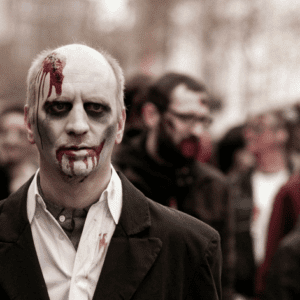
    Brains!

    In another chapter, Evans tackles zombies, flesh-eaters, and pleonasms.

    Also referred to as nominalizations, smothered verbs, or controverted verbs, zombies manifest themselves in nouns that have devoured verbs: implementation, authorization, etc.

    Evans offers a survival guide for dealing with them.

    Also plaguing the writing world is language that sucks the life out of text, and Evans provides a six-page list that helps deal with these flesh-eaters. A handy reference, the list is broken into flesh-eaters (“We are in receipt of”) and preferred usages (“We received”).

    On pleonasms (redundancies), Evans offers nine pages of examples, with italics indicating words that can be struck out (“complete monopoly”).

    He then ends the chapter with seven pages of cliches you want to avoid.

    In another chapter, Evans looks at word meanings that have become muddled over time, clarifying usage for words such as dilemma, entomb, and loan/lend.

    Bibliography

    One of the benefits of books on writing is that they reference other books on writing, so the bibliography serves as a good must-read list. Such is the case here, and readers will also want to check out the blog list for sites to keep tabs on.

    Final Take

    When copy editors at long-running institutions are losing jobs in the interest of the bottom line, this seems as good a time as any to remind the world that writing and editing matter.

    Evans does this, and he does it clearly.

  • The Five Stages of CMOS 16 Grief

    The Five Stages of CMOS 16 Grief

    The seventeenth edition of the Chicago Manual of Style will soon be in the hands of editors everywhere. The sixteenth edition was released way back in 2010, so you can’t blame Ol’ Sixteen for thinking its reign would last forever.

    Let’s check in on how it’s handling the transition (and you can click here for a history of the manual).

    Denial

    “I’m built to last, baby!”

    As Constance Hale wrote in Vex, Hex, Smash, Smooch, “Vocabulary is not all that changes in the linguistic melting pot. Punctuation changes. Spelling changes. Meaning changes. Even grammar changes.”

    Over the coming weeks, editors will be poring over Seventeen to see just what these changes entail. We were given some early teases: internet is being lowercased, email is losing the hyphen, hyphenation guidance in general is supposedly being relaxed a tad. We’re all eager to see what else is in store!

    [UPDATE: Click here for a more detailed look at the changes in the new edition.]

    Anger

    “Back off, man! I’m serious!”

    We can hardly blame Sixteen for being a little miffed. No one likes to be replaced, especially when you were held in such esteem, and it’s entirely natural to have a little resentment toward the new kid on the block.

    Editors also have to learn to deal with change, and this is helped tremendously by understanding that style is style, not an immutable set of laws, and all “rules” are subject to change.

    Bargaining

    “C’mon, I can change. I can lowercase internet!”

    It’s a done deal, Sixteen. You served us all well, but Seventeen is happening.

    I’m looking forward to the print copy. The online version of Chicago is really handy, but there’s nothing like having a big, thick, beautiful reference at your fingertips. That turning of pages, mixed with the anticipation of discovery, activates pleasure centers in the brain that no online search can replicate.

    Or maybe I’m just getting old!

    Depression

    “E-mail, email, whatever. Nothing matters anyway.”

    The fourteenth edition (1993) of the manual was my first, and somewhere along the way my copy’s book jacket went missing. I now look at the battered old thing with fondness and just a tinge of sadness. A lot has changed in my life since 1993. I’ve gained much and lost much as well. Life moves inexorably forward.

    Acceptance

    “It was bound to happen eventually. Good luck, Seventeen.”

    Someday Seventeen too will be replaced, and what a glorious thing it is to watch the marvelous march of language.

    Personally, professionally, I’m embracing change all over the place, and I’ll say this: it’s invigorating!


  • Gerunds at the Airport

    Gerunds at the Airport

    Last night, after dropping my girlfriend off at the airport, I sent her a text that included this sentence: “Don’t worry about me driving home” (her plane had been delayed, the hour had grown late, and she was afraid that I might be too tired to make the hour-and-a-half drive home).

    Spoiler alert: I’m fine.

    In the text, “me driving” is what is called a fused participle, and people are often unsure whether to use that construction or a possessive followed by a gerund (which in this case would be “my driving”).

    Helpful discussions on the matter can be found in the Chicago Manual of Style, Garner’s Modern English Usage, and Fowler’s Dictionary of Modern English Usage. (This is going to be a short post, my main point being that the matter here, while a relatively minor point, is worth investigating for those attempting to fine-tune their grammar).

    In my sentence, “me driving” follows a preposition. Looking to Chicago, we have this: “When the noun or pronoun follows a preposition, the possessive is usually optional.”

    If you’re worried about making the right choice, “usually” is often reassuring, because you can at least feel some measure of confidence that you’ll be able to make a good argument.

    The main consideration for choosing between a fused participle and a possessive plus gerund is usually (there’s that word again) whether the emphasis is on the noun/pronoun or the verb (action). In my case, I’d like to think that my girlfriend’s concern was all about me, and that shifting the emphasis to my driving would miss the mark.

    Perhaps if there had been another option, like flying a helicopter home, then “my driving” (as opposed to “my flying”) would have been the better choice.

    But as it is, I’m going to stick with the me-first approach!

  • Talk About Bleary Eyes

    While attending the George Washington University, I picked up extra scratch by proofreading patents for a law firm. Back in the early nineties, twelve dollars an hour seemed like a lot of money (though, being a college student, the firm might as well have sent my checks directly to the M Street bars).

    The gig entailed traditional proofreading, not the popularly held catch-all sense that can seemingly mean almost any kind of copy editing. The job was to proof already-printed patents against documents the law firm submitted to the Patent and Trademark Office (PTO). I worked as part of a two-person team, taking turns reading the office copy while the other proofreader followed along in the printed patent. (In practice, I followed along about 90 percent of the time. Yes, I had the more difficult task, and no, I didn’t make a cent more for my efforts!)

    If the patent had already been printed, you might wonder about the point of proofing it. Would the patent be reprinted? No, but if the clients, who were billed for our services, thought the change important enough, an errata sheet could be filed with the PTO and permanently attached to the patent.

    Lest you’re thinking, “Wow, you must have gotten a sneak peek at some crazy-cool inventions!,” I can assure you that wasn’t the case. These were chemical and electrical patents detailing processes for such things as substrate application for computer chips. The patents were highly technical, and their proofreading often involved the reading of long chemical strings and formulas, along with such text features as superscripts and subscripts.

    Wait a minute. This was college. Shouldn’t I have been out kidnapping the rival school’s goat?

    The work had to be done in the law firm because the firm, for obvious reasons, wouldn’t allow client files to leave the office. So my partner and I would steal into the office at odd hours (usually Saturday or Sunday mornings), grab the files, and find an empty conference room to spend the next six or so hours performing the incredibly tedious work.

    And the work was tedious, but I credit it for helping me develop the mental muscles that allow me to concentrate for long periods of time. It’s common for people to see an error in text and say, “How could an editor miss this?” But that question presumes that the editor has had that bit of text and only that bit of text laid before him or her, when these instances are usually missed not because editors aren’t capable of picking up a specific error, but because of a lapse of concentration during the course of a long day of editing.

    This is why frequent breaks are so important. When reading text, the mental red flags that go up when something is amiss might very well not be raised if the editor is fatigued. If tired, editors can easily read right over something that would jump out at them if they were fresher.

    I can now look at all the work I did proofreading patents as training for my editing career, but I suppose the training would only have done so much good if I didn’t love the work as well. Even when proofing materials that were largely impenetrable to me, I loved finding errors, and while some patents were fairly clean, any problem that could go wrong at some point inevitably did. Missing lines or even pages of text. Words run together. Even an innocently introduced case of profanity. (Yes, I once caught the f-word in a patent.)

    One of the fun parts of the job was that, because we did off-hours work, almost no one at the firm knew who we were. We felt a bit like secret agents Mission: Impossible–ing our way into the office, knocking out our work, and getting the hell out of Dodge.

    Or maybe that makes it sound a bit cooler than it actually was. Maybe you wouldn’t think there was much cool about a job that involved making sure every little syllable was correct in a word like dichlorodiphenyltrichloroethane. But I enjoyed it, and in many ways I miss the job that I will forever associate with a particular time in my life.

    [twitter-follow screen_name=’CastleWallsEdit’]


  • Mind the Gap

    Looking at the spaces between vertical railings on my friend’s just-built deck, I could only say, “This can’t adhere to any code.” The spaces were a good two feet apart, so any child under the age of six could easily walk right off the deck.

    Needless to say, my friend had words with her contractor.

    The existing railing might even have been worse than no railing at all, because the illusion of safety might have given a false sense of security, whereas if there were no railing whatsoever, people (presumably even children) would be afraid to go near the edge.

    Editing can be like that.

    I’ve noticed that the more professional the design, whether that means typesetting of the text or pictorial or illustrative elements surrounding the text, the more likely the editor is to have a false sense that everything is okay.

    It rarely is.

    I’ve seen good editors miss what should be obvious mistakes on book covers in part, I have to think, because the design looks so nice that it’s hard to believe there could be an error.

    A corollary is that editors can easily fail to fact-check something because of the thought that the writer intended a piece of information to be there and must know what he or she is talking about.

    Trust in editing is a dangerous thing, while skepticism more often than not saves the day.

    But editors should be skeptical of their own impulses as well. Before making any change, editors have to counter the little thrill of making a correction by asking themselves whether there’s any way that the original instance could in fact be correct. Young editors especially can be so fired up with confidence in their abilities that they introduce errors by misreading a usage and making a bad edit.

    So we have to always be skeptical of the text, of our writers, and, perhaps most particularly, of ourselves. As always, do no harm!

    And don’t go stepping off any decks, metaphorical ones or otherwise.  

    [twitter-follow screen_name=’CastleWallsEdit’]

  • A Big Nerd

    “You’re a big nerd, Dad.”

    That is what my daughter told me as we sat in folding chairs and waited for the reading / book signing to begin. But let me explain.

    My fourteen-year-old daughter and I had driven from Southern Maryland into Washington, DC, to attend an event featuring Kelly Link and Juan Martinez at the Politics & Prose bookstore. After enjoying a bite to eat in the store’s basement-level cafe, my daughter and I headed upstairs to grab a couple seats for the reading.

    While waiting for the event to begin, I took the opportunity to explain the singular they and its increasing acceptance. As any fourteen-year-old might, she then hit me with the abovementioned assessment of my coolness.

    And of course she was absolutely correct.

    All of that aside, we had a hell of a time at the reading. Nothing makes me more proud than my daughter’s love of books (if not the finer points of grammar), and I took great joy in introducing her to the works of Kelly Link (and being introduced to a new author myself, having been unfamiliar with Juan Martinez before the signing).

    A few notes from the evening:

    • Reading from her collection Get in Trouble, Link drew laughs with the line “Florida is California on a Troma budget.” As a fan of low-budget horror, I was glad to see so many people appreciated the reference!
    • When asked about their favorite rules to break, Link answered “show don’t tell,” while Martinez mentioned placing action on the page (employing, for instance, five pages of dialogue to power a story).
    • Link reported to be enjoying work on her novel, and both authors talked about how writing a novel, with more room to spread out, was in many ways easier than working on a short story. Both seemed to agree that the novel’s form is far more forgiving than that of the short story.

    All in all, the night in DC (with my daughter, two wonderful authors, and a good crowd at one of my favorite bookstores) was immensely enjoyable.

    Even if my daughter thinks I’m a big nerd.


  • Grief and the Present Tense

    Last week I was pleased to come across the following piece about the present perfect. Posted by Jiwon Lee in the ITBE Link quarterly newsletter, the article has played on my thoughts and prompted me to think about tense in a whole different way.

    A new way of teaching the English present perfect

    Most of us learned about perfect tenses in elementary school, and the past tense learned is probably appropriate here. The learning we’re talking about likely occurred in the past without subsequent, continued thought on the matter. But the reasons why we might in one instance choose the past tense (I went to the store) and in another instance choose the present perfect (I have gone to the store) are worth investigating.

    When we speak or write, we choose our words largely on feel (and with the idiomatic nature of English we’d likely drive ourselves crazy otherwise), so it’s no wonder we don’t spend an overwhelming amount of time questioning why we might decide unconsciously on one of two seemingly appropriate options.

    When we choose the past tense, however, we’re suggesting that something occurred and was isolated as an event in the past. But when we choose the present perfect, we’re suggesting that while something happened in the past, the effects of the action are still active in a circle of time surrounding the immediate present.

    In my life I’ve lost a large number of people I care for deeply, and of late I’ve been thinking much about grief and the grieving process. In the “going to the store” example above, I can easily understand someone not seeing much of a difference between “I went to the store” and “I have gone to the store.” But there is a subtle distinction, and it’s an important one.

    Think about the different connotations between “My friend died” and “My friend has died.” The former relegates the event completely to the past, whereas the latter suggests that the event occurred in the past but in a very real way is still occurring.

    As we come to terms with loss the actual effect might not be “My friend died” but rather “My friend has died and is dying and is dying and is dying” until we finally come to terms with and accept the fact of that death. The present perfect therefore implies a greater influence of a past event over the present, and as anyone who has lost someone knows, death has a way of shaping our sense of time in ways that are certainly felt, if not always completely understood.

  • Nobody Move, Nobody Get Hurt

    People love to correct other people’s grammar, spelling, and usage. What better way to establish superiority or to discredit someone’s argument! And that’s what it’s about, isn’t it? Feeling superior. Or more educated. Or just better. Never mind that a person’s opinion on a matter isn’t more or less valid because that person used an apostrophe improperly or didn’t recognize a difference between eager and anxious.

    I edit for a living. I spend most of my days trying to bring out the best in the text before me, but that doesn’t mean I’m rude. An editor can’t stop editing. Try going to a restaurant with one and see if he or she doesn’t point out a spelling error on the menu. That’s worlds different, though, from correcting someone’s speech, online or off, in a shameless attempt to pat oneself on the back.

    I believe that most people who obnoxiously correct another’s grammar don’t really care about the language but are simply grasping onto a means to run another down, but for people who do care about the language, I’d recommend John McWhorter’s Words on the Move: Why English Won’t—and Can’t—Sit Still (Like, Literally). (And I apologize for the long lead-in/rant.)

    In Words on the Move, McWhorter examines how language has changed through time. He shows readers how it is changing now and why it will always change, and he makes a convincing argument that this is a good thing.

    Still, language change is not going to go down easy for people who cringe when they hear someone say, “What’s the ask?” But even so, McWhorter at least reveals the mechanics behind inexplicable, or seemingly wrong, usages. Does pronouncing nuclear in a certain way (we’re looking at you, President Bush) make at least a little more sense if we understand that that pronunciation has been influenced by words such as spectacular and circular (that is, that an already existing pattern of word formation has resulted in an improper pronunciation)? Perhaps, perhaps not, but it does provide a fuller picture.

    Elsewhere, McWhorter talks about the Great Vowel Shift and shifts in pronunciation today, the oddness of the phrase “used to,” grammaticalization (great word!), and backshift, which explains why compound words like supermarket are pronounced superMARKET when new and SUPERmarket when their newness wears off.

    I understand that it feels good to rail against the way kids speak these days, but Words on the Move provides background and understanding that might make some hold their tongues.

  • ‘Before’ and ‘Ago’ in Fiction

    Does anyone distinguish between before and ago these days? Is anyone else bothered by the nearly ubiquitous use of ago in fiction?

    Take your standard third-person, past-tense narrative. Here a storyteller relates events occurring at some point in the past, and from the reader’s perspective, the storyteller is relating these events from the present, or at least the present associated with the time the book was written.

    So when the storyteller says something like “Stephen remembered the events that happened three days ago,” the word ago would be associated with the storyteller’s present (three days before the time period in which the storyteller is telling the story), whereas the word before would be associated with the timeline of the character in the story (three days before the events that are being narrated in the story).

    The word now is just as problematic, for the same reason, and when I come across it I usually find that the sentence would be just as sound if it were simply dropped.

    The prevalence of ago for before in fiction (and, of course, I’m just talking about the particular instances when it wouldn’t be appropriate) is such that I have to believe it doesn’t bother the majority of readers. I can easily imagine that most readers simply pass it by without raising an eyebrow (and, to be fair, readers know what the author means; the intent is almost never unclear). But it always takes me out of the narrative, if only for a moment.