Category: Uncategorized

  • Scene It First with Delancey Stewart, Marika Ray, Melanie Summers and Kelly Collins (Ep. 7)

    Scene It First with Delancey Stewart, Marika Ray, Melanie Summers and Kelly Collins (Ep. 7)

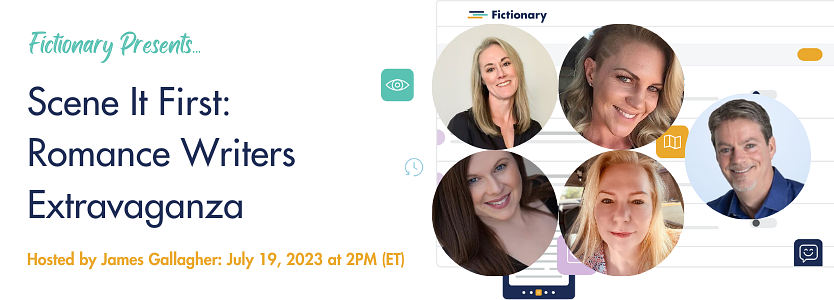
    On July 19, 2023, acclaimed romance authors Delancey Stewart, Marika Ray, Melanie Summers, and Kelly Collins joined me for the seventh episode of the Scene It First series, sponsored by Fictionary. In this series, I speak with bestselling, award-winning authors to talk about first scenes, share secrets of writing craft, and celebrate the stories that thrill and inspire us all.

    In this episode, we enjoyed a lively roundtable discussion of writing romance and of how these friends and writing partners each approach their craft. See more about each author below.

    Upcoming interviews can be joined live by registered members of the Fictionary community, and it’s always free to register.

    In addition to hosting the Scene It First series, James Gallagher is the owner of Castle Walls Editing, a Fictionary-Certified StoryCoach Editor, and the copy editor, developmental editor, or proofreader of more than 300 books.

    About Delancey Stewart

    USA Today bestselling author Delancey Stewart pens steamy, small-town rom-coms that run the gamut of settings and setups, but they always deliver humor, heart, and heat. It’s a guarantee.

    www.delanceystewart.com

    About Marika Ray

    Marika Ray is a USA Today bestselling author who writes steamy rom-coms to brighten your day. All her books come with a money-back guarantee you’ll laugh at least once with every story.

    www.marikaray.com

    About Melanie Summers

    Having sold more than a quarter of a million books around the globe, Melanie Summers has received a Silver Medal and two Bronze Medals at the Readers’ Favorite Awards in the Chick Lit Category.

    www.melaniesummersbooks.com

    About Kelly Collins

    The internationally bestselling author of over 30 novels, Kelly Collins incorporates real-life events to craft stories that lovers of contemporary romance, new adult, and romantic suspense will return to again and again.

    www.authorkellycollins.com

    About Fictionary

    Fictionary is a story-editing software that allows writers and editors to glean insights and perform developmental edits on their works using Fictionary’s 38 story elements for character, plot, and setting.

    The software also provides attractive visual reports, including the story arc (showing location of the inciting incident, plot point 1, midpoint, plot point 2, and climax), as well as reports illustrating such items as the story map, character list, and word count per scene.

    More information can be found at Fictionary.co.

    The Fictionary community can be found here (free to register).

  • Scene It First Interview with Deborah Halverson (Ep. 5)

    Scene It First Interview with Deborah Halverson (Ep. 5)

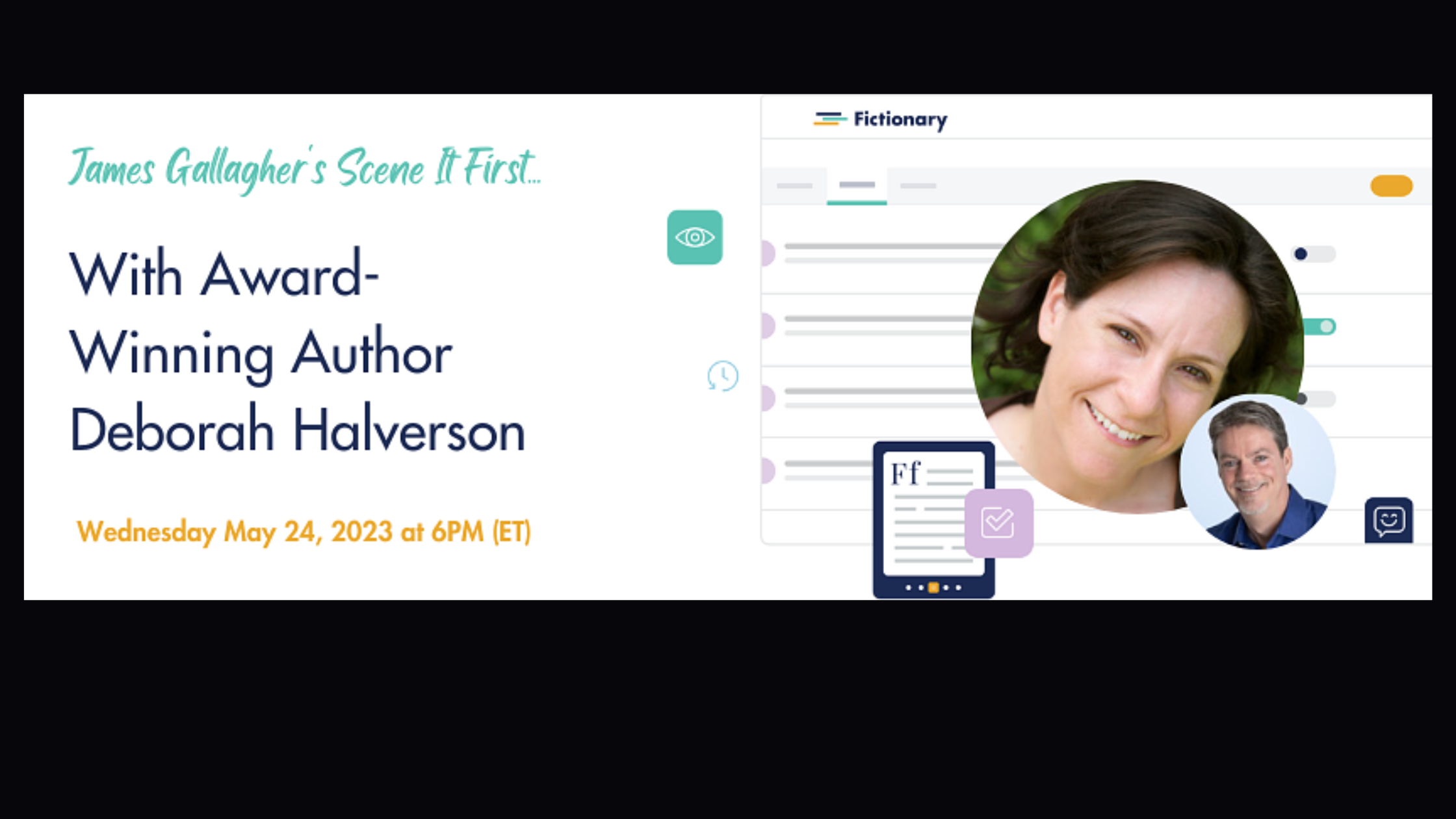
    On May 24, 2023, YA author Deborah Halverson joined me for the fifth episode of the Scene It First series, sponsored by Fictionary. In this series, I speak with bestselling, award-winning authors to talk about first scenes, share secrets of writing craft, and celebrate the stories that thrill and inspire us all.

    In this episode, Deborah talks about her book Writing Young Adult Fiction for Dummies and shares helpful insights on writing YA fiction. Later in the episode we look at the first scene from her novel Big Mouth and take questions from the audience.


    Upcoming interviews can be joined live by registered members of the Fictionary community, and it’s always free to register.

    In addition to hosting the Scene It First series, James Gallagher is the owner of Castle Walls Editing, a Fictionary-Certified StoryCoach Editor, and the copy editor of more than 250 books.

    About Deborah Halverson

    An editor at Harcourt Children’s Books for 10 years, Deborah is the author of Writing Young Adult Fiction for Dummies, Writing New Adult Fiction, the teen novels Honk If You Hate Me and Big Mouth, the picture book Letters to Santa, and three books in the Remix series for struggling readers.

    Armed with a master’s degree in American literature and a fascination with pop culture, she sculpts stories from extreme events and places—tattoo parlors, fast-food joints, and, perhaps most extreme of all, high schools.

    About Fictionary

    Fictionary is a story-editing software that allows writers and editors to glean insights and perform developmental edits on their works using Fictionary’s 38 story elements for character, plot, and setting.

    The software also provides attractive visual reports, including the story arc (showing location of the inciting incident, plot point 1, midpoint, plot point 2, and climax), as well as reports illustrating such items as the story map, character list, and word count per scene.

    More information can be found at Fictionary.co.

    The Fictionary community can be found here (free to register).

  • Scene It First Interview with Marshall J. Moore (Ep. 4)

    Scene It First Interview with Marshall J. Moore (Ep. 4)

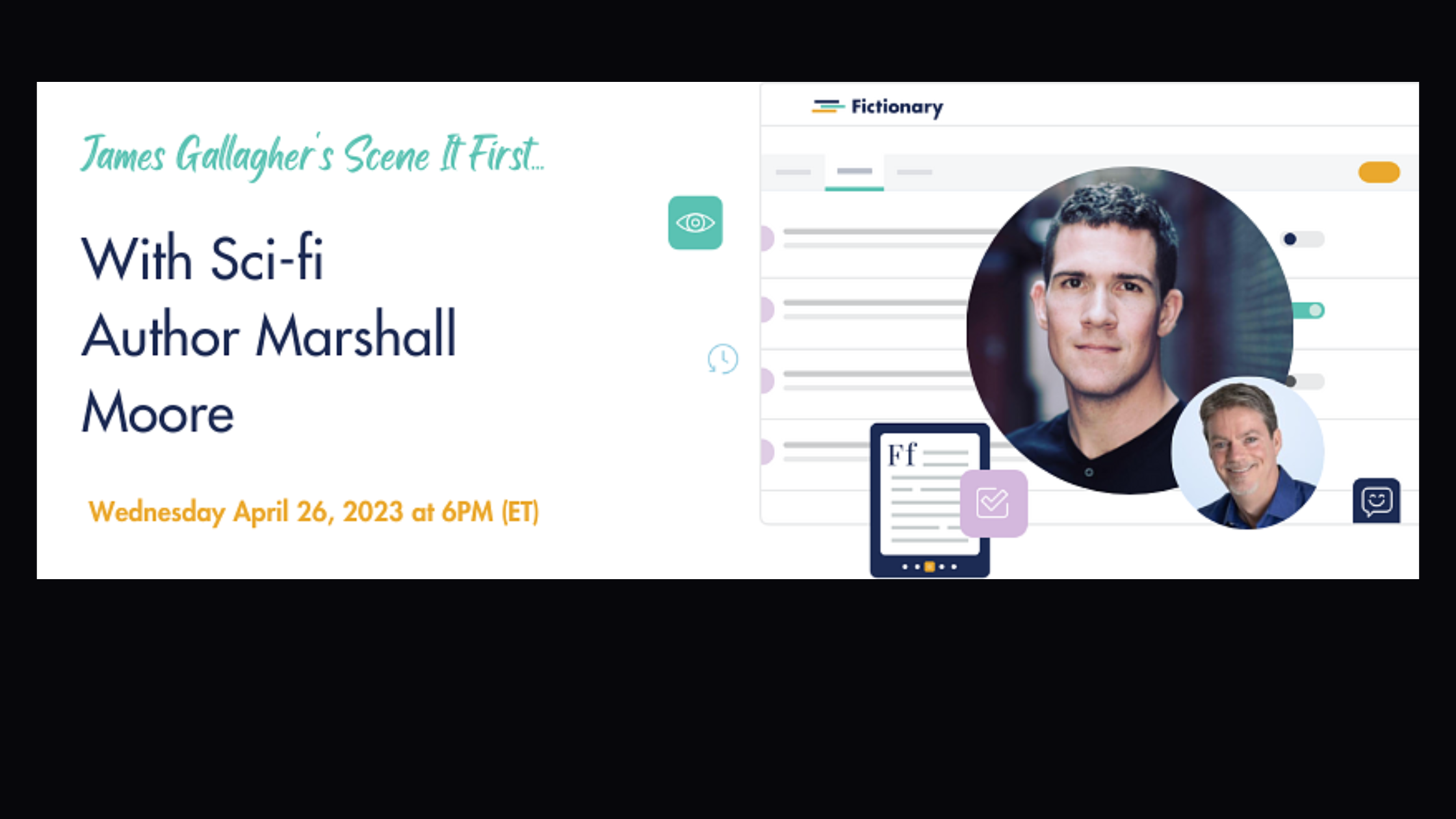
    On April 26, 2023, I was thrilled to welcome fantasy author Marshall J. Moore to the fourth episode of Fictionary‘s Scene It First series, in which we speak with bestselling, award-winning authors to talk about first scenes, share secrets of writing craft, and celebrate the stories that thrill and inspire us all.

    In this episode, Marshall talks about an encounter with Jackie Chan and his approach to writing fantasy, including his strategy for world-building and his incorporation of setting elements. Later in the episode we look at the first scene from his novel The Pale City and take questions from the audience.


    Upcoming interviews can be joined live by registered members of the Fictionary community, and it’s always free to register.

    In addition to hosting the Scene It First series, James Gallagher is the owner of Castle Walls Editing, a Fictionary-Certified StoryCoach Editor, and the copy editor of more than 250 books.

    About Marshall J. Moore

    Marshall J. Moore is a writer and martial artist who was born and raised on Kwajalein, a tiny Pacific island. He has trained a professional mercenary in unarmed combat, sold a thousand dollars’ worth of teapots to Jackie Chan, and was once tracked down by a bounty hunter for owing $300 in overdue fees to the Los Angeles Public Library. An active member of SFWA, Marshall has been published by the Escape Artists podcast network, Air and Nothingness Press, Mysterion, and many others. His short story “Red Lanterns” won second place in the 2022 Baen Fantasy Adventure Award. He lives in Atlanta, Georgia, with his wife, Megan, and their two cats.

    About Fictionary

    Fictionary is a story-editing software that allows writers and editors to glean insights and perform developmental edits on their works using Fictionary’s 38 story elements for character, plot, and setting.

    The software also provides attractive visual reports, including the story arc (showing location of the inciting incident, plot point 1, midpoint, plot point 2, and climax), as well as reports illustrating such items as the story map, character list, and word count per scene.

    More information can be found at Fictionary.co.

    The Fictionary community can be found here (free to register).

  • My Appearance on Story Strategy Live

    My Appearance on Story Strategy Live

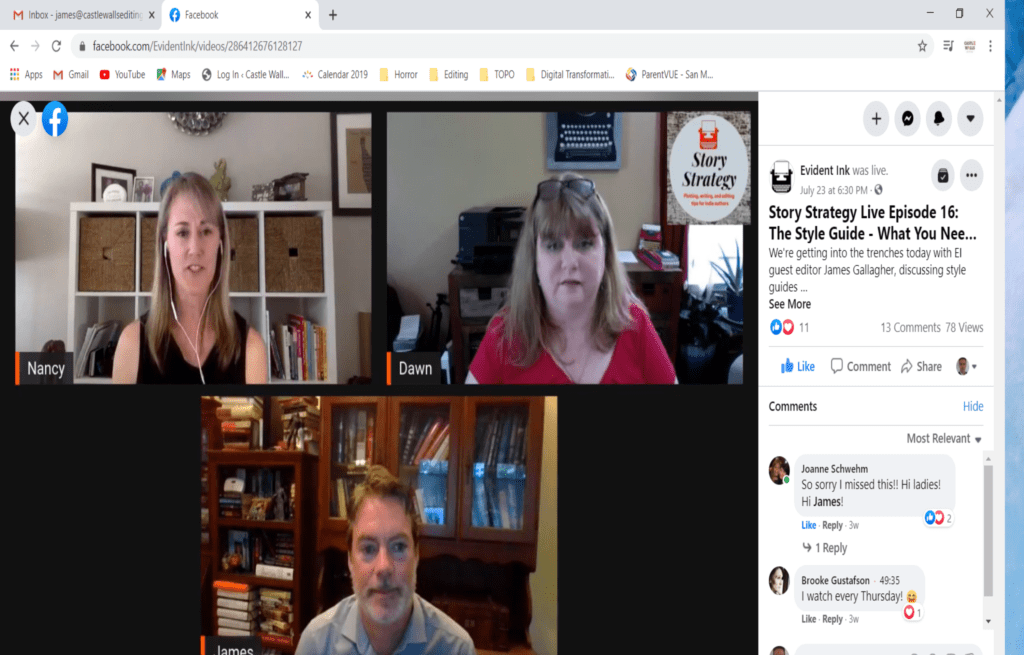
    Recently, I was happy to appear on Story Strategy Live to discuss style guides and style sheets with Nancy Smay and Dawn Alexander of Evident Ink, an editorial agency for whom I perform guest editing.

    You can view the Facebook Live session by clicking here.


    Nancy and Dawn are fantastic hosts, and I’d highly recommend checking out other episodes of Story Strategy Live. We had a lot of fun as we discussed the following topics:


    Thank you, Nancy and Dawn!

    I can’t thank Nancy and Dawn enough for having me on, and if you take the time to check it out, I hope you enjoy it.

    Feel free to send any questions about style guides or style sheets through the contact form on this site or to James@castlewallsediting.com.

  • Staying Connected during Isolation

    Staying Connected during Isolation

    Isolating in our homes during the COVID-19 pandemic has undoubtedly increased the amount of time we’re spending in virtual spaces for business, pleasure, and education. 

    Before the pandemic, I had weekly meetings with clients on Google Hangouts and Skype, but since the shelter-in-place guidance I’ve seen a big increase in meetings via Zoom (not to mention sessions with friends and family on Houseparty).

    I’ve also participated in more online collaboration on Miro, and it’s hard to imagine that virtual collaboration will do anything but increase — whether or not we return to something approaching our old normal. 

    The following fun and informative offerings have popped up in recent weeks:


    That Word Chat with Mark Allen

    Former newspaper reporter and longtime copy editor Mark Allen (@EditorMark) has launched That Word Chat on Zoom. 

    Described as a “video chat with lovers of all things lexical,” the episodes air Tuesdays at 4:30 p.m. ET. The first episode featured a conversation with Mary Norris, the author of Between You & Me: Confessions of a Comma Queen and Greek to Me: Adventures of the Comma Queen.

    During the first episode, I looked from attendee to attendee and was struck by the number of respected editors in the virtual room — a real who’s who of Editor Twitter. It felt good to hang for a bit with these great editors.

    The second episode welcomed Word by Word: The Secret Life of Dictionaries author Kory Stamper and Steve Kleinedler, author of Is English Changing? At one point, the two took word suggestions and wrote on-the-fly definitions. 

    Though they made clear that coming up with definitions off the top of their heads was far from the real dictionary-writing process, it was still fascinating to get a glimpse of how they think — and it was also a lot of fun.


    Sentence Diagramming with Ellen Jovin

    Known on Twitter for her traveling Grammar Table, Ellen Jovin (@GrammarTable) has launched a series of classes on sentence diagramming.

    Whatever your reaction to sentence diagramming — be it a quizzical Huh? or a nostalgic Oh yes, I remember doing that — the first two classes have been a blast, and I look forward to the third.

    (I remember sentence diagramming from grade school nearly four decades ago and haven’t thought about it a lot since, so I’ve greatly enjoyed the creativity of drawing out sentences with a group of fellow editors.)


    ACES and EFA Webinars

    I value my memberships in ACES: The Society for Editors and the Editorial Freelancers Association (EFA), and both have offered free webinars to members during the pandemic (with ACES offering free webinars to nonmembers as well).

    Whether for learning something new or reinforcing knowledge, ongoing education is an important part of being an editor who provides the best possible service to clients. 

    I also find it can be a boost to mental health, because it feels like such a productive use of time (and while I’ve been lucky to maintain steady work during the crisis, the uncertainty around book publishing is just one of many stressors in this new world).


    ACES Annual Conference

    For many, ACES is almost synonymous with the organization’s annual convention, and I’ve been fortunate enough to attend past conventions in St. Petersburg, Portland, and Chicago.

    This year’s convention in Salt Lake City was canceled because of the pandemic, but ACES has scheduled a day of online sessions for May 1. Session topics include the following:

    • The Invention of the Modern American Dictionary with Peter Sokolowski, editor-at-large, Merriam-Webster
    • Grammar Arcana with Lisa McLendon, coordinator of the Bremner Editing Center at University of Kansas
    • Developing a Quality Editorial Process End-to-End with Samantha Enslen, president, Dragonfly Editorial, and Cynthia Williams, editor and project manager, Dragonfly Editorial
    • What’s New in the AP Stylebook with Paula Froke, lead editor, AP Stylebook, and Colleen Newvine, product manager, AP Stylebook


    I’m looking forward to these sessions and am grateful that the people at ACES have done what they can to replace their beloved convention.


    Evident Ink with Nancy Smay

    In addition to serving clients through Castle Walls Editing, I edit romance as a guest editor through editor Nancy Smay’s company Evident Ink, and I am happy to report that Nancy has launched a wonderful series of free live video sessions on Facebook (https://www.facebook.com/EvidentInk/). 

    Nancy welcomes new guests every week, with upcoming sessions including topics such as boosting your writing productivity and using tropes in fiction. The classes take place on Thursdays at 4:30 p.m. ET and are well worth checking out.


    Corona Con

    Because of the cancellation of the Scares That Care horror convention in Wisconsin, author Kelli Owen led the charge to put together a live stream replacement con on April 18.

    Guests included Jonathan Janz, Kelli Owen, Brian Keene, Mary SanGiovanni, Robert Ford, Tim Meyer, Matt Hayward, Wes Southard, Somer Canon, Wile E. Young, Stephen Kozeniewski, Aaron Dries, Bracken MacLeod, and moderators Sadie Hartman (MotherHorror of Nightworms), Bob Pastorella (This Is Horror), Steve Pattee (Horror DNA), and Shane Keene (Ink Heist).

    A link to the day’s events can be found here: 

    https://www.youtube.com/watch?v=GDnXscKJ4nY&feature=youtu.be

    All the sessions are worth watching, but the Jonathan Janz reading stands out as perhaps the day’s biggest bring-down-the-house moment. Reading from his forthcoming work The Raven, Janz delivered a master class in live reading.

  • Over 3.5 Million Words Served

    Over 3.5 Million Words Served

    The other day I summed the word counts on my books-edited spreadsheet and saw that in the last two years I’ve edited over 3.5 million words.

    That’s a big number, the kind of number that’s impossible to fully imagine. Most of the books I copy edit or proofread range from 70,000 to 100,000 words, so the number starts to come into focus when you realize that editing ten 100,000-word books will get you to your first million.

    Before I devoted myself full-time to Castle Walls Editing around two years ago, I’d worked for nearly fifteen years as an editor for Recorded Books. During that time I ran Castle Walls on the side, doing occasion freelance work, so I’d have to do some digging to attempt a guess at a lifetime number for words edited.

    A word, however, is not a word is not a word is not a word. By that I mean that, while most editors base estimates for jobs partially on word count (noting that the number of pages is not a reliable indicator of word count because of variations in font, margins, and line spacing), word count alone will not let you estimate how long a job will take.

    With new authors, editors need to see a sample of the work to determine the level of editing required. An author might ask for a simple “last check” proofread but need a developmental edit.

    Or a job might be riddled with typos and punctuation errors or tangled grammar. Or require fact-checking. Or have time-consuming notes and reference lists. Or be remarkably clean.

    But whatever the case, if the level of edit does not match what’s needed, neither the editor nor the author is well served. As with anything in life, a calm assessment of the work ahead is a good first step for ensuring everyone is happy. 


  • Five Book Mentors for Editors

    Five Book Mentors for Editors

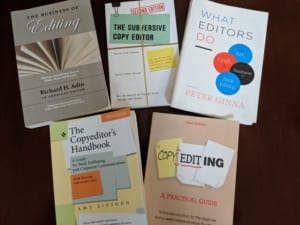
    While there’s no substitute for a mentor of the flesh-and-blood variety, the five “book mentors” below provide indispensable advice on the processes, philosophy, and business of editing.

    (Note that these are not writing or style guides. Click here for my look at the major style guides.)


    The Business of Editing by Richard H. Adin

    A collection of essays by Richard Adin (aka the American Editor), The Business of Editing: Effective and Efficient Ways to Think, Work, and Prosper collects Adin’s sage advice on these key aspects of the profession:

    • Roles
    • Tools
    • Processes
    • Profits
    • The Career of Editing
    • The Future of Editing

    While these essays are free at the American Editor blog, the handy arrangement of selections helps lead you through the above topics, and I thought it well worth the purchase.

    Of late, editor Ruth E. Thaler-Carter has taken over most writing duties on the site, including this post on backups for files and equipment. Thaler-Carter also organizes Communication Central’s Be a Better Freelancer conference, which I attended last fall.

    The Subversive Copy Editor by Carol Fisher Saller

    As senior editor at Recorded Books, I ensured that all the editors had a copy of The Subversive Copy Editor (or, How to Negotiate Good Relationships with Your Writers, Your Colleagues, and Yourself).

    In the book, Saller shares her kind, helpful approach to editing. Her “subversiveness” refers to her belief that editors are not the writer’s adversary but people who work in service to the author (and reader).

    The second part of her subversiveness is her belief that editors often need to look beyond the “rules” and do what makes most sense for the work at hand.

    Not so subversive at all!

    The Subversive Copy Editor is broken into two parts: “Working with the Writer, for the Reader” and “Working with Your Colleagues and with Yourself.”

    Saller also edits the Chicago Manual of Style Online’s Q&A. More about her can be found here.  

    What Editors Do Edited by Peter Ginna

    With essays from the best editors in the field (including the above-mentioned Carol Fisher Saller), What Editors Do: The Art, Craft & Business of Book Editing provides a host of insights into the profession.

    The book is broken into the following parts:

    • Part I: Acquisition: Finding the Book
    • Part II: The Editing Process: From Proposal to Book
    • Part III: Publication: Bringing the Book to the Reader
    • Part IV: From Mystery to Memoir: Categories and Case Studies
    • Part V: Pursuing an Editing Career: Varieties of Editorial Experience

    Many independent editors don’t have the opportunity to work in-house for a major publisher, and this books opens a window into that world.

    Peter Ginna has been an editor and publisher for Bloomsbury Press, Oxford University Press, Crown Publishers, St. Martin’s Press, and Persea Books.

    The Copyeditor’s Handbook by Amy Einsohn

    The following quote from Kim Hawley of the Chicago Book Clinic says it all about The Copyeditor’s Handbook: A Guide for Book Publishing and Corporate Communications:

    “A definite ‘must have’ for the beginning to intermediate editor or author, and even the experienced editor. An indispensable reference tool.”

    The book, which includes exercises and answer keys, is broken into these parts:

    • Part 1: The ABCs of Copyediting
    • Part 2: Editorial Style
    • Part 3: Language Editing

    A professional editor for scholarly, trade nonfiction, and corporate publishing, Amy Einsohn also taught copyediting courses. A tribute to the late Einsohn can be found on Copyediting.com here.

    Copyediting: A Practical Guide by Karen Judd

    The oldest title on my list, Karen Judd’s Copyediting: A Practical Guide is still a well respected resource for copy editors and a good addition to any editor’s shelf.

    The book begins with “What Is Copyediting?” and runs through the subjects of copyediting and proofreading symbols, punctuation and grammar, style and word usage, notes and bibliography, specialized copyediting, and other aspects of copyediting.

    ***

    These are all books that have helped me in my copyediting career. I hope you find them useful as well.

  • Getting to the Why of Editing

    Getting to the Why of Editing

    In his wildly popular TED Talk video How Great Leaders Inspire Action, author Simon Sinek maintains that most businesses know what they do, and that some businesses even understand how they do it, but that few businesses truly understand why they do it.

    Why does your organization exist? he asks. Why do you get out of bed in the morning? Why should anyone care?

    I spent almost 15 years working an in-house gig as an editor at Recorded Books (a company that will always have a special place in my heart). But nearly six months ago, I left behind regular paychecks and benefits to begin an adventure running my own editing business.

    I’m a copy editor.

    I love copyediting.

    But that’s what I do.

    I’m learning all the time and refining my processes (something I hope and expect will always be the case). But even so, I can give you a good breakdown of how I do what I do.

    But why do I do it?

    Sinek makes a compelling case for answering this question, and I’m sold on the importance of doing so.

    I should answer it for myself, certainly.

    But perhaps more importantly, I should answer it for my clients and for my potential clients. In truth, they shouldn’t just ask the question. They should demand an answer.

    So here goes.

    Anyone who’s chosen the freelance route can rattle off the usual reasons for going it on your own:

    • Being your own boss
    • Setting your own schedule
    • Pursuing the kind of work you want
    • Avoiding office politics

    These are all compelling, but they don’t actually strike at the why of what I do.

    So how do I get to why?

    My Castle Walls Editing home page features rotating images with these slogans:

    • Serving the Author
    • Serving the Audience
    • Serving the Work

    Each represents a different aspect of my why.

    Serving the Author

    In The Subversive Copy Editor (a must-read for any editor), Carol Fisher Saller expresses her philosophy that editors and authors are not adversaries vying for control of the text. They are instead partners working in service to the reader.

    As an editor, I want to help the author. Helping is important to me, and on a basic level it makes me feel good. I have a strong need to please, and editing lets me do this in a direct way.

    Serving the Audience

    I’m a reader as well as an editor, and reading has always been a place of shelter and warmth (Clive Barker, Ramsey Campbell, and all the other writers I admire have gotten me through a lot of tough times, and reading to my children was one of the great pleasures of my life).

    In a blog post, Baltimore Sun editor John McIntyre wrote, “And to be an editor, you must first be an avid reader. You have to hear all the voices to know which one is appropriate for your writer, your subject, your publication, your reader.”

    So reading is important for both personal and professional reasons. And as an editor, I’m able to help deliver text to readers everywhere—and this is a mission I can believe in, heart and soul.

    Serving the Work

    As a child, one of the chief ways I pleased my mother was by tidying up my room. I’ve carried this desire for neatness—and the psychological rewards of tidying up—into my profession. My mother died when I was not yet out of my teens, but I think she would be proud of the work I do.

    Certain kinds of editing appeal to me more than others, but at the heart of all jobs is that sense of straightening up. Addressing a reference list, for example, can be tedious work, but seeing a final product that appears just the way it should, down to the smallest detail, is extremely satisfying.

    My Why

    So why do I edit? It comes down to three things:

    1. I enjoy helping people.
    2. I enjoy being part of the book-making process.
    3. I enjoy cleaning up text.

    Those are simple reasons, but they feel honest and they work for me. I hope they work for you too.


  • Four on the Floor with Kathe Koja

    Four on the Floor with Kathe Koja

    My Four on the Floor interview with Kathe Koja appears below. I first discovered Koja’s writing in the early ’90s, when as a college student I visited a bookstore (remember those?) and picked up the Dell/Abyss paperback edition of her novel The Cipher. (If you’ve seen either this edition or the Abyss edition of her novel Bad Brains, you’ll likely remember the stunning cover art by Marshall Arisman).

    You can probably easily count the number of times a writer has truly opened your eyes, and reading Koja had that effect on me. Thematically, stylistically, this was a horror novel (though Koja’s writing defies genre) unlike any horror novel I’d ever read. 

    If you haven’t experienced her writing, that glittering promise nestled in 2018 is the experience of reading one of her novels for the very first time. Enjoy!

    About: Kathe Koja’s books include Under the Poppy, The Bastards’ Paradise, The Cipher, and Skin; her young adult novels include Buddha Boy, Talk, and Kissing the Bee. Her work has been honored by the ALA, by the ASPCA, and with the Bram Stoker Award. She’s a Detroit native and lives with her husband, artist Rick Lieder. She also runs Loudermilk Productions, creating site-specific immersive events, including performances of Faustus and her own adaptation of Under the Poppy.

    1. A Library Journal reviewer once wrote that your prose reads like “a collaboration between Clive Barker and William S. Burroughs.” Are there any writers (or artists in other mediums) whose works have exerted a particular influence on your writing?

    The great, fierce, subtle Shirley Jackson was a lasting influence on me as a beginning writer—her “Notes for a Young Writer,” in Come Along with Me, is really a fiction master class in less than 20 paragraphs. And the work, her novels and her stories, pretty much defies category: it’s Shirley Jackson’s work, period.

    David Bowie was a tremendous influence too—not just his genius as a musician, but his indelible example of fidelity to his own instincts and interests, his courage in making the work he wanted to make; he transcended categories, too, his music was Bowie music, first and always.

    I’ve written YA novels, horror novels, historical novels, and what stays constant is my voice, so I very much took those examples to heart.

    2. The beautifully styled and richly atmospheric nature of your prose would require a deft editorial hand. What has been your experience with editors?

    Whenever I send a manuscript to any editor, it’s always complete, or as complete as I can possibly make it—I wouldn’t send it otherwise!—so I don’t invite much in the way of collaborative editing, but I’m of course wide open to close and critical reading and comments: the writer and editor have identical goals, to bring the book (or story) to its highest level of completion, so I listen very carefully to all editorial notes.

    My best editorial experience? I was so fortunate to be able to work with Frances Foster at Farrar, Straus & Giroux: she was thorough, she was subtle, and whenever we disagreed, which was seldom, she was always open to honest argument. We worked on seven YA novels together and the process was utterly seamless. It’s no wonder she was a publishing legend.

    3. In what ways do you play with the overall structure of your novels and at what point in your process are you most aware of structure?

    All my fiction begins with a character—for The Cipher it was Nicholas, the failed poet; for Skin it was Tess, the stubborn sculptor; for Talk it was Kit Webster, the thoughtful and watchful young actor; for the Under the Poppy trilogy it was Istvan the puppeteer and his cadre of fantastic mecs—and the story just accretes around that person, through research, and notes, in a very hands-off kind of process, just letting the thing grow and find its shape until it’s time, finally, to start writing.

    I’m not able to work with outlines, I need to discover what’s being made in and by the making itself. So the structure is never imposed, it’s always organic to whatever’s being written—for one example, I had no idea the Poppy trilogy would be a trilogy, but the story just kept growing, kept showing itself to have more and more facets, until it became three books.

    4. Are there any recent books or films that have frightened or inspired or opened your eyes to something new in the world?

    A true life-changing example is Anthony Burgess’s A Dead Man in Deptford, his biographical novel about the sui generis Elizabethan poet and playwright Christopher Marlowe. I read it, fell head over heels for Marlowe, read all his poems and plays, and ended up writing a novel about him called Christopher Wild that’s also turning itself into a performance piece. A creative force of nature, Marlowe, that’s for certain.

    Recent work I’ve loved: Carter Scholz’s short novel Gypsy, the Netflix series Dark, and Perfume Genius’s album No Shape.

    Kathe Koja can be found online on Twitter, on Facebook, and at her website.

    Readers will also want to check out this interview conducted by Jeff VanderMeer for the Weird Fiction Review and this New Yorker piece about her novel Headlong.

  • A Walk-Through of the Copyright Page

    A Walk-Through of the Copyright Page

    In their zeal to dive into the newest work by their favorite author, readers often flip quickly past the copyright page.

    After all, why pore over a bunch of legal information when the author’s voice is calling from just a few pages away?

    But the page, located on the back (or verso) of the title page, holds a wealth of information that can suddenly become very interesting to writers nearing publication (especially if they’re self-publishing their work).

    Read on for the main parts of the copyright page.

    Publisher’s Address

    The copyright page usually lists the publisher’s name, address, and (often) web address.

    Self-publishers might choose to form their own publishing company, and the U.S. Small Business Administration is a good resource for starting and naming your business, creating a business plan, and other such information.

    Copyright

    While the Copyright Act of 1989 does not require that works contain a valid copyright notice to receive protection under copyright laws, most still choose to list the copyright on the copyright page—and, come on, it’s the copyright page!

    Most copyrights look something like this, with the copyright year matching the year of publication:

    ©2018 by John Doe

    The copyright is also usually followed by some version of the “All rights reserved” statement.

    A substantially new edition of a book will receive a new date assignment and could result in something like this:

    ©1997, 2005, 2018 by John Doe

    Copyrights for books published before January 1, 1978, may also be renewed, resulting in something like this:

    ©1936 by John Doe; © renewed 1964 by the Estate of John Doe

    For books published after this date, the copyright lasts for the life of the author plus an additional 70 years.

    More information about the length of copyright protection can be found here.

    To register or not to register?

    Registering your copyright is not required to receive copyright protection, but some still choose to do so as a further precaution. Registrants must pay a fee and send copies of the book to the Copyright Office. More information can be found here and here.

    What about works in the public domain?

    When a work has fallen out of copyright and into the public domain, no copyright is listed.

    What the heck is ℗?

    This is a performance copyright, protecting the audio narration of a work. As an editor at Recorded Books, I listed the ℗ credit on thousands of audiobook covers.

    The ℗ credit is linked to the year the audiobook is published, so you could have a copyright of 2007 for the original work but a ℗ credit of 2018 for the audiobook edition.

    More information about copyright can also be found on this helpful post from the Chicago Manual of Style.

    Publishing History

    The publishing history of a work is expressed in statement such as this:

    First edition published in 1887.

    Fiction Disclaimer

    This disclaimer may take many forms, but it usually sounds something like this:

    This is a work of fiction. Names, characters, businesses, places, events, locales, and incidents are either the products of the author’s imagination or used in a fictitious manner. Any resemblance to actual persons, living or dead, or actual events is purely coincidental.

    Country of Printing

    The country where the book was printed is listed on the copyright page, so you will usually see “Printed in the United States of America” or “Printed in China” or “Printed in” whatever other country is appropriate.

    The Number Line

    Perhaps the bit of information whose meaning is least apparent on first glance, the number line (or printer’s key) indicates the print run.

    The number line can be represented in a few ways, but it might look like this:

    2 4 6 8 10 9 7 5 3 1

    Whatever the order of the numbers, the lowest number is removed with each printing, so for the second printing of this work, the “1” would be removed, and you’d have this:

    2 4 6 8 10 9 7 5 3

    International Standard Book Number (ISBN)

    The ISBN is a unique identifier for your book, sort of like your book’s Social Security number. You will need a separate ISBN for each version of your book (that is, an ISBN for the hardcover, another for the paperback, and another for the ebook).

    More information can be found at Bowker, the only official source for ISBNs in the United States.

    Acknowledgements, Permissions, and  Other Credits

    Acknowledgements of previously published parts of the book, illustration credits, and permissions for quoting from copyrighted material are also listed on the copyright page.

    Credits for the cover art, the cover art designer, and the designer for the book’s interior (text) may also be listed here, and will look something like this:

    Jacket design by Jane Doe

    Photograph of lion ©2018 by Shutterstock

    If you see “Design by So-and-So” on the copyright page and “jacket” or “cover” is not mentioned, the credit usually refers to the typesetting and design of the interior pages.

    Library of Congress Cataloging-in-Publication (CIP) Data

    CIP data is bibliographic information prepared by the Library of Congress to facilitate book processing for libraries and book dealers.

    Information about obtaining CIP data can be found here.

    There is no charge to obtain this data, but the publisher is required to provide a complimentary copy of the book.

    Other Information

    We’ve covered the major pieces of the copyright page, but the page may also include such information as the International Standard Serial Number (ISSN), a Digital Object Identifier (DOI), and translation information.

    That’s a lot to process, but the next time you open a book, you just might find yourself lingering over this data-rich page.