Category: Recommended Reading

  • Book Review: ‘Because Internet’ by Gretchen McCulloch

    Book Review: ‘Because Internet’ by Gretchen McCulloch

    If all the cool kids on Editor Twitter are gushing over a book on language, then I should probably read it too.

    Because peer pressure.

    But also because I follow other editors for good reasons: to learn from them, to stay current on trends in the industry, to feel part of a community even while working largely in isolation.

    I haven’t been steered wrong when jumping on the latest reading trend and picking up books such as Benjamin Dreyer’s Dreyer’s English, Emmy J. Favilla’s A World without “Whom” and Kory Stamper’s Word by Word.

    Gretchen McCulloch’s Because Internet: Understanding the New Rules of Language is the latest it book in the editorial realm, and rave reviews and brisk sales have backed up the hype.

    In her book, McCulloch skillfully examines language change via electronic forums, from the days of ARPANET to today’s Snapchatters, breaking down Internet People into three waves characterized by

    • Old Internet People (First Wave)
    • Full Internet People (Second Wave)
    • Semi Internet People (Second Wave)
    • Pre Internet People (Third Wave)
    • Post Internet People (Third Wave)

    I’m nearing fifty, so it’s safe to say I’ve lived through most of these waves, and I enjoyed the bursts of nostalgia as McCulloch walked readers through BBSs and listservs and AIM and MySpace, all the way through Facebook, Gchat, and Instagram.

    Beyond a simple evocation of days gone by, however, the grouping of internet users serves a useful function: allowing readers to place themselves — and their attitudes toward internet communication — in a greater context, thereby encouraging readers to examine how and why they communicate before turning their eye toward how others do so.

    Any preconceived notions of internet language as a bastardization of more formal language are quickly shattered as McCulloch explores nuance in internet communication, whether through capitalization or punctuation or use of emoticons and emoji.

    I can imagine someone, exhausted by charges of laziness about the way people communicate on the internet (ruserious?), presenting Because Internet as a gift to a text-speak derider. The highest praise for the book might lie in how quickly it opens the eyes of the most resolute of the kids-these-days, get-off-my-lawn crowd.

    In other words, as the author demonstrates, language use on the internet has a lot less to do with laziness than it does with complex factors developing in real time and bolstering expressiveness rather than limiting it.

    People hate-reading the book to grouse about language change may instead find themselves taking notes on why their use of the period is misunderstood or on how they can better communicate with loved ones via a new set of tools.

    At heart the book displays a generous, enthusiastic love for language and for seeing where it is leading us and how we are shaping it.

    As McCulloch writes, “When we study informal language, we open our minds wide. We step out of the library and see the complexity of the wide world that surrounds us.”

    McCulloch herself is an internet linguist and the author of the Resident Linguist column at Wired. She also runs All Things Linguistic and cohosts the Lingthusiasm podcast.

    McCulloch’s writing style combines her academic bona fides (you don’t doubt her chops) with a playfulness that shines through often enough to make it an enjoyable as well as informative read.

    Final Take

    Seeing people ridicule each other for their use of language is one of the darker sides of being online.

    Knowledge of how and why people use language is usually inversely proportional to the frequency with which people ridicule others’ language (which is why you so rarely see good editors “correcting” people’s posts and tweets; most editors prefer to limit their comments on your language to when they’re being paid to do so).

    Increasing your understanding of how people are using language is therefore reason alone to read this book.

    Because Internet is highly recommended for both outsiders looking in, hoping for a better handle on how to communicate on the internet, and the savviest of internet wordslingers, looking for insights on where the language is going and how they’re helping to shape it.


  • Book Review: ‘Our Lady of the Inferno’ by Preston Fassel

    Book Review: ‘Our Lady of the Inferno’ by Preston Fassel

    Along with the much-anticipated rebirth of Fangoria magazine came Fangoria Presents, a publishing venture that launched with the release of 2018’s critically acclaimed Our Lady of the Inferno by Preston Fassel.

    With its splashy neon-pink-accented cover art and the all-but-flickering “Fangoria Presents” signage in the paperback’s upper-right corner, Our Lady has much of the same irresistible appeal that readers of a certain age will remember from garishly designed VHS tapes in their local video-rental store.

    (Another pink book, Autumn Christian’s wonderful Girl Like a Bomb, is basking in similarly positive reviews, making one wonder if pink has become horror’s new black.)

    The Setting

    Fassel’s tale takes place over nine days in June of 1983 and is set largely on New York’s Forty-Second Street, otherwise known as the Deuce. The nineties had yet to see Times Square turned into a place where tourists could safely swing into an Applebee’s (shudder), and you were more likely to run into hookers, drug dealers, and porn theaters than a “three-for” app combo.

    For most, eighties nostalgia is a joyful blast from the past, and, as we know, it’s everywhere, seen particularly in films like It and the at-least-partly It-inspired Netflix series Stranger Things

    Readers, however, should not expect a glut of “fun” references to that decade, which isn’t to say that Our Lady doesn’t skillfully reference the eighties. It does, and talk of exploding heads and summer camp slashers attest to Fassel’s knowledge and love for the genre. But the novel is more Taxi Driver than Friday the Thirteenth, and references to Flashdance and Sally Ride and the X-Men’s Jean Grey are both intentional and essential to the story and its lead character.

    The Plot

    Our Lady centers on Ginny Kurva, the bottom girl (a sort of fixer) for a group of prostitutes living at the seedy (and aptly named) Misanthrope. Having maneuvered her way into a position of influence with a grotesque pimp known as the Colonel, Ginny is able to care for her younger sister (wheelchair user Tricia) and run a type of school for the Colonel’s hookers, even as Ginny herself is subject to the pain and degradation inflicted by the life.

    Ginny has also struck up a friendship of sorts with horror-film fanatic Roger Neiderman, who tips her off to a predator stalking girls on the Deuce. We learn that the predator, assumed male, is in fact Nicolette, who works at the Staten Island Landfill by day and creates there a kind of killer-dog-prowled, Thunderdome-esque labyrinth by night, with Nicolette the Minotaur at its heart.

    As Ginny sinks deeper into alcohol-fueled self-care and is pushed to the breaking point, she nears a confrontation with both the Colonel and Nicolette, with the stakes being any hope for the future, should she even survive.

    But is it horror?

    Even as a horror fan, this is a question that usually doesn’t excite me. Yes, it’s somewhat annoying when people take the tack that anything skillfully enough realized cannot possibly be horror (Silence of the Lambs a prominent example), but I largely block out that noise. In many ways horror is the most inclusive of genres, and people who can only cast it in a restricted light are doing themselves a disservice.

    Still, I have seen people questioning whether Our Lady is horror, so I suppose it’s worth addressing. The novel doesn’t have supernatural elements, and the author doesn’t employ jump-scare-like tactics to frighten the reader. Fassel also leans on character over plot, with big issues much on his mind (the case of course with so much good horror), so those with an aversion to anything remotely literary might get nervous.

    But, as mentioned, horror references abound, specifically to films of the era, and the gore comes in sharp spikes. If you look at elements that horror must have, you can see that the book contains an attack by a monster (Nicolette), a speech in praise of the monster, a labyrinth, and a scene with the hero (Ginny) at the mercy of the monster.

    Our Lady also has a consistently bleak tone. The book is horror enough for me, but you can debate that to your heart’s content.

    The Verdict

    Fassel is one hell of a writer, and Our Lady of the Inferno is an extraordinary novel drenched in an eighties atmosphere both more true and less sanitized than many are accustomed to. The real horrors here lie in botched abortions, hopeless servitude, and the kind of arrangements one brokers with oneself to get by — and to care for those they love.

    If I have any quibbles it’s that Nicolette, in comparison with Ginny, feels underdeveloped, and the confrontation between the two is pushed so late into the novel that one might wish it had a little more room to breathe.

    But those are minor complaints, and Our Lady lives up to its place as the first book in the Fangoria Presents line, which continues with My Pet Serial Killer by Michael J. Seidlinger and Carnivorous Lunar Activities by Max Booth III. I’m looking forward to both and happy to have Our Lady on my bookshelf.

    (Fassel had apparently done a signing the week before at the store where I bought the book, so I was also lucky enough to unknowingly snag a signed copy.)

  • Five Book Mentors for Editors

    Five Book Mentors for Editors

    While there’s no substitute for a mentor of the flesh-and-blood variety, the five “book mentors” below provide indispensable advice on the processes, philosophy, and business of editing.

    (Note that these are not writing or style guides. Click here for my look at the major style guides.)


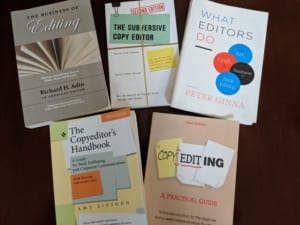
    The Business of Editing by Richard H. Adin

    A collection of essays by Richard Adin (aka the American Editor), The Business of Editing: Effective and Efficient Ways to Think, Work, and Prosper collects Adin’s sage advice on these key aspects of the profession:

    • Roles
    • Tools
    • Processes
    • Profits
    • The Career of Editing
    • The Future of Editing

    While these essays are free at the American Editor blog, the handy arrangement of selections helps lead you through the above topics, and I thought it well worth the purchase.

    Of late, editor Ruth E. Thaler-Carter has taken over most writing duties on the site, including this post on backups for files and equipment. Thaler-Carter also organizes Communication Central’s Be a Better Freelancer conference, which I attended last fall.

    The Subversive Copy Editor by Carol Fisher Saller

    As senior editor at Recorded Books, I ensured that all the editors had a copy of The Subversive Copy Editor (or, How to Negotiate Good Relationships with Your Writers, Your Colleagues, and Yourself).

    In the book, Saller shares her kind, helpful approach to editing. Her “subversiveness” refers to her belief that editors are not the writer’s adversary but people who work in service to the author (and reader).

    The second part of her subversiveness is her belief that editors often need to look beyond the “rules” and do what makes most sense for the work at hand.

    Not so subversive at all!

    The Subversive Copy Editor is broken into two parts: “Working with the Writer, for the Reader” and “Working with Your Colleagues and with Yourself.”

    Saller also edits the Chicago Manual of Style Online’s Q&A. More about her can be found here.  

    What Editors Do Edited by Peter Ginna

    With essays from the best editors in the field (including the above-mentioned Carol Fisher Saller), What Editors Do: The Art, Craft & Business of Book Editing provides a host of insights into the profession.

    The book is broken into the following parts:

    • Part I: Acquisition: Finding the Book
    • Part II: The Editing Process: From Proposal to Book
    • Part III: Publication: Bringing the Book to the Reader
    • Part IV: From Mystery to Memoir: Categories and Case Studies
    • Part V: Pursuing an Editing Career: Varieties of Editorial Experience

    Many independent editors don’t have the opportunity to work in-house for a major publisher, and this books opens a window into that world.

    Peter Ginna has been an editor and publisher for Bloomsbury Press, Oxford University Press, Crown Publishers, St. Martin’s Press, and Persea Books.

    The Copyeditor’s Handbook by Amy Einsohn

    The following quote from Kim Hawley of the Chicago Book Clinic says it all about The Copyeditor’s Handbook: A Guide for Book Publishing and Corporate Communications:

    “A definite ‘must have’ for the beginning to intermediate editor or author, and even the experienced editor. An indispensable reference tool.”

    The book, which includes exercises and answer keys, is broken into these parts:

    • Part 1: The ABCs of Copyediting
    • Part 2: Editorial Style
    • Part 3: Language Editing

    A professional editor for scholarly, trade nonfiction, and corporate publishing, Amy Einsohn also taught copyediting courses. A tribute to the late Einsohn can be found on Copyediting.com here.

    Copyediting: A Practical Guide by Karen Judd

    The oldest title on my list, Karen Judd’s Copyediting: A Practical Guide is still a well respected resource for copy editors and a good addition to any editor’s shelf.

    The book begins with “What Is Copyediting?” and runs through the subjects of copyediting and proofreading symbols, punctuation and grammar, style and word usage, notes and bibliography, specialized copyediting, and other aspects of copyediting.

    ***

    These are all books that have helped me in my copyediting career. I hope you find them useful as well.

  • Book Pick: ‘Quack This Way’

    Book Pick: ‘Quack This Way’

    At one point in Quack This Way: David Foster Wallace & Bryan A. Garner Talk Language and Writing (2013), Wallace suggests that usage dictionaries are perfect bathroom readers because the entries have the appeal of trivia, are brief, and connect with usages the reader will inevitably encounter soon thereafter.

    While Garner’s usage dictionary is one of my go-to references, I prefer to leave it at my desk, as it’s a hefty volume.

    But even so, Wallace’s observation is spot-on, and you can do worse than randomly selecting a page in Garner’s Modern English Usage and reading a few entries.

    A much slimmer volume, Quack This Way can be enjoyed in its entirety over a cup or two of coffee, though you’ll want to make a home on your bookshelf for this transcript of the filmed 2006 interview (Wallace’s last long interview).

    Packed with insights into language and writing, the book features highlight-worthy lines on nearly every page, no surprise considering Wallace’s reputation as one of the finest authors of his generation and Garner’s as one of the world’s premier lexicographers.

    “[T]he average person you’re writing for is an acute, sensitive, attentive, sophisticated reader who will appreciate adroitness, precision, economy, and clarity.” — David Foster Wallace

    In the introduction, Garner touches on the friendship between the two men, and it is here Wallace’s suicide, in 2008, is most immediate, especially when Garner relates the author’s habit of crossing out his name on the title page when signing his work.

    Garner handles these difficult passages well, providing insight into the men’s relationship and leaving the reader with a greater appreciation for the privilege of taking in this conversation.   

    The pages that follow feature the text and only the text of their interview, with Wallace’s speech preceded by a simple “DFW:” and Garner’s with “BAG:”.

    Garner engages, encourages, and steps back enough to let Wallace’s thoughts come to the fore, and Wallace, as Garner described him in the introduction, strikes the reader as “self-effacing, apologetic, and endearing.”

    In what is essentially a master class on writing and language, Garner and Wallace explore the following:

    • Learning to write well
    • The difference between expressive and communicative writing
    • Writing that mistakes complexity for intelligence
    • Vogue words
    • Structure (openings, middles, endings)
    • Passive voice, beginning sentences with conjunctions & buried verbs and nouns
    • Officialese and genteelisms

    In addition, readers are treated to mentions of writers whom Wallace admired (all good additions to your reading list) and Wallace’s thoughts on the importance of a writer’s “big trio”: dictionary, usage dictionary, and thesaurus.

    Quack This Way is a perfect single-sitting read, a welcome addition to your bookshelf, and a smart gift for anyone even marginally interested in language and writing.


  • Book Pick: ‘Do I Make Myself Clear?’ by Harold Evans

    Book Pick: ‘Do I Make Myself Clear?’ by Harold Evans

    Too often people perceive the work of editors as so much pedantry or needless fussiness.

    But editors help authors communicate to their audience, and, as Harold Evans demonstrates in Do I Make Myself Clear? Why Writing Well Matters, writing well does matter—and sometimes it even saves lives.


    [bctt tweet=”“Words have consequences.”—Harold Evans, author of DO I MAKE MYSELF CLEAR?” username=”CastleWallsEdit”]


    Emotional Response

    I did not expect to react emotionally to a book about writing clearly, but I did.

    Twice, in fact.

    In the chapter “Money and Words,” Evans looks at how the words customer convenience led to deaths because of an auto company’s internal language about faulty ignition switches. I lost two people I love to a car accident, so the subject will always expose raw emotions.

    Words do indeed have consequences. Careless language will not always have devastating results, but easily understandable text touches lives in myriad ways, whether helping people decide on political candidates or choosing new home appliances or almost anything else you can imagine.

    The second emotional response was to Evans’s observations on “The Weasel, Twelve Monkeys and the Shrub,” David Foster Wallace’s 2008 Rolling Stone article about John McCain.

    Evans details how Wallace’s account of McCain’s time as a prisoner of war in Vietnam transmitted that experience in a way no other account had. Evans describes Wallace’s language as “prose with the frost off,” and he points out the techniques, such as asking questions, that make the piece so effective.

    My emotional response came both from the secondhand transference of the power of Wallace’s writing and from my knowledge of Wallace’s suicide, which is always difficult for me to process.

    Why Listen to Evans?

    A former editor for the Sunday Times and the Times (London), Evans holds the British Gold Award for Lifetime Achievement in Journalism and was voted by his peers as the all-time greatest British newspaper editor.

    Methinks he knows of what he speaks.

    Evans’s Approach

    Evans divides the book into three main sections: “Tools of the Trade,” “Finishing the Job,” and “Consequences.”

    Throughout, Evans breaks down pieces of writing and offers suggestions on how to rework text for clarity. As an editor, it’s thrilling to look over the shoulder of a master and take in the process.

    And when I say “breaks down,” I mean it. Evans tears apart writing and shows the reader exactly what he’s doing, why he’s doing it, and how the text sings afterward.

    At one point Evans even—gasp!—takes on Jane Austen.

    Clear as Mud

    Clear writing is always the goal, right?

    Not for the “mistakes have been made” crowd.

    Evans addresses writing whose intent is to obfuscate, and politicians are far from the only ones who don’t exactly want their meaning to be clear.

    For editors, this underscores the importance of working with authors to clarify (ahem) just what kind of editing is desired.

    With fiction, an author might feel like an editor has altered their voice or diminished the beauty of their language.

    In nonfiction or corporate work, a writer might feel like an editor has produced something that “sounds” less impressive (or exposed the fact that little has been said in the first place).

    My experience in corporate work has been that there are those who will do anything to prevent an editor from getting ahold of the work, and I believe this comes from the fear that editors will rewrite just for the sake of rewriting.

    This undoubtedly happens. But if editors are committed to helping authors, in any field, and if there’s adequate communication, then both parties should be able to enjoy a harmonious rather than contentious relationship.

    Readability

    Anyone who needs to write for reading level can benefit from Evans’s section on readability. In these pages, he discusses the following tools:

    • Flesch Reading Ease index
    • Flesch-Kincaid grade level
    • Dale-Chall formula
    • Gunning fog index

    Evans provides an evenhanded assessment of how these tools can help writers while also warning that the tools are blind to meaning and can’t address the thing writers must worry about most: placing “the right words in the right order.”

    Shortcuts

    In one chapter, Evans offers 10 shortcuts for making your writing clear, addressing active and passive voice, adjectives and adverbs, prepositions, and other such trouble spots.

    It’s the kind of chapter anyone can read out of context and walk away with a pocketful of valuable advice.

    Brains!

    In another chapter, Evans tackles zombies, flesh-eaters, and pleonasms.

    Also referred to as nominalizations, smothered verbs, or controverted verbs, zombies manifest themselves in nouns that have devoured verbs: implementation, authorization, etc.

    Evans offers a survival guide for dealing with them.

    Also plaguing the writing world is language that sucks the life out of text, and Evans provides a six-page list that helps deal with these flesh-eaters. A handy reference, the list is broken into flesh-eaters (“We are in receipt of”) and preferred usages (“We received”).

    On pleonasms (redundancies), Evans offers nine pages of examples, with italics indicating words that can be struck out (“complete monopoly”).

    He then ends the chapter with seven pages of cliches you want to avoid.

    In another chapter, Evans looks at word meanings that have become muddled over time, clarifying usage for words such as dilemma, entomb, and loan/lend.

    Bibliography

    One of the benefits of books on writing is that they reference other books on writing, so the bibliography serves as a good must-read list. Such is the case here, and readers will also want to check out the blog list for sites to keep tabs on.

    Final Take

    When copy editors at long-running institutions are losing jobs in the interest of the bottom line, this seems as good a time as any to remind the world that writing and editing matter.

    Evans does this, and he does it clearly.

  • Book Rec: ‘Vex, Hex, Smash, Smooch’ by Constance Hale

    Book Rec: ‘Vex, Hex, Smash, Smooch’ by Constance Hale

    Wired Style and Sin and Syntax author Constance Hale inspires an infectious appreciation for verbs in Vex, Hex, Smash, Smooch: Let Verbs Power Your Writing. While the book dropped in 2012, its not-so-hot-off-the-presses status doesn’t diminish its readability, power, or utility for writers and editors.

    Deep into the book, Hale relates that, while serving as an editor at Wired and Health, she would circle the verbs in the first two or three paragraphs of clips writers sent in. If the verbs struck her as dynamic and made the sentences jump, the writers got a call.

    If not, not.

    How’s that for scaring you into checking your verbs?

    (Now that’s a phone you could slam to end a call!)

    GREAT ADVICE: Circle your verbs to see if your sentences crackle.

    On opening sentences with “there are” or “it is” constructions, Hale calls out the “phantom subject” (as termed by Patricia O’Conner in Woe Is I) as a bad idea, a “false start,” before also deriding throat-clearing constructions such as “I think” and “It seems like.”

    Evenhanded throughout, Hale also writes that the authors of A Comprehensive Grammar of the English Language and usage expert Bryan Garner defend the “existential there” in certain contexts, specifically those pushing the emphasis to the end of a sentence (hard to argue with her example from Shakespeare: “There is no terror, Cassius, in your threats”).

    The best of books like Hale’s enrich our understanding of language and provide readers with tools for making writing and editing decisions.

    Hale succeeds on all counts.

    The Structure

    As the author says early on, the book dips into “a little evolution, a little history, a lot of grammar, a little usage.” To explore these areas, Hale divides each chapter into four sections:

    • Vex, in which Hale explores confusing aspects of language, syntax, and verbs
    • Hex, in which the author tackles persistent myths about writing
    • Smash, in which Hale showcases poor usage and demonstrates how to avoid it
    • Smooch, in which Hale showcases good writing (and gets just a tad mischievous)

    I read the book cover to cover, but as Hale herself asserts in the introduction, Vex, Hex works equally well, and perhaps better, when one picks and chooses sections to explore.

    The book is designed in a way that facilitates this grab-bag approach, with the early chapters focused on linguistics and cultural history, the middle chapters on the grammar of verbs, and the late chapters on usage and style.

    Wherever you enter the work, though, you’re bound to find something well worth your time.

    Collective Soul

    While I enjoyed the book, I do have a minor disagreement with the author over the treatment of collective nouns. Hale wrote that she always treats singular collective nouns as singular for verb agreement, whereas I prefer the strategy of treating the noun as singular when the members of the group are acting as a group and plural when the members of the group are acting as individuals.

    Hale’s strategy is simpler and cleaner for editors, as no decisions need be made. In Garner’s Modern English Usage, we read that there is “little ‘right’ and ‘wrong’ on the subject,” but that one should be consistent and not flip-flop between singular and plural verbs in a piece.

    These gray areas should excite editors, should glint with a bit of magic. I like having the leeway to make those decisions. Everything can’t be one thing or the other, and I’m thankful for areas of language that require flexible thinking (though these areas do come with the knowledge that no matter what you do, someone will inevitably think you’re wrong).

    The Wait Is Over!

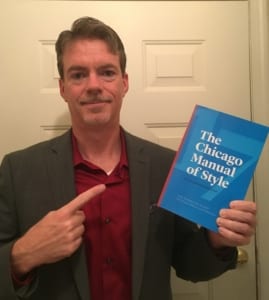
    I have to admit, this week I’m all about Chicago. I just got back from Dallas (where I saw both Dawn of the Dead and Hot Fuzz at the Alamo!) and upon my return I found a little something on my doorstep.

    Hello, Seventeen!