Category: Editing & Writing Tips

  • Sign on the Dotted Line: The Editing Contract

    Sign on the Dotted Line: The Editing Contract

    Signing a contract can be intimidating. What am I getting into here? What might be lurking in the fine print?

    When it comes to the author–editor relationship, contracts can reassure authors

    • that they’ve chosen the right editor
    • that the editor will provide the services they want
    • that the pay and delivery schedule will meet their expectations


    The Right Editor for You

    Authors find editors in all kinds of ways, and if you poke around social media for a minute or two, you’ll probably come across authors asking where they can go to find a good editor.

    Editors may be referred by other authors (editors love this).

    Authors may find editors blind on the internet or through resources such as the Editorial Freelancers Association (of which I’m a member).

    Authors may even turn to friends who love to read and regularly point out grammar miscues on Facebook (but please don’t point out grammar miscues on Facebook).

    Wherever an author finds an editor, the contract is a sign of the editor’s professionalism. The contract says the following to the author:

    • “I am a professional, I take my job seriously, and I will treat you in a professional manner.”
    • “I want to be absolutely clear on the work that you want me to do, and I want you to be absolutely clear on the work I’m doing.”
    • “I want to prevent any misunderstandings on the cost of the work or when you can expect the work to be delivered.”

    Whether your editor is an old friend or a complete stranger, contracts set the business transaction off on the right foot and preserve the relationship between the parties by preventing misunderstandings.

    With something as important as a manuscript an author has toiled over, better safe than sorry is a good approach for everyone involved.

    The Services You Want

    An author’s view of the kind of editing that should be done on a manuscript can be very different from the editor’s.

    Authors and editors may even have different definitions for what is entailed by the different levels of editing: developmental editing, line editing, copyediting, and proofreading. (No surprise here, because editors often have different definitions themselves.)

    Authors might not even be aware there are different levels of editing, so prework discussions leading to the contract can be extremely informative.

    For example, the contract can prevent an author from thinking the copyeditor will perform Big Picture structural work on a manuscript when the copyeditor thinks he will be editing for grammar, spelling, punctuation, style, and consistency only.

    No Surprises

    Unspoken expectations lead to trouble, especially when it comes to money and the nature of the work involved.

    A contract may specify the type of file that will be supplied to the editor (an editor may be expecting a Word document when the author is planning to send a PDF for markup or share a Google document).

    A contract might say that the work will be billed based on the supplied word count and not the word count of the edited document (often much lower), or a contract may spell out a project fee and a pay schedule.

    Either way, addressing payment expectations (including the deposit and methods of payment) avoids one of the greatest sources of contention.

    In addition, an author might expect that the editor’s fee includes a full review of the edited manuscript after the author has addressed comments and accepted and rejected changes, whereas the editor might see this as a separate charge.

    What happens when the author or editor has to pull out of a project, for whatever reason? This can be covered in the contract too.

    Another thing to keep in mind is that if authors see something they don’t like in the contract, they are free to raise the issue with the editor and are encouraged to do so.

    After all, editors and authors are working toward a common goal: to make the author’s manuscript as good as it can be.

    Contracts help achieve this goal and reassure both parties that their expectations are being met.

    (For more on contracts and setting fees, The Paper It’s Written On by Karin Cather and Dick Margulis and The Science, Art and Voodoo of Freelance Pricing and Getting Paid by Jake Poinier, aka Dr. Freelance, are excellent resources.)

    About James Gallagher:

    James Gallagher is a copyeditor and the owner of Castle Walls Editing LLC. To view a sample contract or to find out how James can help with your writing projects, email James at James@castlewallsediting.com.


    References:

    Cather, Karin, and Dick Margulis. The Paper It’s Written On: Defining Your Relationship with an Editing Client. New Haven, CT: Andslash Books, 2018.

    Poinier, Jake. The Science, Art and Voodoo of Freelance Pricing and Getting Paid. Phoenix, AZ: More Cowbell Books, 2013.


  • What Are Zombie Rules in Grammar?

    What Are Zombie Rules in Grammar?

    Zombies are fueled by mindless hunger, and this mindlessness is part of what makes them scary.

    If you have a choice between reasoning with a zombie and bashing one in the head with a shovel, the latter approach is more likely to help you avoid becoming one of the undead yourself.

    Zombie rules in grammar (“rules” that have no grammatical basis but nonetheless refuse to die) are frightening because they’re driven by much the same brand of mindlessness.

    You can probably reel off your favorite zombie rules the same way you’d reel off your favorite zombie flicks. “Never end a sentence with a preposition,” “Never start a sentence with a conjunction,” and “Never split infinitives” are the Night of the Living Dead, 28 Days Later, and Shaun of the Dead of the grammar world.

    More obscure zombie rules stalk the landscape as well: the number of items between can apply to and the use of double negatives (think Dead Alive and Cemetery Man).

    People faced with zombie rules generally arm themselves with reasonable arguments that often involve Latin, John Dryden, and Winston Churchill quotes (“This is the type of errant pedantry up with which I will not put”).

    But zombie rules wouldn’t be zombie rules if they were easy to kill (though people won’t stop trying, and there are seemingly billions of blog posts devoted to grammar rules that aren’t really rules).

    Why do people hold on to zombie rules?

    (1) They were learned as absolute truths during one’s formative years and have never been questioned. If pressed, most will cop to their certainty about a grammar “rule” as coming from an elementary school teacher or some other distant authority.

    So changing one’s stance on ending a sentence with a preposition might involve a slight shifting of a long-held world view. Doing so might cause a little tremor in your foundations. But evaluating and resetting your world view is a good thing, and we should all reevaluate our beliefs on a regular basis.

    (2) It’s hard to admit you were wrong. Changing your view on rules such as these can feel like you’re admitting you’ve been wrong for years, possibly decades. But this is a sting that can be lessened by the realization that most “rules” aren’t rules, and that what we’re really talking about are styles and conventions.

    Audience and levels of formality and register often determine the guidelines you’ll follow. Language conventions are ever changing, and embracing this can be quite freeing (while there was no shortage of debate sparked by the major style guides’ lowercasing of internet, a good number of copyeditors undoubtedly felt a rebellious thrill when they first started taking down that I).

    (3) The “rule” makes you feel superior. People love to correct other people’s grammar. Check any comments thread and you’ll quickly find someone attempting to invalidate someone else’s argument by pointing out a misstep in grammar, spelling, or punctuation.

    People’s use of grammar is also tied up in their self-perception and it’s used to broadcast their level of education. It’s also used as a barricade to prevent others from accessing their realm.

    But people can love grammar and not be an ass about it. Inflexibility and a rigid adherence to “rules” across all situations are probably your best ways of advertising how little you actually know about language. Let’s try not to use our knowledge to hurt or exclude others. Let’s try to be kind, share knowledge generously, and open ourselves to the idea that we have much to learn.

    I suppose I could say more, but I’m off to watch Return of the Living Dead III.

    ABOUT JAMES GALLAGHER

    I’m a copyeditor and the owner of Castle Walls Editing. If you have a manuscript and need a copyeditor, contact me through this site or email me at James@castlewallsediting.com.

  • Writing Sprints for NaNoWriMo and Beyond

    Writing Sprints for NaNoWriMo and Beyond

    National Novel Writing Month (NaNoWriMo) is fast approaching, and many writers are biting their nails hoping they can find the time to pound out 50,000 words in November.

    “Not enough time” is a constant refrain among hopeful writers — and an understandable one. Day jobs, family, friends, chores, outside-of-work appointments, life(!) all come between writers and actual, honest-to-God, sitting-down-at-your-computer writing.

    But a piece of advice you’ll hear again and again from successful writers is that writers write. No one has the time, but if you really want to write, you’ll find the time. You’ll make the time.

    Sprints are one way you can do this.

    WHAT IS A SPRINT?

    If you’re familiar with the business world, you’ve probably heard about Agile and Scrum and Scrum sprints, or timeboxed activities that take place over a short time (usually a month) with a clear goal. Sprints help businesses stay on task, cope with change, and deliver better products.

    For our purposes, especially if words like deliverables and iterative processes put you to sleep, sprints are short bursts of a single, uninterrupted activity.

    You might sit down and write for half an hour, take a break, and then conduct another sprint. People also join group sprints through social media, the camaraderie adding further incentive to meet your writing goals.

    BENEFITS OF SPRINTS

    The following are ways sprints can help you during NaNoWriMo and beyond.

    You accomplish a short-term goal. Micro habits are small, achievable tasks you can do every day to give you a sense of accomplishment, which in turn increases your ability to tackle larger projects. Even making your bed in the morning lets you tick an item off your to-do list and feel better about the day’s challenges.

    Lack of confidence is a barrier writers struggle with. No one can write a novel. I mean, come on. It’s too big a task. Too daunting. But you can write for half an hour. You can pound out 500 words. And if you do this again and again, you’ve written a novel without being crushed under the enormity of mentally tackling the whole thing at once.

    You separate yourself from distractions. Writers are great procrastinators. Let’s face it: writing is hard. It requires discipline and facing our own fears. You can’t hide from yourself on the page.

    Writing is something many writers feel they were meant to do, something they feel is their calling, perhaps even the most important thing they’ll ever do. That’s a lot of pressure, and it’s easy to shy away from it. You can’t fail if you don’t try.

    But you also can’t succeed.

    Our world also presents us with more distractions than ever. (Is your Twitter feed calling?) Sprints make you block all that out, at least for the duration of the sprint. You don’t check email, Facebook, or Twitter. You don’t answer your phone. You ignore the kids. You do what you have to do.

    You instill discipline into your writing routine. Muscles develop day-by-day with exercise, and the more you exercise, the better shape you find yourself in. Your brain benefits from exercise too.

    The more writing sprints you run, the more you train your brain to jump quickly into writing mode.

    People who have trouble sleeping are told to make the bed a place for sleep only, so your mind associates it only with sleep and will therefore slip into sleep mode faster when you crawl under the sheets. Writing sprints help you do something similar when sitting down at your computer.

    You send a clear message to those around you. Has anyone ever struck up a conversation with you while you’re reading in a public place? I always feel like the person sees you reading and thinks, Oh, God, they’re reading. What a terrible fate! I better go rescue them! It’s infuriating.

    Family and friends can do the same thing while you’re writing. Hanging up your DO NOT DISTURB sign or doing whatever it takes to tell friends and family that you’re writing for the next hour (or half hour, or whatever the duration of your sprint is) helps create that space.

    Specifying a definitive amount of time also helps wall this time off, because it prevents the “as good a time as any” approach to interrupting that someone can take if there are no definitive boundaries around your time.

    WHAT ARE THE KEYS TO A SUCCESSFUL SPRINT?

    You can do a few things to get the most out of your sprints.

    Prepare. The most important thing is to work steadily and productively through the sprint. If you sit down and write nothing, you haven’t made it out of the starting blocks.

    For NaNoWriMo, you can outline your novel ahead of time (but it’s almost November and the clock is ticking!). Another trick is always ending your writing session before the end of a scene, so in the next writing session you can pick right up where you left off.

    In your free moments (washing dishes, driving home from work, conducting brain surgery), think about what you’re going to write. This prevents you from having no idea where you’re going when you sit at the computer or take out your notebook and pen.

    Commit. The busiest time of the year at any gym is usually right after New Year’s. Everyone is packing the place and is committed to New Year’s resolutions to exercise more. But check out the same gym in mid February and count the tumbleweeds blowing by.

    You have to commit to your sprints and make them productive. With NaNoWriMo, it’s easy to start strong but end up jumping ship when fatigue sets in. So the depth of your commitment will be tried.

    NaNoWriMo provides great progress reports, and that “words per day to finish” feature can help or hurt your confidence. So try to come out of the gates quickly to keep that number as low as possible. And then use sprints to manage your one-day-at-a-time approach.

    Communicate. As we talked about above, those around you can both support and hinder your writing efforts, and many times this is well meaning or unintentional. Someone who doesn’t write may want to help but end up invading your mental space.

    So it’s important to set your time boundaries and enforce your do-not-disturb policy. And then be exceedingly kind to the people who enable your writing by watching your kids, giving you that space, or providing any of the other kindnesses and allowances loved ones make for this demanding endeavor.

    ARE EDITING SPRINTS GOOD OR BAD?

    I’ve seen more and more talk online about editing sprints, which follow the same concept. A fairly recent ACES: The Society for Editing chat even centered on this topic, and a lot of great editors extolled the virtues of editing sprints for tackling their work.

    I like the sentiment. It’s hard to argue that an uninterrupted period of activity is bad for editing. There’s no doubt that ignoring email or social media while editing is a good thing, but I also feel like this should go without saying.

    More than anything, though, I don’t like the word sprint associated with editing. With writing, it’s often important to get that first draft on the page at any cost. But editing needs to be slow and methodical — never a frantic, rushed activity.

    So while I think the idea of an editing sprint is a good one, I don’t like the word in this context, and I would prefer editors use it for admin tasks or some other activity that doesn’t require the slow, methodical mindset.

    When I worked at the audiobook company Recorded Books, we proofed thousands and thousands of audiobook covers. The covers came fast and furious, and there was always temptation to rush to handle the workload.

    So I put together a sheet of Editing Rules of the Road, with the first rule being to “Slow Down!” When it comes to editing, this is always good advice.

    ABOUT JAMES GALLAGHER

    ACES and EFA member James Gallagher is owner/editor at Castle Walls Editing. If you’re in need of copyediting, send a message through the contact form on this site or email James at James@castlewallsediting.com.

  • Five Tools That Help My Editing Business

    Five Tools That Help My Editing Business

    No electronic tool can match the mind of an editor when it comes to making judgments informed by training, widespread reading, on-the-job experience, and lessons shared by peers and mentors.

    Searching the #spellcheckcantsaveyou hashtag on Twitter, for example, will give you tweet after (often-humorous) tweet of spellchecker fails.

    But that doesn’t mean spellcheckers aren’t useful (if limited) tools. You just have to know the limitations of your tools so you can let them help you without relying on them in areas where they fall short.

    I regularly use the following five tools and am happy to have them at my disposal.

    PerfectIt

    PerfectIt from Intelligent Editing is essentially a consistency checker that looks at such areas as spelling, abbreviations, capitalization, hyphenation, house style, and bullets and lists.

    You run PerfectIt from within Word and can set customized styles for clients. I run it on every document I edit, and if it occasionally turns up something I might have missed otherwise, then I’m thankful for the assist.

    Editor’s Toolkit Plus 2018

    Editor’s Toolkit Plus 2018 from the Editorium is a Word add-on that collects easy-to-use macros for doing such things as fixing ellipses, finding and replacing multiple items, cleaning up common editorial problems, and extracting embedded footnotes.

    The 2018 version includes Editor’s ToolKit, FileCleaner, QuarkConverter, NoteStripper, ListFixer, MegaReplacer, QuarkConverter, InDesignConverter, Puller, and WordCounter. Many of these features are great time savers (and editors can always benefit from making their processes more efficient).

    Toggl

    Tracking time spent editing is essential for estimating editing fees and managing your schedule. Toggl is a time tracker with handy reporting features for generating client reports.

    I haven’t compared Toggl to other time-tracking tools, but I find it easy to use and am happy with it. (My only complaint is that I occasionally forget to turn it on or off, but I can only blame myself for that!)

    Google Docs

    I use Google Docs for my style sheets and small writing jobs. I wrote this post, for example, on Google Docs before copying it to WordPress. (I find writing on WordPress a bit maddening, and my experience has been that you’re much less likely to lose your work when writing with Docs.)

    DropTask

    I proofread for a publisher that uses DropTask to move covers through the proofing process.

    DropTask uses lively visuals so workflow can be managed by dragging and dropping jobs (and all their accompanying files) through stages represented by circles and icons. DropTask is easy to use and is even quite a bit of fun (if you’re into that kind of thing).

    Special Mentions:

    In addition to the above, I’ve been using the following with various clients: Miro (an online whiteboard and collaboration tool), Basecamp (project and document management and team communication), Paymo (project management and time tracking), and PayPal (payments).

    Poor carpenters may blame their tools, but I’d say that poorer ones refuse to use the tools at their disposal. What tools do you use?

    About James Gallagher

    Copyeditor James Gallagher serves clients through his business, Castle Walls Editing. Email James at James@castlewallsediting.com to find out how he can help with your writing projects.

  • Five Book Mentors for Editors

    Five Book Mentors for Editors

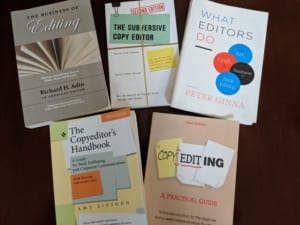
    While there’s no substitute for a mentor of the flesh-and-blood variety, the five “book mentors” below provide indispensable advice on the processes, philosophy, and business of editing.

    (Note that these are not writing or style guides. Click here for my look at the major style guides.)


    The Business of Editing by Richard H. Adin

    A collection of essays by Richard Adin (aka the American Editor), The Business of Editing: Effective and Efficient Ways to Think, Work, and Prosper collects Adin’s sage advice on these key aspects of the profession:

    • Roles
    • Tools
    • Processes
    • Profits
    • The Career of Editing
    • The Future of Editing

    While these essays are free at the American Editor blog, the handy arrangement of selections helps lead you through the above topics, and I thought it well worth the purchase.

    Of late, editor Ruth E. Thaler-Carter has taken over most writing duties on the site, including this post on backups for files and equipment. Thaler-Carter also organizes Communication Central’s Be a Better Freelancer conference, which I attended last fall.

    The Subversive Copy Editor by Carol Fisher Saller

    As senior editor at Recorded Books, I ensured that all the editors had a copy of The Subversive Copy Editor (or, How to Negotiate Good Relationships with Your Writers, Your Colleagues, and Yourself).

    In the book, Saller shares her kind, helpful approach to editing. Her “subversiveness” refers to her belief that editors are not the writer’s adversary but people who work in service to the author (and reader).

    The second part of her subversiveness is her belief that editors often need to look beyond the “rules” and do what makes most sense for the work at hand.

    Not so subversive at all!

    The Subversive Copy Editor is broken into two parts: “Working with the Writer, for the Reader” and “Working with Your Colleagues and with Yourself.”

    Saller also edits the Chicago Manual of Style Online’s Q&A. More about her can be found here.  

    What Editors Do Edited by Peter Ginna

    With essays from the best editors in the field (including the above-mentioned Carol Fisher Saller), What Editors Do: The Art, Craft & Business of Book Editing provides a host of insights into the profession.

    The book is broken into the following parts:

    • Part I: Acquisition: Finding the Book
    • Part II: The Editing Process: From Proposal to Book
    • Part III: Publication: Bringing the Book to the Reader
    • Part IV: From Mystery to Memoir: Categories and Case Studies
    • Part V: Pursuing an Editing Career: Varieties of Editorial Experience

    Many independent editors don’t have the opportunity to work in-house for a major publisher, and this books opens a window into that world.

    Peter Ginna has been an editor and publisher for Bloomsbury Press, Oxford University Press, Crown Publishers, St. Martin’s Press, and Persea Books.

    The Copyeditor’s Handbook by Amy Einsohn

    The following quote from Kim Hawley of the Chicago Book Clinic says it all about The Copyeditor’s Handbook: A Guide for Book Publishing and Corporate Communications:

    “A definite ‘must have’ for the beginning to intermediate editor or author, and even the experienced editor. An indispensable reference tool.”

    The book, which includes exercises and answer keys, is broken into these parts:

    • Part 1: The ABCs of Copyediting
    • Part 2: Editorial Style
    • Part 3: Language Editing

    A professional editor for scholarly, trade nonfiction, and corporate publishing, Amy Einsohn also taught copyediting courses. A tribute to the late Einsohn can be found on Copyediting.com here.

    Copyediting: A Practical Guide by Karen Judd

    The oldest title on my list, Karen Judd’s Copyediting: A Practical Guide is still a well respected resource for copy editors and a good addition to any editor’s shelf.

    The book begins with “What Is Copyediting?” and runs through the subjects of copyediting and proofreading symbols, punctuation and grammar, style and word usage, notes and bibliography, specialized copyediting, and other aspects of copyediting.

    ***

    These are all books that have helped me in my copyediting career. I hope you find them useful as well.

  • A Walk-Through of the Copyright Page

    A Walk-Through of the Copyright Page

    In their zeal to dive into the newest work by their favorite author, readers often flip quickly past the copyright page.

    After all, why pore over a bunch of legal information when the author’s voice is calling from just a few pages away?

    But the page, located on the back (or verso) of the title page, holds a wealth of information that can suddenly become very interesting to writers nearing publication (especially if they’re self-publishing their work).

    Read on for the main parts of the copyright page.

    Publisher’s Address

    The copyright page usually lists the publisher’s name, address, and (often) web address.

    Self-publishers might choose to form their own publishing company, and the U.S. Small Business Administration is a good resource for starting and naming your business, creating a business plan, and other such information.

    Copyright

    While the Copyright Act of 1989 does not require that works contain a valid copyright notice to receive protection under copyright laws, most still choose to list the copyright on the copyright page—and, come on, it’s the copyright page!

    Most copyrights look something like this, with the copyright year matching the year of publication:

    ©2018 by John Doe

    The copyright is also usually followed by some version of the “All rights reserved” statement.

    A substantially new edition of a book will receive a new date assignment and could result in something like this:

    ©1997, 2005, 2018 by John Doe

    Copyrights for books published before January 1, 1978, may also be renewed, resulting in something like this:

    ©1936 by John Doe; © renewed 1964 by the Estate of John Doe

    For books published after this date, the copyright lasts for the life of the author plus an additional 70 years.

    More information about the length of copyright protection can be found here.

    To register or not to register?

    Registering your copyright is not required to receive copyright protection, but some still choose to do so as a further precaution. Registrants must pay a fee and send copies of the book to the Copyright Office. More information can be found here and here.

    What about works in the public domain?

    When a work has fallen out of copyright and into the public domain, no copyright is listed.

    What the heck is ℗?

    This is a performance copyright, protecting the audio narration of a work. As an editor at Recorded Books, I listed the ℗ credit on thousands of audiobook covers.

    The ℗ credit is linked to the year the audiobook is published, so you could have a copyright of 2007 for the original work but a ℗ credit of 2018 for the audiobook edition.

    More information about copyright can also be found on this helpful post from the Chicago Manual of Style.

    Publishing History

    The publishing history of a work is expressed in statement such as this:

    First edition published in 1887.

    Fiction Disclaimer

    This disclaimer may take many forms, but it usually sounds something like this:

    This is a work of fiction. Names, characters, businesses, places, events, locales, and incidents are either the products of the author’s imagination or used in a fictitious manner. Any resemblance to actual persons, living or dead, or actual events is purely coincidental.

    Country of Printing

    The country where the book was printed is listed on the copyright page, so you will usually see “Printed in the United States of America” or “Printed in China” or “Printed in” whatever other country is appropriate.

    The Number Line

    Perhaps the bit of information whose meaning is least apparent on first glance, the number line (or printer’s key) indicates the print run.

    The number line can be represented in a few ways, but it might look like this:

    2 4 6 8 10 9 7 5 3 1

    Whatever the order of the numbers, the lowest number is removed with each printing, so for the second printing of this work, the “1” would be removed, and you’d have this:

    2 4 6 8 10 9 7 5 3

    International Standard Book Number (ISBN)

    The ISBN is a unique identifier for your book, sort of like your book’s Social Security number. You will need a separate ISBN for each version of your book (that is, an ISBN for the hardcover, another for the paperback, and another for the ebook).

    More information can be found at Bowker, the only official source for ISBNs in the United States.

    Acknowledgements, Permissions, and  Other Credits

    Acknowledgements of previously published parts of the book, illustration credits, and permissions for quoting from copyrighted material are also listed on the copyright page.

    Credits for the cover art, the cover art designer, and the designer for the book’s interior (text) may also be listed here, and will look something like this:

    Jacket design by Jane Doe

    Photograph of lion ©2018 by Shutterstock

    If you see “Design by So-and-So” on the copyright page and “jacket” or “cover” is not mentioned, the credit usually refers to the typesetting and design of the interior pages.

    Library of Congress Cataloging-in-Publication (CIP) Data

    CIP data is bibliographic information prepared by the Library of Congress to facilitate book processing for libraries and book dealers.

    Information about obtaining CIP data can be found here.

    There is no charge to obtain this data, but the publisher is required to provide a complimentary copy of the book.

    Other Information

    We’ve covered the major pieces of the copyright page, but the page may also include such information as the International Standard Serial Number (ISSN), a Digital Object Identifier (DOI), and translation information.

    That’s a lot to process, but the next time you open a book, you just might find yourself lingering over this data-rich page.

  • Sentences That Pack a Wallop

    “Tell all the truth but tell it slant.”—Emily Dickinson

    If you haven’t read Mongrels by Stephen Graham Jones, you should fix that at the very first opportunity (see glowing reviews from Paul Tremblay, Benjamin Percy, Kirkus Reviews, Publishers Weekly, and a host of others).

    While the following doesn’t contain spoilers, I do quote lines from the book, and these lines would be best experienced in their original context. So if you haven’t read Mongrels, I’d jump ship and do that first. If that means you never get back to this post, so be it.

    Mongrels opens with a boy living with his grandfather, aunt, and uncle, all of whom, unlike the boy, are werewolves (or so the boy tells us). Of Grandpa, we hear this:

    “The moon was always full in his stories, and right behind him like a spotlight.”

    What a sentence. The rhythm is a bit unusual, and the moon-as-spotlight imagery speaks volumes about Grandpa.

    A little later we have this:

    “He twisted the cap off his wine cooler, snapped it perfectly across the living room, out the slit in the screen door that was always birthing flies and wasps.”

    On first read-through of this sentence I didn’t (and why would I?) catch the sexual tinge to the word slit. But even as I hit the period I had to jump back and reread. This imagery, like so many other well-connected portions of the novel, appears again later, and this next line gives us a clue as to what the author is doing.

    “Just a story that keeps changing, like it’s twisting back on itself, biting its own stomach to chew the poison out.”

    This is a book about storytelling and of how we make sense of our lives. Tell it slant, indeed.

    “And none of Grandpa’s stories were ever lies. I know that now. They were just true in a different way.”

    And still later:

    “Darren was just like Grandpa, telling one story, meaning another.”

    And then this, infused with sadness:

    “That’s how it is with werewolves. You have something, then you just have the story of it.”

    Stephen Graham Jones is a hell of a writer. His pages reward the careful reader, and writers in particular would do well to pay close attention. Think of it as a master class.

    Refresher on Types of Sentences

    Sentences seem like simple enough beasts. You have a capital letter, one or more words, and a period (or possibly a question mark or exclamation point or ellipsis). You usually have a subject and predicate (noun and verb).

    There are four basic types of sentences:

    • Declarative (statement)
    • Imperative (command)
    • Interrogative (question)
    • Exclamatory (statement of emotion or excitement)

    Sentences can also be described as

    • Simple (one clause)
    • Compound (two or more independent clauses)
    • Complex (one or more independent clauses plus one or more dependent clauses)

    Those are the basics, but between that capital letter and concluding punctuation mark lie infinite possibilities, and in fact sentences can stretch to infinity by connecting a never-ending series of independent clauses with conjunctions. Sentences can be punchy, or elaborate, or confusing, or hard to parse, or downright unsettling.

    Sentences can foreshadow something to come or make you question something you’ve already read. Sentences can turn back on themselves or open themselves up to shocking possibilities. Sentences can be ho-hum, but when reading ones laid down by craftsmen operating at the top of their form, they can reshape your world.

  • The Crossing: Jumping from an In-Office Job to Full-Time Freelancing

    In Michael Connelly’s The Crossing, retired LAPD detective Hieronymous “Harry” Bosch does something he swore he’d never do: He reluctantly agrees to cross over to the defense to help half-brother Mickey “Lincoln Lawyer” Haller clear a client from a murder rap.

    After a career spent putting murderers behind bars, Bosch finds working for the defense to be extremely problematic, even if it requires a similar application of his detective skills. Apprehending criminals is what he does best. That is his mission, and he is nothing if not a man committed to his mission.

    But Bosch also has to accept that this crossing is not without its advantages.

    “For the first time he realized how free he was to follow his instincts and cast his net in whatever direction he wanted.” (from Michael Connelly’s The Crossing)

    In-house editors might feel something similar when contemplating a jump to full-time freelancing, a crossing that could entail pursuing more interesting jobs and clients—a crossing that could also promise a type of freedom unlike anything they’ve ever experienced.

    Why Cross Over?

    Throughout his career as a homicide detective, Bosch had numerous run-ins with his superiors and with those who didn’t share the belief in his mission.

    “With the department he had certainly employed his instincts. But there was always a lieutenant and sometimes a captain to be briefed and an approval needed. There were rules of procedure and rules of evidence. There was a partner and a division of labor. There was a budget and there was the constant, never abating knowledge that every move he made, every word he typed, would be reviewed and possibly turned against  him.” (from Michael Connelly’s The Crossing)

    Escaping office politics is one reason editors might want to embrace freelancing. Editors are often introverts who shy away from socializing, so freelancing would seem to allow them the freedom to do their work with less social interaction.

    And going it on their own works well for many editors.

    The flip side of this, however, is that office camaraderie is not always a bad thing, and some enjoy daily, face-to-face interaction with colleagues. Some even need this interaction for their health and mental well-being.

    Even when working in isolation, though, freelancers can still find avenues for connecting with colleagues, whether that be through social media, industry conventions, or community meetings at libraries and other local institutions.

    The Mission

    Bosch always demonstrates a strong sense of mission. His mother was killed when Bosch was just a boy (a crime Bosch himself solved years after), and Bosch is relentless in the pursuit of murderers. 

    “He remembered a time long before when he had been told his mother was dead and that he was alone in the world.” (from Angels Flight)

    Bosch is driven by the belief that, when it comes to victims, “everybody matters or nobody matters,” and he never wavers from this belief, so no case is too big or too small. (Editors do well to apply this same sense of mission to each and every job.)

    Freelance editors have to be similarly driven. They are required to motivate themselves and organize their own time. Freelancers have to do their own marketing and their own accounting. They have to set aside money for taxes and pay these on a quarterly schedule.

    “I have accomplished everything in my life by channeling negatives into motivation.” (from Michael Connelly’s Angels Flight)

    Many rise to these challenges and even enjoy the administrative side of freelancing (these tasks allow editors to turn off their editorial brains for a bit while still feeling productive), but some simply aren’t suited for this kind of work and need the greater structure that traditional office work provides.

    No Boss, But Many Bosses

    Most editors have never knocked their boss through a sheet of glass, like Bosch did in a memorable confrontation, but even so, the idea of working for yourself appeals to many. Certain personalities feed off the chance to call all of the shots and to succeed or fail entirely on their own efforts.

    As the saying goes, though, if every client is a boss, freelancers can find themselves trading one boss for many.

    Benefits of the Office

    Full-time staffers enjoy a variety of benefits that cannot be discounted: health care, paid vacations, employer contributions to retirement plans, and even (for some) yearly bonuses.

    In addition, offices provide computer equipment, software, and supplies, and some employers will even fund training and cover the costs of conference fees and professional associations.

    On the plus side, freelancers can save on commuting costs and can also enjoy tax breaks for a variety of expenses. Freelancers can also save on clothing costs (the classic image of the freelancer is of someone working in his or her pajamas).

    Schedule

    A 9-to-5 routine allows a certain ease to scheduling and a predictability that many enjoy. The ability to work when and where you want is, however, one of the main draws to freelancing, and any number of life circumstances can make this very appealing indeed.

    Freelancers, on the other hand, might find themselves scrambling for work and taking every job that comes their way. This so-called freedom, then, could seem like anything but if a freelancer is essentially forced to work all the time.

    Finding Clients

    Bosch is not a sit-behind-the-desk type of detective. One of his mantras is “Get off your ass and knock on doors,” which is exactly what freelancers have to do in their search for clients.

    “Sometimes you don’t know what you are looking for until you find it.” (from Michael Connelly’s Suicide Run)

    One of the advantages of being in an office is that the work is essentially given to you, and you don’t have to go out and find clients. But freelancers need to be on the constant lookout for prospective clients, and as such, they are never not working.

    Getting Paid

    In-house staff generally don’t have to worry about their fees. They agree to a yearly salary and the checks come (usually) on a regular basis.

    Freelancers, however, have to first figure out what to charge, which isn’t an easy thing (and freelancers inevitably also face the challenge of raising their rates and successfully communicating these increases to clients).

    The truth about editing is that two seemingly similar jobs could require vastly different time commitments, and an editor won’t be able to gauge the amount of time required for a job until after sampling a chapter or portion of the work, all of which makes setting a fee difficult. A freelancer also has to decide whether to charge by the page or by the hour (something that might scare off clients who would be reassured by a fixed price).

    For assistance in this regard, Rich Adin at An American Editor has published numerous informative posts about setting fees, and freelancers can also find helpful resources at the Editorial Freelancers Association (EFA).

    Another question for freelancers is whether to list their rates online or provide individual quotes for each job. As with so many things, there are no wrong or right methods, and one approach might work well for one editor and not for another.

    Security

    An office gig might seem to offer more security, with freelancers often unsure of whether they will have work, or enough work, from month to month, but layoffs are also a reality, and editors working in-house might feel that all their eggs are placed in one basket. They might reasonably feel that if they lose their job, they lose everything, while freelancers have income being channeled through a number of sources.

    The Way Forward

    As Bosch found in The Crossing, some decisions tear at your gut, and a clear path isn’t always easy to discern.

    Having a strong sense of mission, though, can go a long way toward ensuring that whatever choice you make, you’re going to end up doing the work you were meant to be doing.

  • Hyphens, Hauntings, and the Architecture of Sentences

    Outside the James Brice House, purportedly the most haunted structure in Historic Annapolis, night had nearly fallen, and it felt as though the brick-lined streets—once trod by no less than Founding Fathers—were themselves absorbing the last of the daylight.

    I stood among the skeptics and believers assembled for one of the city’s nightly ghost tours, and emerging wraith-like from the guide’s tales of hauntings past and present, a particular word caught my attention.

    The guide had referred to the connecting passages between the wings of the “Big Brice House” as hyphens.

    Apparently I love horror and punctuation matters in equal measure.

    Far from a student of architecture, I’d never heard the term hyphen refer to part of a structure, but of course it made complete sense. The hyphens I work with are connectors as well, connecting syllables and words, prefixes and suffixes to roots, fragments ripped unceremoniously apart by end-of-line breaks.

    Even creepier, suspended hyphens appear to connect words to thin air, but those seemingly empty spaces are in fact haunted by words that aren’t visible, but which nonetheless occupy that space, if only in our mind’s eye.

    Mr. Hyphen, I Presume

    For a book, going out of print can be a kind of death, and while digitization has made books more accessible, even instantly accessible, printed works can still (and do) go missing from the world—or they become exceedingly rare, moving into that hard-to-find territory you used to reserve for absinthe or Cuban cigars.

    Such was the case with Meet Mr. Hyphen and Put Him in His Place by Edward N. Teall. In her book Between You and Me: Confessions of a Comma Queen, Mary Norris mentioned this work, calling it the “best thing ever written about hyphens.”

    Teall’s book was also referenced on the Merriam-Webster website, where I learned that the folks at my favorite dictionary had introduced Norris to Mr. Hyphen.

    I searched for the book in vain, finding it had gone out of print, but earlier this year, at the American Copy Editors Association (ACES) conference in St. Petersburg, Florida, I bumped into Merriam-Webster’s Peter Sokolowski on an elevator and asked him about it. He responded that he had a copy of the book sitting on his office desk, and he encouraged me to continue my search, insisting that I should have no trouble finding it.

    Reenergized, I did indeed locate a copy, though obtaining it was a bit pricey. I work with a number of talented typesetters and would like to make it more easily available, but from what I can see there are some concerns about whether the 1936 work is in the public domain (in that time period, it hinges on whether the book’s copyright was renewed, and I haven’t been able to research that yet).

    The search for Mr. Hyphen made obtaining it all the more enjoyable, though, and I would encourage anyone who is able to lay hands on it to give it a read. Its corporal form may be fading from the world, but its spirit is strong, and Mr. Hyphen should be rattling his chains and bumping around the attic for years and years to come.

    The Blueprint of a Sentence

    While an architect might use a blueprint to assemble a structure, a writer can refer to a sentence diagram to see the underlying grammatical arrangement. Earlier this year, at the above-mentioned ACES conference, a ghost from the past—sentence diagramming—leapt out at me in the form of a session (“How to Diagram Sentences—and Why”) conducted by Bremner Editing Center coordinator Lisa McLendon.

    Someone outside the editing community might harbor an understandable skepticism about a group of adults having a grand old time while diagramming sentences, but I witnessed the phenomenon firsthand, and if you haven’t diagrammed a sentence since childhood (or ever) I’d highly recommend grabbing a blank sheet of paper and a writing implement.

    If you want a little help getting started, pick up a copy of Sister Bernadette’s Barking Dog: The Quirky History and Lost Art of Diagramming Sentences by Kitty Burns Florey. You can almost hear the cackling of that elementary school teacher, that terror of your youth, can’t you?

    Bigger on the Inside

    Elaborate literary construction entwined with a fictional structure hiding infinite space can be found in Mark Z. Danielewski’s masterpiece House of Leaves. Incorporating unreliable narrators, found manuscripts, academic study, extensive footnotes, letters from a psychiatric hospital, and references to a documentary film that may or may not exist, House of Leaves is as haunting a novel, if it can be called a novel, as I’ve ever read.

    Haunting as well is Danielewski’s proposed 27-volume series, The Familiar. Four volumes have been released to date, with another scheduled to be published this Halloween. Beautiful works constructed to replicate the viewing experience of such bingeable TV shows as Breaking Bad, fans of typography (and all readers) should not deny themselves the pleasure of exploring this ambitious series.

    Hauntings and Structure

    In Ghostland: An American History in Haunted Places, Colin Dickey explores the idea that unusual architectural features are closely connected to hauntings.

    “Ghosts fester in places untended to, where the usual patterns of behavior aren’t or can’t be enforced, where once-regular places become strange, where it’s no longer clear what a building’s function was, where the shadows multiply and nothing restricts your mind from projecting your thoughts and dreams and nightmares onto the walls and corridors.”

    That passage puts me in mind of the great writer Peter Straub, whose literary stylings and intricate constructions birth horrors both supernatural and all too real. Writers can look to the structure of their sentences, their paragraphs, their chapters, to see how that architecture serves as a viewing screen for the projections of their readers’ fears and deepest desires.

    Sentences are built, like homes, with words as the materials of construction. Sometimes a structure has a good foundation but needs to be knocked flat so the writer can build anew on the palimpsest-like ghost of the old. Writers should never be afraid to tear down their homes and build grander mansions. Those previous structures remain, if unseen, haunting always the new works they have spawned.

    [twitter-follow screen_name=’CastleWallsEdit’]

  • Sorry, Darlings: Depression, Rejection, Revision and Publication

    When I was seventeen, my mother and sister were killed in a car accident. I’ve said this, almost word for word, to many people over the years, and saying it has always been more than a statement of events. It’s always been a self-aware explanation (at least in part) of who I am.

    But even with the impact (crash terms naturally enter my writing when I think about their deaths), I’ve never written explicitly about the accident (or, to me, THE ACCIDENT). That changed, however, with my story “Sorry, Sis” (which has been published over at Liquid Imagination).

    [I break down the story below, so if you’d like to read it without spoilers, now would be a good time.]

    Three Stories, One Ending

    I wrote “Sorry, Sis” nearly a year ago during a period of depression, which I’ve experienced to greater and lesser degrees for most of my life. I cried a lot while writing the story, and it’s as personal a tale as I’ve written. The mixture of sorrow, dark humor, and self-recrimination is very me.

    You might even say those are my calling cards.

    I wrote two other stories during this period. At some point I stepped back and recognized that all three ended with a type of suicide, and I thought (1) ending every story with a suicide would make me a bit of a one-trick pony and (2) I probably needed to stop “winging” my depression and address it seriously.

    I did address it, and I developed what I believe are helpful tools for moving forward. I find myself in a good place, with many wonderful people in my life. Still, I’ve been living in my skin for forty-six years, and I know a lot about myself, and I know depression can descend at any moment, without warning.

    Those tools are going to come in handy.

    Kill Your Darlings

    Most writers have been advised to “kill their darlings,” which, essentially, means that you should edit out writing that is too self-indulgent or is more important to you than to the story itself. As I went through the process of getting “Sorry, Sis” published, I had to take heed of this advice—no easy thing given the emotions invested in the story.

    When I wrote “Sorry, Sis” I employed what I thought was an interesting structure, one that I believed made sense for the story and also kept the reader off-balance.

    I was thinking of the story being published online. Knowing that an online audience can click away from your story at any moment, I thought that I could maintain that audience’s interest by giving readers a number of different looks.

    That was my hope, anyway.

    But hopes, like too many of us, oft die early deaths.

    In my first drafts, the story employed a three-part structure in which the first part, describing a childhood incident, was told in the third person. The second part, in which the main character reveals that he is being haunted by his dead sister, was told in the first person past tense, while the third part, which brings the story to its conclusion, was told in the first person present.

    I also employed lists in the story, and I was, quite frankly, in love with the structure. This is brilliant! I can’t wait for the raves to pour in!

    It turns out that reality is less kind than a writer’s initial impression of his own work.  

    Rejection Can Be a Good Thing

    Six submittals. Six rejections.

    Your stories are going to get rejected for all kinds of reasons. That’s part of the process, and it doesn’t necessarily mean you have to revise your story with each rejection.

    But it does provide you with an opportunity to revisit your work and to take a hard look at what’s working and what’s not.

    I’d already made some substantial revisions even before sending it out. In the earliest version, the character had lost both his mother and sister to a car accident. While that was true in my life, it was too much for the story to bear.

    So my mother was expelled from the tale.

    Sorry, Mom.

    The more substantial structural revisions came after comments from one of the editors who rejected the work. (While having your story accepted for publication is the ultimate goal, receiving helpful comments is a pretty damn good thing too.)

    The editor’s critique made me realize something I already knew: the first person voice was, by far, the strongest part of the story.

    So I also jettisoned the opening third person passage, and the story was immediately stronger for it.

    A common criticism of fledgling (and not-so-fledgling) writers is that they don’t know where to begin their stories. An editor might look at a story and determine that the real beginning is actually three pages in.

    That was certainly the case here.

    When you’ve put your heart into your work, it isn’t easy to step back, approach it again, tear it apart, and reassemble it. But that’s art, and you have to be merciless.

    Kill your darlings.

    All’s Well That Ends Well

    So the story was published, and in the introduction to the issue editor Edwin Riddell called it “a creepy cracker if ever there was one, with some great writing, searing truth, and insight into little-explored aspects of the duality of our motives and actions.”

    Kind words.

    Words that made me proud and made me happy I wasn’t too proud to heed a professional’s advice and kill my story for the sake of my story.

    I hope my mother and sister would have been proud as well.

    [twitter-follow screen_name=’CastleWallsEdit’]