Category: Business of Editing

  • Castle Walls Update: New Edition of the Chicago Manual & Other News

    Castle Walls Update: New Edition of the Chicago Manual & Other News

    This fall is full of exciting happenings in my editing world!

    • Style alert! CMOS 18 hits the streets
    • My appearance on Club Ed Discussions
    • My upcoming course on editing horror
    • My upcoming presentation for ACES VCON24

    The Chicago Manual of Style releases a new edition

    While the Associated Press frequently updates its style guide to accommodate the fast pace of delivering up-to-the-minute news, The Chicago Manual of Style is updated approximately every seven years in deference to the much longer development times for book-length projects.

    So the recent release of the style guide’s eighteenth edition is big news for editors, who are eagerly educating themselves on the style changes in the new edition.

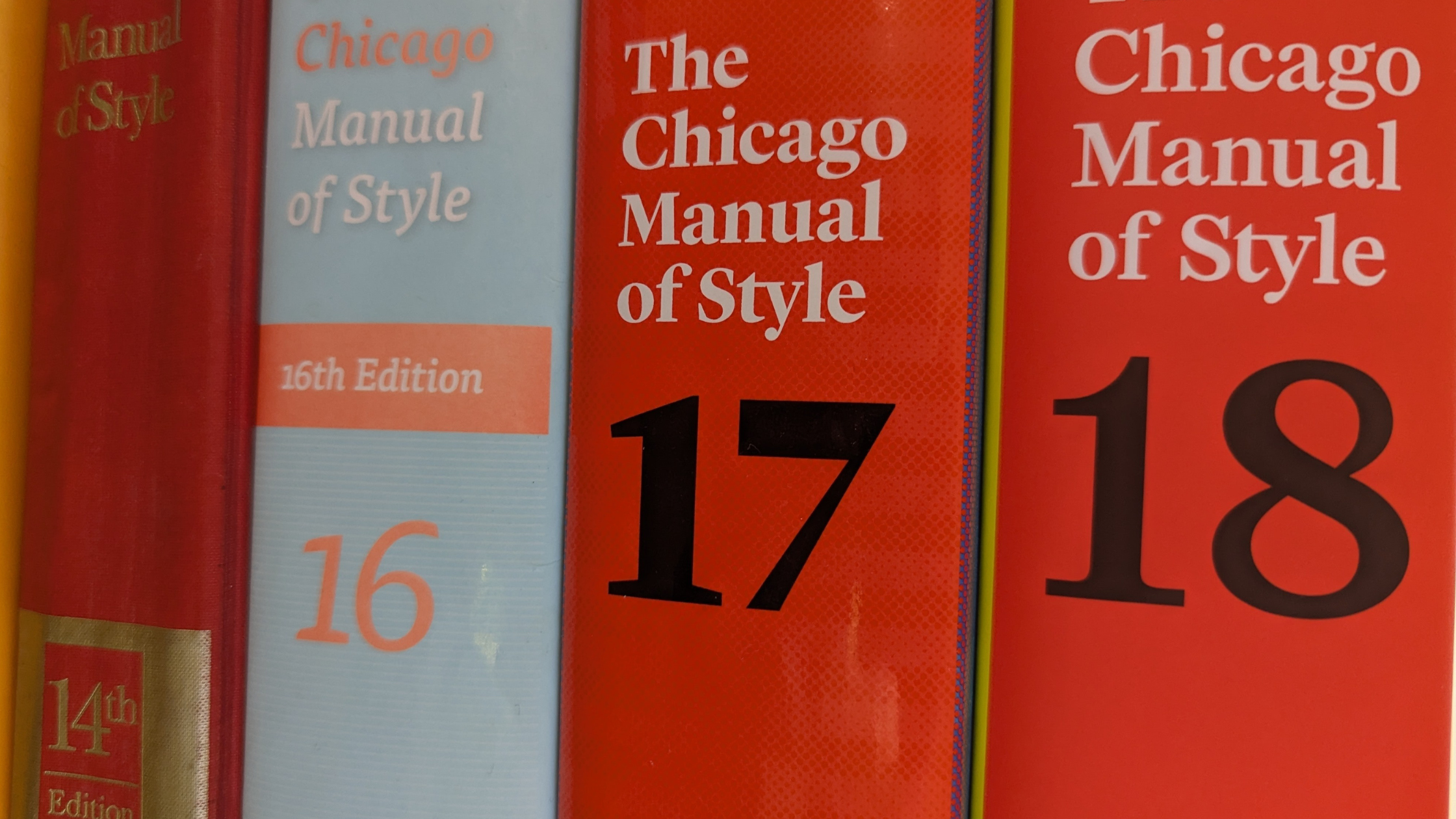
    I have a subscription to the online edition, and generally that’s my go-to resource because of its search capabilities. But I couldn’t resist purchasing the print edition (and its strikingly yellow cover) to sit beside my print editions going back to the fourteenth (my first edition). With the number of years between editions, it’s a good investment, and it’s comforting to have it on my shelf.

    Some changes will take some getting used to (I’ve spent too many years avoiding numerals at the beginning of a sentence to not look askance). But most I’m on board with.

    Always use a capital letter for complete sentences after a colon? Sounds good to me. Check Merriam-Webster for capitalization of adjectives derived from proper nouns (think french fries or Dutch oven)? Even better.

    I talk horror, romance, and copyediting on Club Ed Discussions

    On August 13 I was thrilled to join Jennifer Lawler on Club Ed Discussions, a discussion series she hosts for editors in her Club Ed membership. While the discussions are recorded, they’re reserved for her members, so I can’t share the link here, but I had a blast talking about the similarities between horror and romance, working with authors and publishers, and other aspects of copyediting.

    Jennifer is one of my favorite people in the editing world, and taking her classes has been an important part of my editing journey. Through Club Ed, Jennifer offers classes, community, and other resources to support editors and help them deliver quality services to authors and publishers.

    I’m teaching a class on editing horror!

    Speaking of Club Ed, Jennifer Lawler has long wanted to add a horror course to her offerings but doesn’t herself edit horror. Knowing my love of the genre, Jennifer asked me to develop a course for her platform, and this October students will be able to participate in Editing Horror with James Gallagher.

    The class begins with a one-hour live webinar that will be available for later viewing and also includes an online forum and feedback on a sample chapter edit. I am beyond excited!

    I’ll be presenting a session for ACES VCON24

    ACES: The Society for Editing is hosting a virtual conference from September 25 to 27, and I’ll be presenting the session “How to Create an Annual Report for Your Editing Business.”

    Presenting before a national conference of my peers is a huge honor and will be one of my highlights for the year. I’m also looking forward to all the other informative sessions from the fantastic editors at the conference.

    Other news

    I’ll just add that I’ve been busy with copyediting, proofreading, and developmental editing work for indie authors and publishers. This year I’ve been pleased to add Hachette Book GroupPenguin Random House, and Catapult to my clientele.

    Happy writing!

  • A Look Back at EFACON 2023

    A Look Back at EFACON 2023

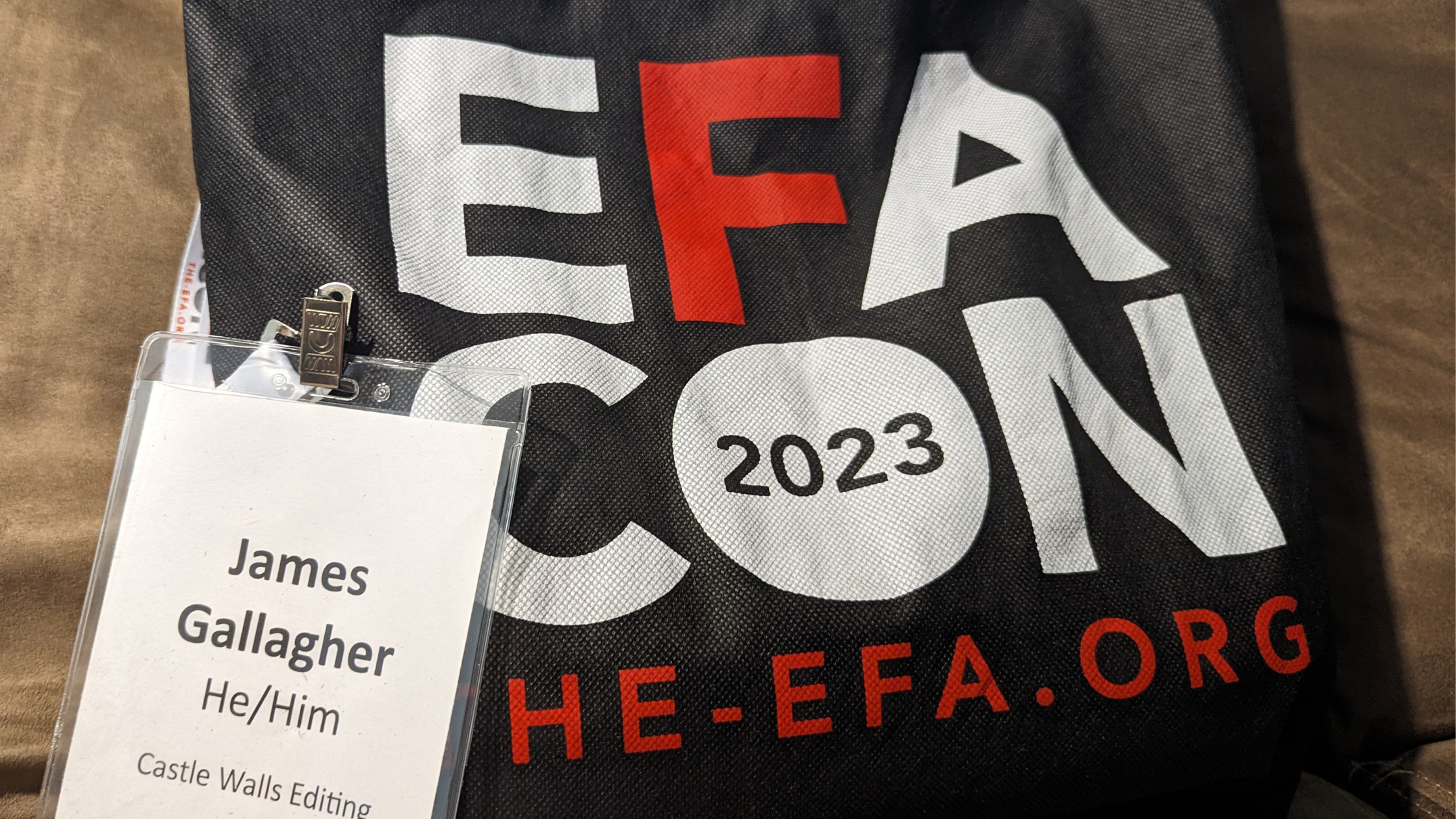
    Attending EFACON 2023 on August 18 and 19 in Alexandria, Virginia, increased my editorial knowledge and strengthened my ties in the editorial community. I left the conference with renewed enthusiasm for my work and already look forward to future events from the Editorial Freelancers Association (EFA).

    In the following I discuss benefits of the conference and provide a high-level lesson from each of the eight sessions I attended. I’ll also add here that the keynotes from Dr. Cathy Hannabach, Cecilia Tan, and Ran Walker were all excellent, and the EFA did a praise-worthy job selecting these speakers.

    People

    Like many editors, I’m introverted, and it’s all too easy to hide in a corner, keep my eyes down to avoid interaction, or look for the empty table at meals. But I’d promised myself that I would engage with people at the conference and am proud that I interacted more than I ever have at similar events.

    As freelance editors, we generally work alone and can often feel isolated, so building that sense of community and expanding our network does wonders for increasing our opportunities for learning from others, sharing job opportunities, and enjoying the camaraderie of like-minded professionals.

    A common theme at the conference was that you never know how a connection will pay off, even years later, so with every interaction you’re planting seeds. Perhaps more important, you’re interacting with the kind, generous people in the editing community, and that’s something to appreciate in and of itself.

    I certainly learned from all my interactions, even in terms of broadening my conception of what people do and how they work, and I was also able to share what I’ve learned since going full-time freelance at the end of 2017.

    I already knew some of the attendees from online venues, and it’s a wonderful experience to finally meet people in person. There’s a unique thrill to Oh, that’s so-and-so!

    Friday and Saturday entailed two long days of sessions, and by the end of the second day I was mentally and socially at my end, so I headed out before the final reception. While that would have been a nice capper, it’s important to recognize your limits, and I left feeling good about all aspects of the conference.

    Processes

    The EFACON sessions provided a wonderful opportunity to learn from editing superstars and to improve my processes.

    The following are the sessions I attended at EFACON, with a takeaway for each. Multiple sessions were scheduled for each time slot, and I’m looking forward to catching ones I missed once the recordings become available.


    Diversify Your Business: From Building Communities to Teaching—How to Provide Editing-Adjacent Services to Authors (presented by Jessica Snyder)

    This provided an excellent start to my conference, especially because it challenged me to think differently. Jessica talked about how coaching, online courses, and consulting can help you serve clients and increase your income to protect against lost income due to disability or illness. She also explored options for better work-life balance.

    TAKEAWAY: It’s easy for me to get in an editing groove and move from one job to the next, but you never know what’s around the corner, and you should never stop thinking about how your business can change and adapt.


    An Editor’s Guide to Assessing and Addressing Problematic Content (presented by Crystal Shelley)

    I’ve long been a fan of Crystal Shelley and have learned much from all the helpful resources she provides, so Crystal was at the very top of presenters I was excited to see. In her session Crystal looked at the ways biased and exclusive language renders text ineffective or harmful. She offered practical tips for offering guidance on problematic language or representation, flagging content, crafting clear queries, providing feedback, and handling client resistance.

    TAKEAWAY: More than anything, I left Crystal’s session wanting to embody her approach of knowing that we’re all human and capable of mistakes, but by listening and learning we can do better, show kindness to others through language, and help to better serve our clients.


    Client Interactions and Relationship Management (presented by Katie Chambers)

    Katie Chambers is a wonderful presenter, lively, funny, and engaging. In this session Katie shared her processes for template emails, e-mail management, client intake, data and systems, and client management.

    TAKEAWAY: Data, data, data! Collecting data on clients and the associated work is vital, and refining processes for doing so should be ongoing.


    Oops! Finding and Fixing Bloopers in Fiction (presented by Amy J. Schneider)

    The author of “that little yellow book,” Amy Schneider was another presenter I was greatly looking forward to seeing. Amy discussed language bloopers (pet phrases, danglers, redundancy), action bloopers (Chekhov’s gun, drop-in characters), and factual bloopers (body position, anachronisms, geography).

    TAKEAWAY: Easy takeaway here. When one of the best copyeditors anywhere shares insights into her craft, you sit up and take notes on every observation.


    One on One: Coaching for Creativity and Craft (presented by Christina M. Frey)

    I’ve taken two line editing classes from Christina Frey, and I’m convinced she’s a genius. In this session Christina discussed how an editorial coach can provide support beyond the typical editor-writer relationship, the qualities of a good editorial coach, approaches, and techniques for listening and adjusting.

    TAKEAWAY: Clients have needs beyond your service offerings, so expanding your thoughts on how you might meet those needs could open all-new areas for your business.


    Find Your NICHE: How to Niche Down and Market Your Specialty (presented by Jeanette Smith)

    I know Jeanette from an EFA chapter and was beyond excited to be there to support her and see her deliver her presentation. She nailed it! Jeanette examined all aspects of NICHE: natural talents, interests, characteristics, heart, and environment.

    TAKEAWAY: Again, it’s easy to get lost in the work and let the marketing side of your business flag. Thinking about your niche can help you better direct your services at the clients you most desire.


    Talking Points: Copyediting Dialogue in Fiction (presented by Amy J. Schneider)

    Here Amy addressed handling the mechanics of dialogue to maintain character voice while keeping dialogue understandable for the reader and letting the story shine. She looked at dialogue tags, verbs of utterance, action beats, punctuation, unspoken dialogue, informal dialogue, sounds and other nonverbal expressions, non-English language and translated dialogue, and electronic communication.

    TAKEAWAY: With The Chicago Guide to Copyediting Fiction, Amy literally wrote the book on copyediting. I’m just smart enough to realize when to pay attention and take lessons from one of the best in the field.


    Retreats: Build Your Business with a Getaway (presented by Laura Poole)

    Here Laura Poole delved into business retreats and professional getaways, discussing benefits, logistics, and suggested activities for group, solo, and virtual retreats. By the end of the session, I think everyone in the room was dreaming of a getaway to ponder all aspects of their businesses.

    TAKEAWAY: This is the third time I’ve said this, but it’s incredibly easy to get caught up in your work. However, stepping away and changing your environment can inspire you with new ideas that might completely revamp how you do business—and make happier clients in the process.


    What We Wish We’d Known Before We Started Freelancing (panel discussion presented by Lori Paximadis, Jeanette Fast Redmond, and Amy J. Schneider)

    This esteemed panel shared insights on building a steady client base, marketing strategies, business policies and boundaries, contracts, client acquisition, automation tools, and efficiency. As a means of both looking back and looking forward, this was a fantastic way to end my conference, head spinning with ideas and hopes for my business.

    TAKEAWAY: Never ever ever stop thinking about new ways to approach your business.

    Final Thought

    EFACON 2023 benefited me personally and professionally. I’ll do my best to continue to build on what I learned there, and I’m thankful for new and deepened editing relationships among my peers.
  • Course Review: Editing for Point of View and Perspective

    Course Review: Editing for Point of View and Perspective

    The self-paced Editing for Point of View and Perspective class from Club Ed delves into finer editing considerations of particular benefit to developmental editors and line editors. As with all Club Ed courses, the materials and exercises are first-rate.

    After having taken many quality courses from Club Ed creator Jennifer Lawler, I’d picked up this self-paced class many months before I finally settled down to work my way through it. Because I’d benefited from previous courses with Jennifer, I had high expectations, and I was not disappointed.

    A reality of editing schedules is that authors sometimes push delivery dates, so having a learning opportunity at hand can help relieve anxiety—as well as sharpen your editing skills—when time unexpectedly opens on your calendar.

    Instructor Led v. Self-Paced

    I’ve taken both instructor led and self-paced classes from Club Ed, and there are pros and cons to each. At Club Ed, both options present you with reading materials (Word documents or PDFs) and exercises for each lesson.

    Instructor Led

    With instructor-led courses, materials are released weekly for the lessons (usually over a four-week period). Students are asked to return assignments before the beginning of the next week.

    The two main advantages of instructor-led courses are class forums and instructor feedback.

    The forums allow participants to interact with the instructor and other classmates. This provides further insight and discussion, as well as the opportunity to network with other editors.

    The feedback on each exercise is arguably the most valuable component of Jennifer’s courses. Editing is often best learned through doing, and Jennifer provides a detailed critique on each student’s work, invaluable for adjusting the new skills being practiced.

    Self-Paced

    The main value of self-paced courses is, of course, the flexibility to take courses on your own time. When time opens, they are there waiting to fill gaps in your schedule.

    Ask any editor and they’ll tell you that scheduling a live class is a surefire way to have work suddenly overwhelm your inbox. While I try to balance live and self-paced classes, live classes always bring a bit of anxiety around fitting them into a full editing schedule.

    (I also want to add that I try to take at least a couple of courses each year, and I hope to always do so. Whether it’s largely a refresher course or one that covers a new skill, training is wonderful for maintaining skills, developing new ones, meeting new editors, and renewing your enthusiasm for the art.)

    While self-paced classes don’t entail instructor feedback on the exercises, Jennifer does include an answer sheet with her suggested approach to each exercise. The individual feedback of instructor-led courses is most valuable, but these answer keys go a long way toward bridging that gap and are extremely helpful.

    The Class

    Editing for Point of View and Perspective helps developmental editors spot and solve POV and perspective errors in fiction. The class is broken into four lessons:

    Lesson 1

    The first lesson covers the basics of POV and perspective, the differences between the two, the three main POVs, and common problems editors will encounter with POV and perspective.

    Lesson 2

    The second lesson takes a closer look at the possibilities and limits of POVs and examines how an author’s choices affect the story. The lesson also examines where narrator perspective and character perspective interconnect.

    Lesson 3

    The third lesson delves into perspective problems as early-warning signs of other issues in the manuscript. The materials demonstrate how developmental problems in a manuscript can be intertwined, and strategies are offered for prioritizing and addressing these issues.

    Lesson 4

    The fourth lesson addresses POV and perspective issues that occur less frequently in manuscripts but for which an editor should nonetheless be prepared. The materials show where authors can go wrong and the strategies editors can use to get authors back on track.

    Overall Assessment

    POV and perspective issues require a sensitivity and ear for what is happening right down to the sentence level, and editors who develop this sensitivity and ear will be able to offer clients strong advice for modulating the narrative distance between the text and the reader. This class provides insightful materials and useful exercises for developing this higher-level editing skill.

  • My First Annual Report for Castle Walls Editing

    My First Annual Report for Castle Walls Editing

    [vc_row][vc_column][vc_column_text]I finally did it. For the first time since committing to full-time freelancing at the end of 2017, I’ve drafted an annual report for Castle Walls Editing.

    While the report is for my eyes only, putting it together has been tremendously helpful, and I’ve already started my 2022 report, which I’ll be updating throughout the year.

    Benefits of Creating an Annual Report

    I didn’t create a report for the first three full years of my business. For the most part, I am my business, and no one was asking for it. I had work in front of me, and creating such a report required time I could spend earning money and completing jobs.

    But now that I have the report (printed, in fact, and within easy reach), I couldn’t be happier that I put it together, and I’d encourage anyone else, no matter how small their business, to do the same.

    The following are the main benefits I found from creating an annual report:

    • The report made me take a hard look at my business. It’s easy to ignore realities when they’re not staring you in the face. It’s easy to work and work and work and focus only on the job in front of you. Creating this report forced me to take a hard look at my business, the good and the bad. Seeing the bad isn’t easy, but it’s the first step toward addressing what isn’t working and heading in a better direction.
    • The report captured all areas of my business in one place. The report gives me a comprehensive scan of all areas of my business in one easy-to-access resource. I expand more below on the areas of the report, so I’ll just say here that having a quick resource for reviewing and thinking about finances, training, clients, and other areas of the business helps me keep those areas top of mind. And this has already prompted me to think more about the business even while I’m working in the business.
    • The report made me feel more businesslike. I was working at home even before the pandemic, and I do my best to create a businesslike atmosphere. I maintain fairly regular work hours, and I have a professional properly outfitted workspace. But I’m working alone in my home, and it can be easy to lose sight of the business as a BUSINESS. The report lends weight to the significance of what I’m doing, and it encourages me to think of the business as a business, something that’s often a challenge for freelancers.
    • The report let me celebrate my successes. I could do better in many areas of the business, and that will always be true. I never want to stop growing and learning and doing better. But it’s not easy to run an editing business and pay your bills and make your clients happy. And I’ve done this for four full years since leaving in-house employment to pursue this dream. That’s a hell of an accomplishment, and I’m proud of it. 

    What I Included in the Report

    Although I didn’t create a report for 2018, 2019, or 2020, I added income and client information for those years in the appendixes. For each year I created a pie chart with share by client, and this let me see areas of the business that have grown or shrunk over those years.

    Another helpful visual was a line graph of my income by year. I dipped a bit in 2021, but in terms of income, 2020 and 2021 were both well above 2018 and 2019, so the graph is still satisfying.

    The following are the main areas I addressed in my report. In my overview, I spoke honestly, in a conversational tone. In a sense, I am indeed having a conversation with myself about my business. I wanted to be honest, I wanted to be fair, and I wanted to be kind.

    • Overview
    • 2021 Income
    • Clients
    • Training
    • Equipment and Tools
    • Insurance
    • Appendix A: 2018
    • Appendix B: 2019
    • Appendix C: 2020
    • Appendix D: Books Edited in 2021
    • Appendix E: All Courses

    Going Forward

    The 2021 report served as a good start for my 2022 report. I simply carried over information that would apply and moved around information that could shift (for example, I moved my 2021 financial information into an appendix).

    I didn’t break my 2021 report down by quarter, but I plan to do that this year, and it will be fairly easy because I’ll be doing it each quarter rather than at the end of the year.

    For items like training, I can add courses as I go.

    The report is and always will be a work in progress. This year I plan to add a section on my web presence and social media. I hope to take a more in-depth look at my clients. I’d like to add a section on lessons learned and goals for the following year.

    I’ve also rededicated myself to consistent time tracking, and next year’s report will contain more breakdowns of that data, so helpful in estimating fees for clients and seeing the kinds of jobs that are most profitable.

    Have you run an annual report for your business? If not, I’d highly recommend doing so. It’s been wonderful for me, and that should translate into a better business for my clients.[/vc_column_text][/vc_column][/vc_row]